
 電話で予約
電話で予約 WEB予約
WEB予約
 LINEで予約

Author: Medical Corporation Shingetsukai Representative Dr. Shinya Sasagawa
Houreisen Skin Clinic — Specialized in Nasolabial Fold & Wrinkle Treatment
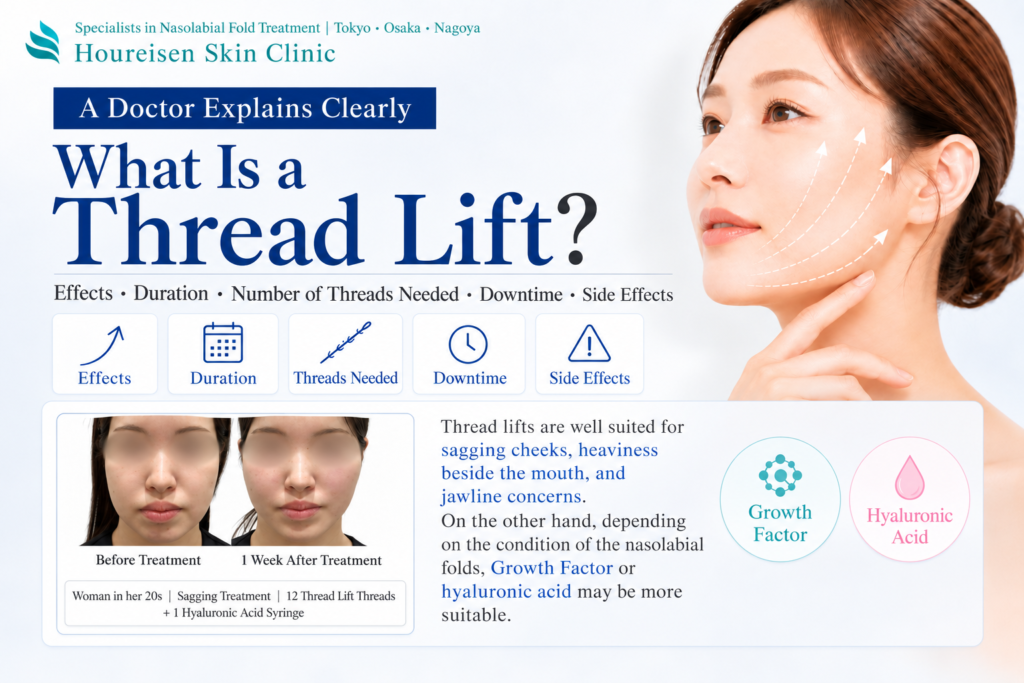
Have you noticed fullness around the corners of your mouth beginning to sag, or your jawline becoming less defined? A thread lift is a treatment designed to lift sagging facial tissue without surgically cutting away the skin.
Houreisen Skin Clinic specializes in nasolabial fold and wrinkle treatments, but we also treat facial sagging involving the cheeks, mouth area, and jawline. In this article, we explain how thread lifts work, their benefits, actual patient cases, how many threads may be needed, treatment costs, and what to expect after the procedure.
Key Takeaway
A thread lift uses medical threads with small barbs to physically lift sagging cheek tissue. It can improve heaviness around the mouth and create a more defined jawline, with lifting effects visible immediately after treatment.
At our clinic, we evaluate cheek fat, skin thickness, and facial asymmetry before determining the type, number, and placement of threads. Our goal is to achieve a natural-looking result. There are no additional charges beyond the cost of the threads, and we explain the total treatment cost before the procedure.
目次
- What Is a Thread Lift? How Does It Make the Face Look Slimmer?
- How Can a Thread Lift Improve the Mouth Area and Jawline?
- Woman in Her 20s, Our Clinic Nurse | Improving the Jawline and Fullness Around the Mouth
- Woman in Her 40s | Improving Fullness Beside the Corners of the Mouth
- Woman in Her 30s | Improving Vertical “Curtain Lines” Beside the Mouth When Smiling
- Woman in Her 50s | Lifting the Cheeks and Softening Nasolabial Folds
- Who Is a Good Candidate for a Thread Lift?
- Types of Thread Lifts | PCL and PLCL Used at Our Clinic
- When Do Thread Lift Results Appear and How Long Do They Last?
- What We Consider Important for Natural-Looking Results
- How Many Threads Are Needed? Thread Lift Pricing
- For Patients Concerned About Deep Nasolabial Folds or Marionette Lines
- Thread Lift Procedure and Pain During Treatment
- How Long Is the Downtime? Returning to Work and Going Out
- Thread Lift Side Effects and Risks
- Frequently Asked Questions About Thread Lifts
- If You Are Concerned About Sagging Cheeks or the Mouth Area, Please Consult Us
What Is a Thread Lift? How Does It Make the Face Look Slimmer?
A thread lift is also called a thread lifting procedure. The surface of each thread has small hook-like projections called cogs. These cogs engage the tissue beneath the skin and lift sagging cheek tissue from within.
Lifting tissue that has accumulated around the mouth or sagged over the jawline can create a cleaner, more defined facial contour. This is why the lower half of the face can appear tighter and slimmer after treatment.
Compared with a surgical facelift, a thread lift requires much smaller entry points and generally involves less downtime. Collagen formation is also stimulated around the inserted threads, which may help improve skin firmness in addition to providing a lifting effect.
How Can a Thread Lift Improve the Mouth Area and Jawline?
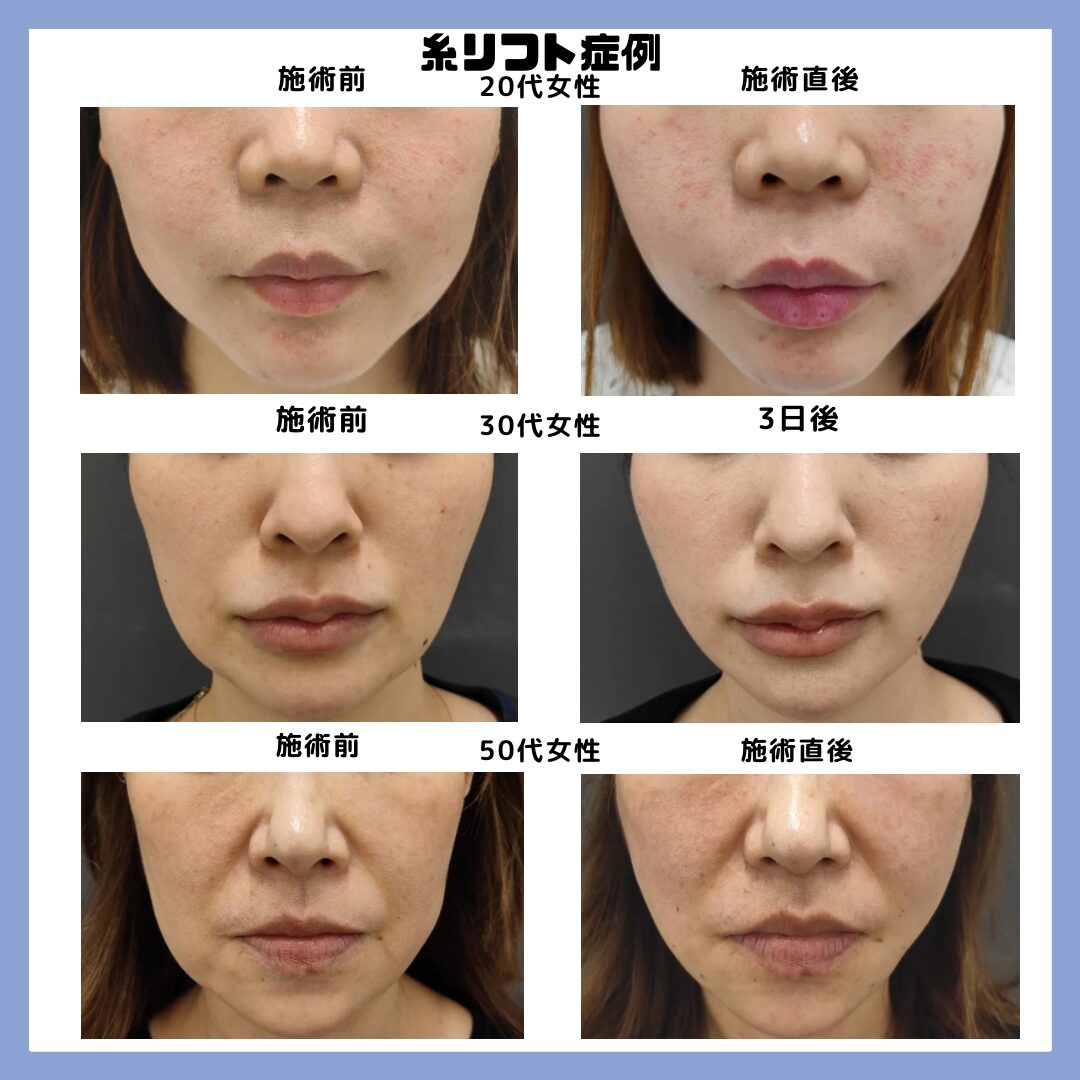
The following are thread lift cases treated at our clinic. In addition to fullness beside the mouth when viewed from the front, please also pay attention to the jawline when viewed from an angle.
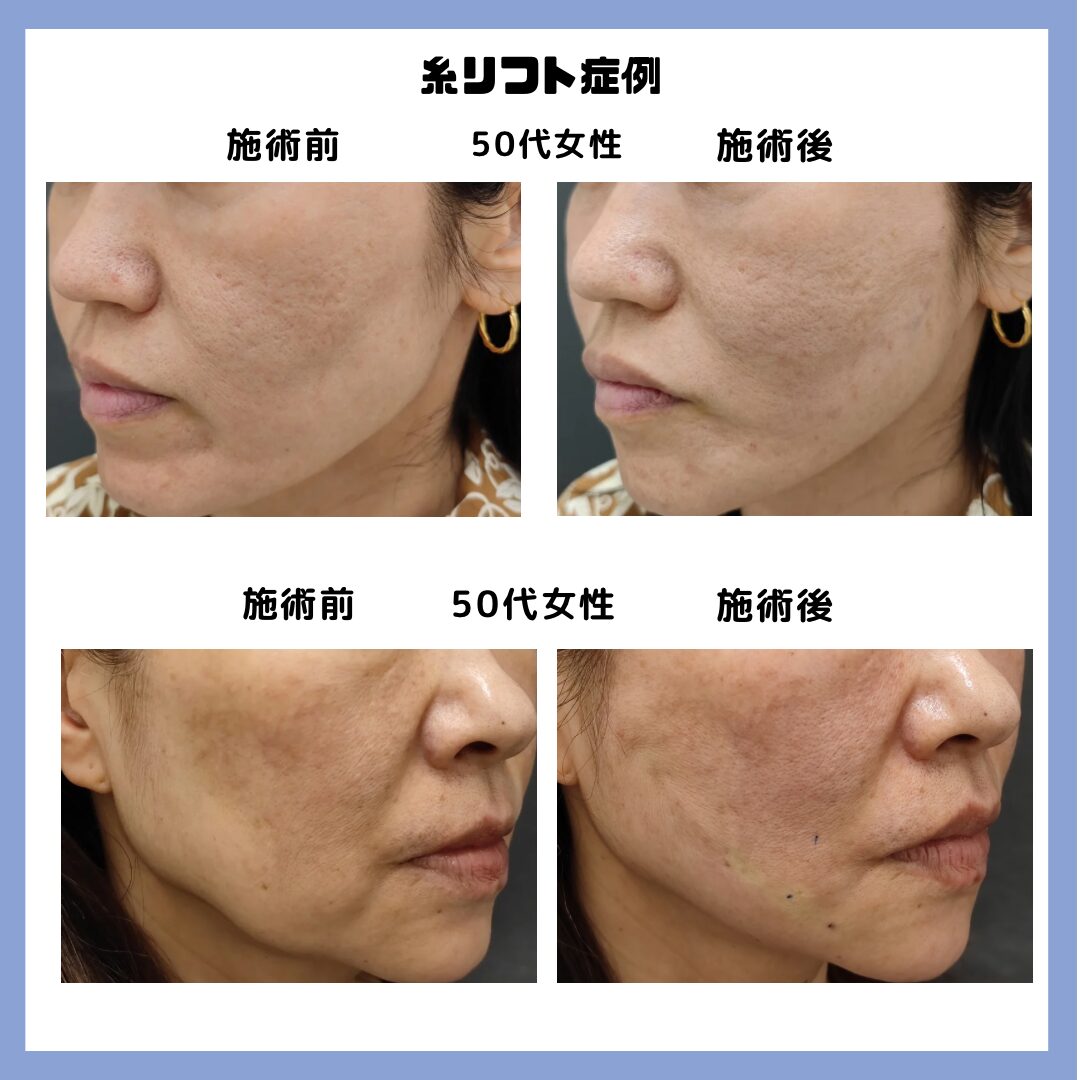
View More Thread Lift Before & After Cases
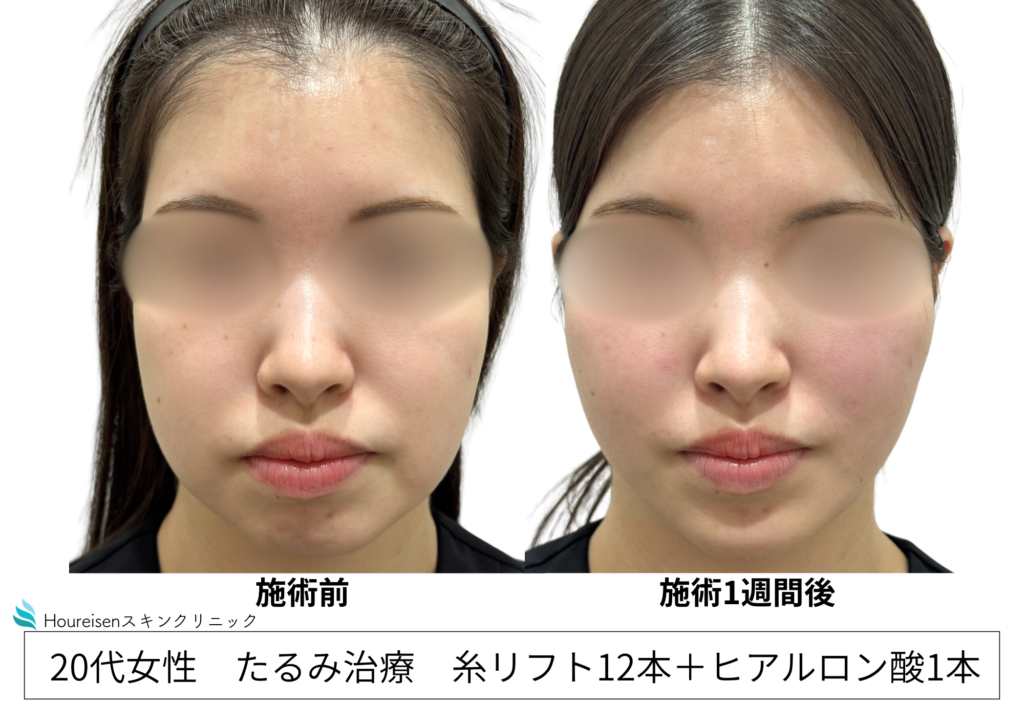
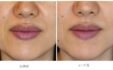
Woman in Her 20s, Our Clinic Nurse | Improving the Jawline and Fullness Around the Mouth
This patient is a nurse at our clinic. Her cheeks were lifted using 12 threads, and one syringe of hyaluronic acid filler was injected into the chin. The heaviness around the mouth improved, and the jawline became more defined.
View Photos and Treatment Details for This Case
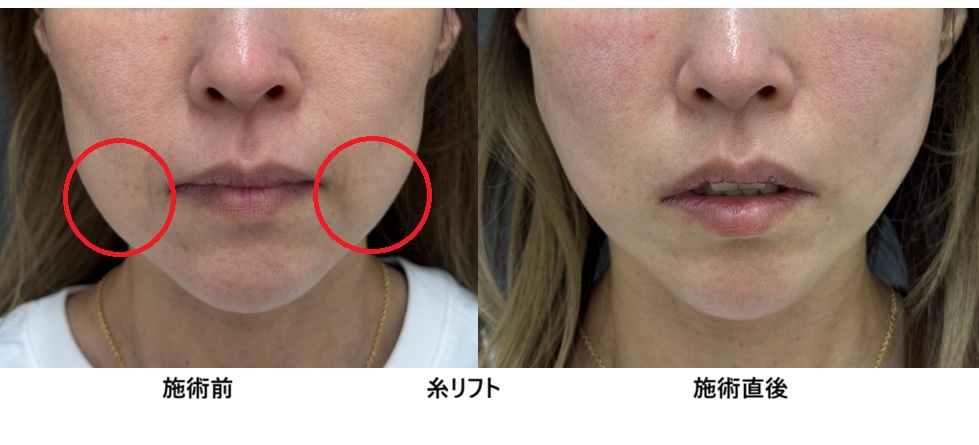
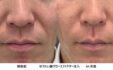
Woman in Her 40s | Improving Fullness Beside the Corners of the Mouth
This patient was concerned about the fullness that overlapped the sides of the mouth. Six threads were inserted on each side, for a total of 12 threads, to lift the cheeks and improve sagging around the mouth.
View Photos and Treatment Details for This Case
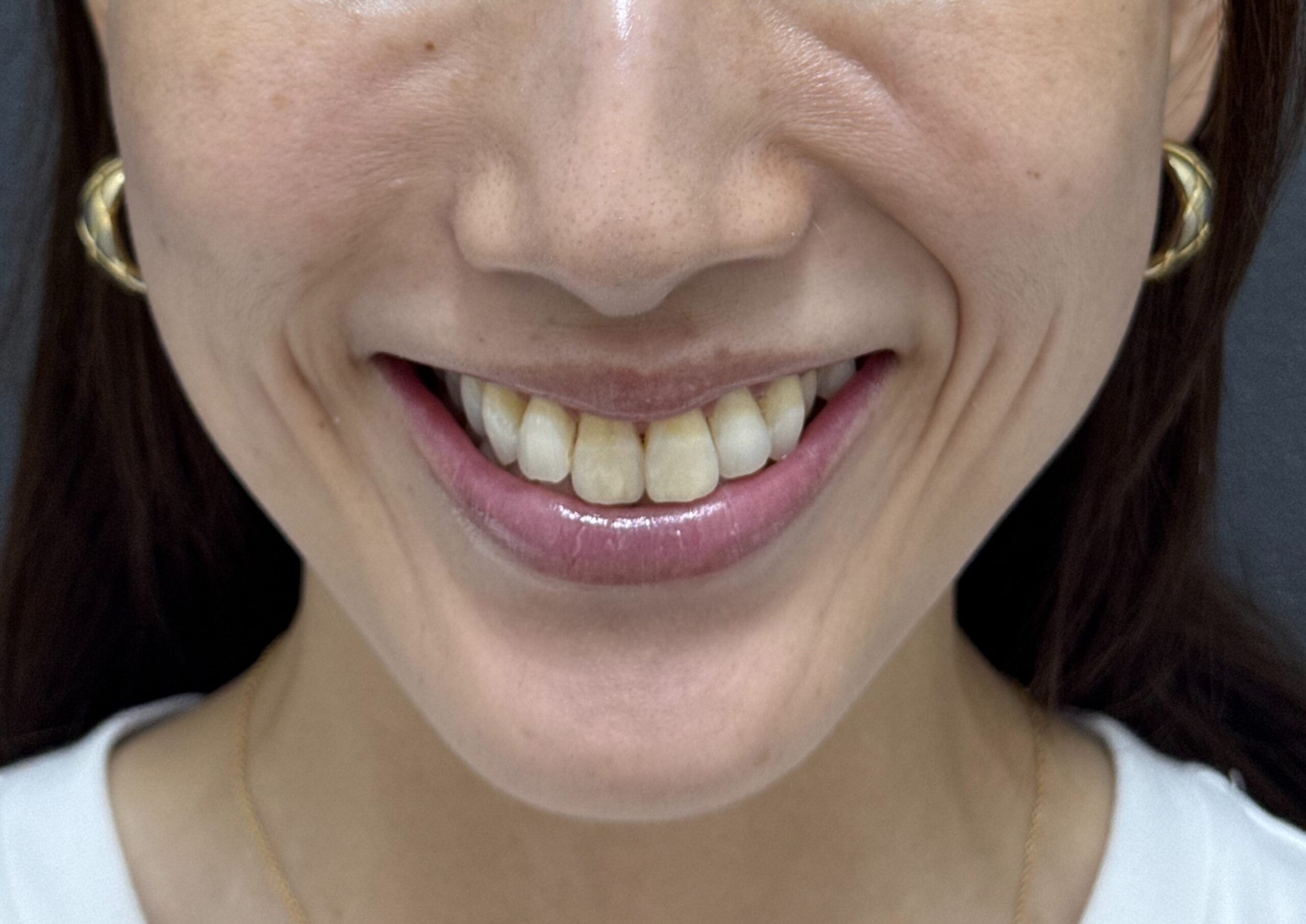
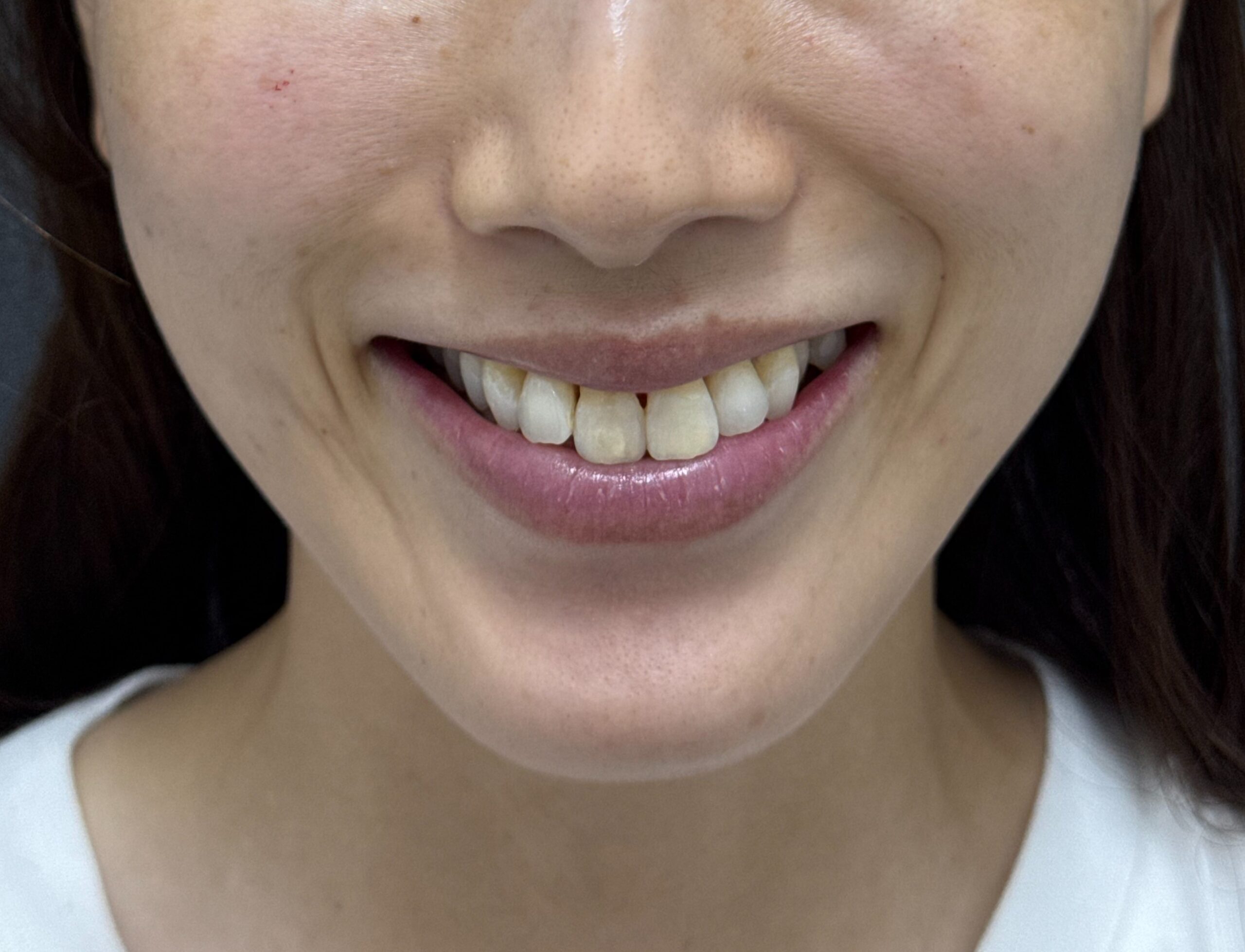
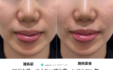
Woman in Her 30s | Improving Vertical “Curtain Lines” Beside the Mouth When Smiling
This patient was concerned about vertical folds that appeared beside the corners of her mouth when she smiled. A thread lift was combined with hyaluronic acid injections into the nasolabial folds and corners of the mouth.
View Photos and Treatment Details for This Case
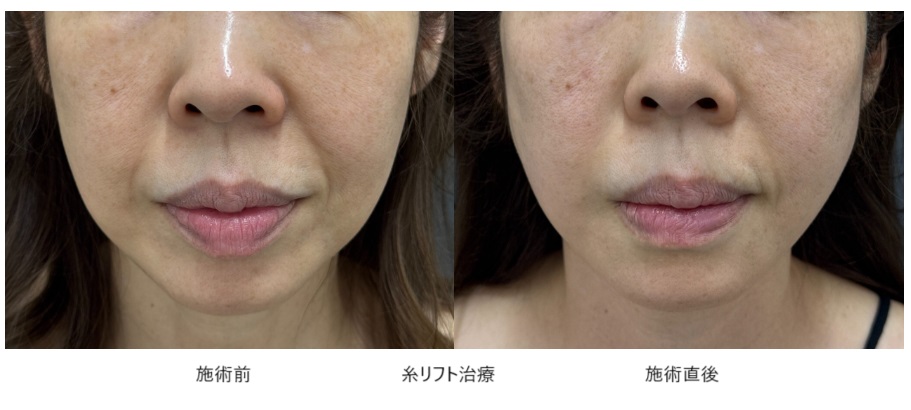
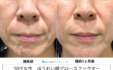
Woman in Her 50s | Lifting the Cheeks and Softening Nasolabial Folds
This patient had sagging cheek tissue that overlapped the nasolabial folds, making them more noticeable. By lifting the cheek tissue with a thread lift, both the nasolabial folds and sagging around the mouth improved.
View Photos and Treatment Details for This Case
Who Is a Good Candidate for a Thread Lift?
A thread lift may be suitable for people who have sagging cheek tissue or fullness beside the mouth and whose jawline has become less defined. It is also an option for patients who want a noticeable lifting effect but would prefer to avoid surgical incisions.
Types of Thread Lifts | PCL and PLCL Used at Our Clinic
There are absorbable thread lifts that gradually dissolve inside the body and non-absorbable threads that remain in the tissue. At our clinic, we use absorbable threads.
Thread lift materials include PDO, PCL, and PLCL. We use PCL and PLCL because we place importance on both durability and the collagen-stimulating effect that may support skin firmness. These materials are absorbed more slowly than PDO. Our goal is not only to lift the cheeks, but also to help maintain firmness in the skin.
Research has reported that PCL can remain in tissue longer than PDO and may support collagen formation for a longer period. PLCL has also been studied for collagen formation and skin remodeling.
At our clinic, PCL and PLCL are not used to reduce cheek fat. They are used to lift sagging facial tissue. Our goal is to preserve natural cheek fullness while creating a cleaner appearance around the mouth and jawline.
References: Basic research comparing PCL and PDO / Basic research on PLCL and skin remodeling. Neither study directly compares clinical treatment outcomes in humans.
PCL | Flexible and Soft
PCL stands for polycaprolactone. It is a flexible material that moves naturally with facial expressions such as smiling and talking. We use it when we want to lift the cheeks and mouth area while maintaining a natural appearance.
PLCL | Flexibility with Stronger Lifting Support
PLCL is made from a combination of polylactic acid and caprolactone. The PLCL threads used at our clinic provide both flexibility and lifting strength and are used for patients who want stronger lifting of sagging cheeks and the area beside the mouth.
Learn More About the Differences Between PDO, PCL, and PLCL
When Do Thread Lift Results Appear and How Long Do They Last?
The Lifting Effect Can Be Seen Immediately After Treatment
Because the threads physically lift the cheek tissue, a lifting effect can be seen immediately after the procedure. Swelling and a temporary tight sensation may occur at first, but these usually improve over approximately 1–2 weeks as the face begins to feel more natural.
Visible Lifting with PCL and PLCL Is Generally Expected to Last Around One Year
With the PCL and PLCL threads used at our clinic, approximately one year is one guideline for how long the visible lifting effect may last. The duration varies depending on the number and placement of threads, the degree of sagging, and the weight of the cheek tissue.
The threads themselves are gradually absorbed over approximately 18–24 months. This does not mean that the face remains lifted with exactly the same strength throughout that entire period. As the threads are absorbed, collagen formation around them may also help support skin firmness.
If you begin to notice heaviness beside the mouth or loss of jawline definition again, please consult us about additional treatment. We will assess your previous result and current degree of sagging before recommending the type and number of threads.
What We Consider Important for Natural-Looking Results
With a thread lift, it is important not only to achieve lifting but also to maintain a natural appearance when smiling. At our clinic, we assess cheek fat, skin thickness, and natural facial asymmetry from the front, diagonal, and side views.
We identify areas where cheek fullness should be preserved and areas around the mouth or jawline that should appear more defined. We then determine the position, depth, direction, and number of threads and adjust the amount of lifting while considering the overall facial balance.
I have seen patients who received thread lifts at other clinics and experienced complications such as facial nerve paralysis, numbness, threads protruding through or becoming visible under the skin, or difficulty opening the mouth that continued for approximately one month.
For this reason, at our clinic we pay close attention to the course of nerves and blood vessels and insert the threads into the appropriate tissue layer in order to reduce the risk of these complications. To date, we have not experienced these types of complications at our clinic.
We recommend that patients do not choose a clinic based only on low prices or discount coupons. A thread lift is a procedure in which the physician’s technique can affect both the result and safety.
How Many Threads Are Needed? Thread Lift Pricing
At our clinic, approximately 8–14 threads in total are commonly used for both sides of the face. The number required depends on whether treatment is focused mainly around the mouth or whether the cheeks and jawline are being treated more extensively.
PCL threads are ¥22,000 per thread, and PLCL threads are ¥27,000 per thread. Consultation and anesthesia fees are included, so there are no additional charges beyond the thread cost.
| Number of Threads | PCL | PLCL |
|---|---|---|
| 1 thread | ¥22,000 | ¥27,000 |
| 8 threads | ¥176,000 | ¥216,000 |
| 10 threads | ¥220,000 | ¥270,000 |
| 12 threads | ¥264,000 | ¥324,000 |
| 14 threads | ¥308,000 | ¥378,000 |
Prices above assume that all threads used are of the same type. Thread lift treatment is an elective cosmetic procedure and is not covered by Japanese public health insurance.
We provide clear and transparent pricing. We do not pressure patients into treatment or repeatedly add unnecessary options or upgrades.
We discuss your goals and budget and explain the recommended thread type, number of threads, and total cost before treatment.
For Patients Concerned About Deep Nasolabial Folds or Marionette Lines
Lifting the cheeks with a thread lift can also make nasolabial folds and marionette lines caused by sagging less noticeable. For patients with deeper indentations, combining a thread lift with hyaluronic acid filler may provide a smoother result.
The thread lift elevates sagging tissue, while hyaluronic acid fills the indentation. Combination treatment is not always necessary. You may choose to treat only the area that concerns you most, or both treatments can be performed on the same day.
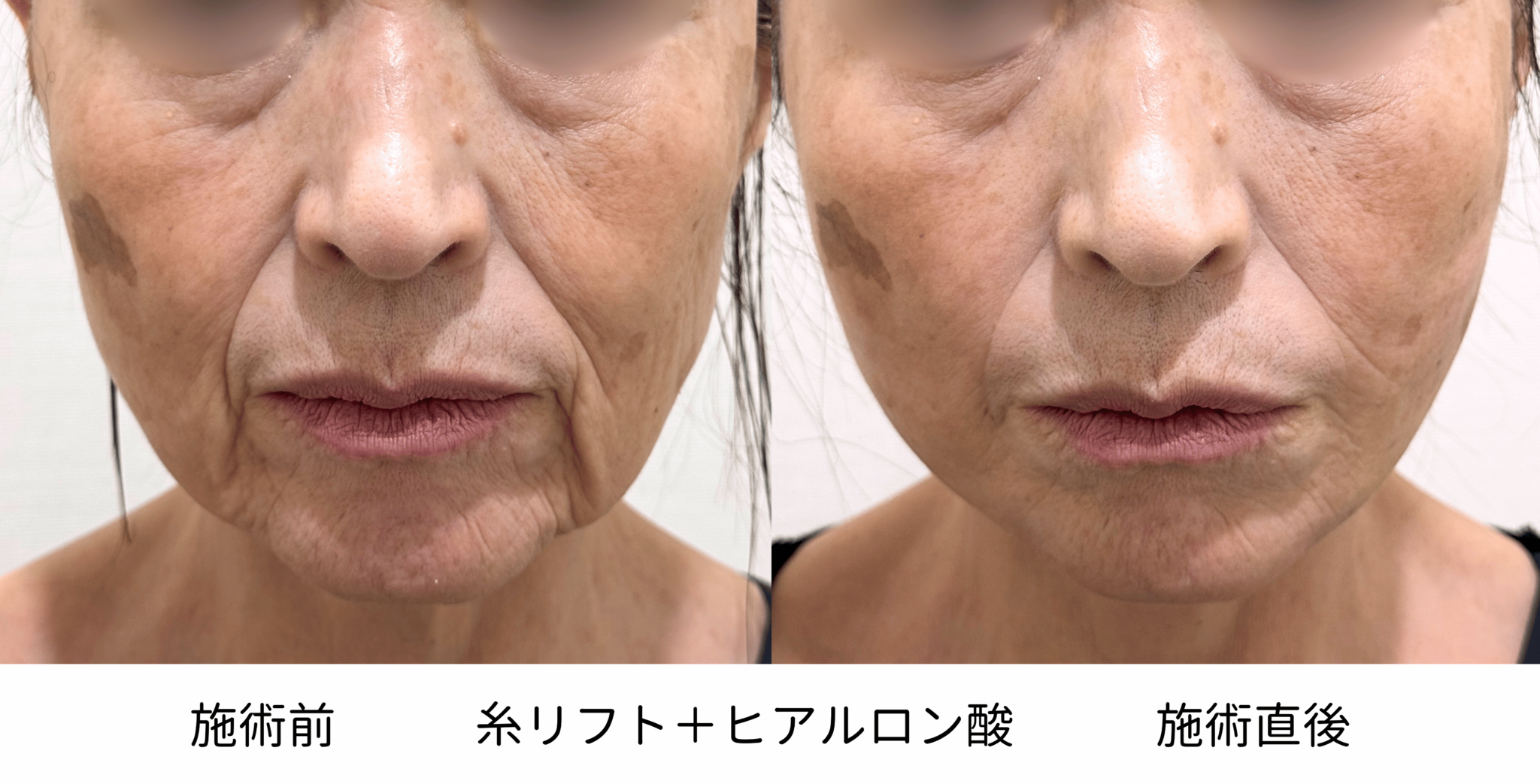
Woman in Her 60s | Improving the Mouth Area with Thread Lift and Hyaluronic Acid
This patient was especially concerned about the marionette line on the left side. The cheeks were lifted with threads, and hyaluronic acid was injected into the nasolabial folds and marionette lines to improve the balance between the left and right sides.
View Photos and Treatment Details for This Case
Hyaluronic acid provides an immediate visible effect. For the products used at our clinic, approximately 1–2 years is a general guideline for duration. If indentation rather than sagging is the main concern, hyaluronic acid alone may sometimes be recommended instead of a thread lift.
Learn About Hyaluronic Acid Treatment for Nasolabial Folds / How Much Can a Thread Lift Improve Nasolabial Folds?
Thread Lift Procedure and Pain During Treatment
Consultation and Treatment Design
We first ask which area concerns you most and how much lifting you would like. After examining your face, we determine the type and placement of threads and explain the cost and important precautions.
Please let us know about any previous thread lift or injectable treatments, medications you are currently taking, and any drug allergies. Patients who are pregnant or may be pregnant cannot undergo thread lift treatment. Patients who are breastfeeding may also be unable to receive treatment depending on their circumstances.
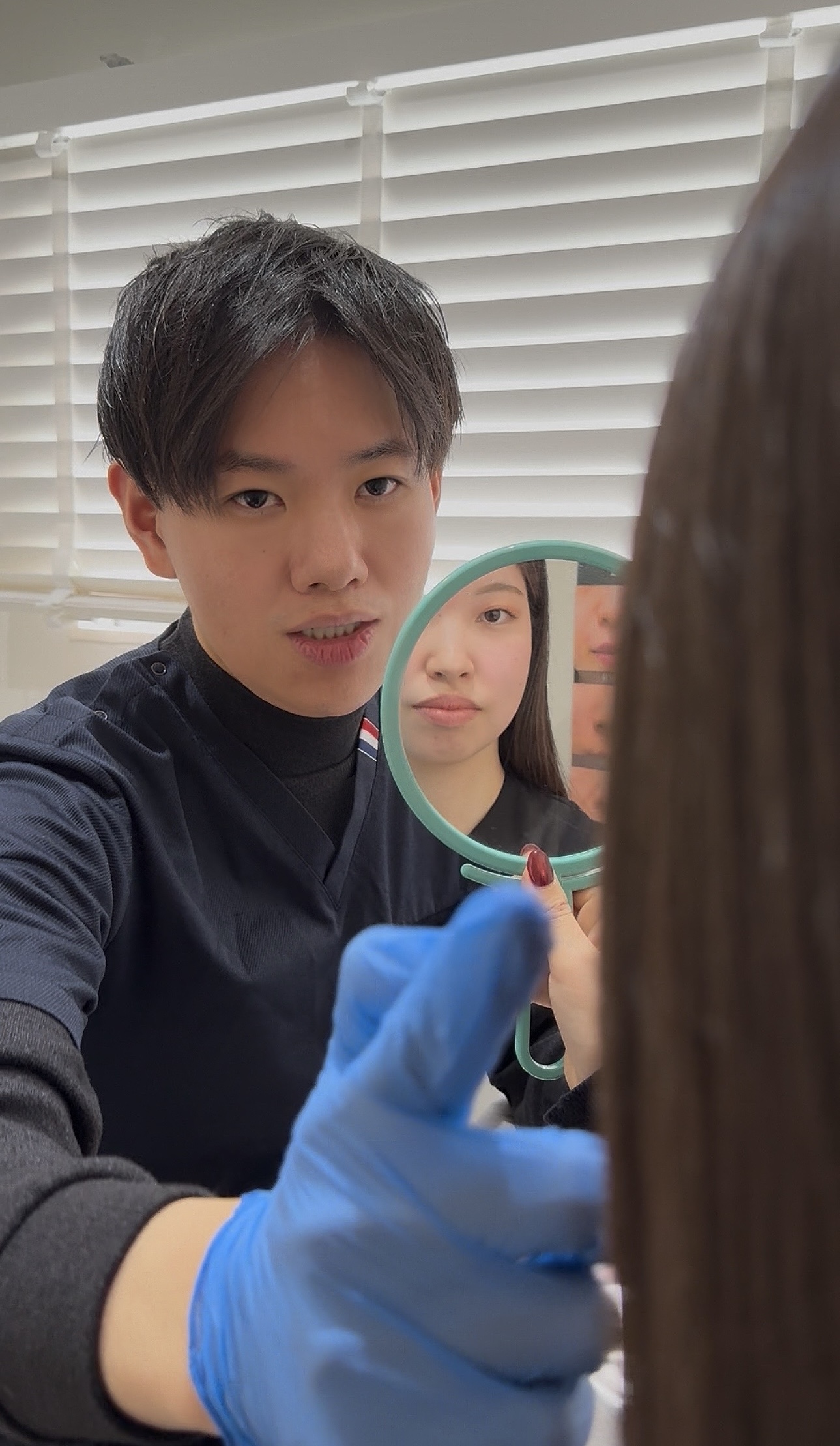
Local Anesthesia Is Given Before the Threads Are Inserted
Local anesthesia is administered first. Once we confirm that the area is numb, the threads are inserted. You may feel a brief sting during the anesthetic injection, but the discomfort is generally tolerable. During insertion of the threads, you may feel pressure or a pulling sensation.
If the pain is strong, additional anesthesia can be administered. However, using excessive anesthesia can increase swelling after treatment, so we adjust the amount while checking your level of discomfort.
We then check the degree of lifting and the balance between the left and right sides and make adjustments as necessary.
Before treatment, we also explain the aftercare instructions. Antibiotics are prescribed to help prevent infection, and pain medication is provided when necessary.
Learn More About Pain During and After a Thread Lift
How Long Is the Downtime? Returning to Work and Going Out
Swelling generally lasts several days to approximately one week. If bruising occurs, it may take approximately 1–2 weeks to fade. At our clinic, we carefully select the insertion layer and technique in order to minimize swelling and bruising as much as possible.
Many of our patients look relatively natural after approximately one week. A pulling sensation may continue when smiling or opening the mouth, but in most cases there is little visible abnormality.
| Time After Treatment | Typical Course |
|---|---|
| Same day to several days | Temporary puffiness from anesthesia, swelling, mild pain, and tightness may occur. |
| Around 1 week | Swelling and visible irregularities usually begin to settle. Some patients may still experience discomfort when moving the mouth. |
| 1–2 weeks | Bruising and tightness gradually improve. Some sensations of tightness or discomfort may continue for several weeks. |
Learn More About Swelling, Bruising, and Returning to Work After a Thread Lift
Important Aftercare Instructions
Thread Lift Side Effects and Risks
After a thread lift, swelling, bruising, pain, and a feeling of tightness may occur. Temporary facial asymmetry or skin dimpling may also occur.
Potential complications are also reported to include infection, visible or exposed threads, and injury to nerves or the parotid gland. To date, we have not experienced these complications at our clinic. We perform treatment with careful attention to facial anatomy and to the position, depth, and handling of the threads.
Please contact the clinic where you received treatment if pain or swelling becomes worse each day, redness or warmth spreads, a thread becomes exposed, or you have difficulty moving part of your face. Do not massage the area forcefully or pull on an exposed thread yourself.
Frequently Asked Questions About Thread Lifts
Where in the Face Are the Threads Inserted?
Threads are inserted beneath the skin in areas that need lifting, such as the cheeks, the area beside the mouth, and the jawline. The entry point and direction of the threads vary depending on where the sagging is located. During your consultation, we explain which areas we plan to lift and how the threads will be placed.
Will a Thread Lift Make My Face Sag More in the Future?
No. At our clinic, we also expect thread-induced tissue remodeling and collagen formation to help support firmer skin that may be less prone to sagging.
Will the Scars Be Noticeable?
Because a thread lift does not require a large surgical incision, the wounds are limited to small entry points where the threads are inserted. These usually become less noticeable over time. If redness continues or pus develops, please contact the clinic where you received treatment.
Will My Face Immediately Return to How It Was Once the Threads Dissolve?
No. The threads are gradually absorbed, so the face does not suddenly return to its pre-treatment appearance on a specific day. The lifting effect gradually weakens over time, while collagen formed around the threads may continue to support skin firmness.
When heaviness beside the mouth begins to concern you again, this may be a good time to discuss whether additional treatment is appropriate.
Can I Have HIFU or DENSITY After a Thread Lift?
Yes. We also recommend HIFU or DENSITY as maintenance treatments after a thread lift. After the threads have lifted the tissue, energy-based treatments can be used to help tighten the skin and maintain firmness.
At our clinic, we generally wait approximately 3 months after a thread lift before performing either HIFU or DENSITY.
Learn More About Combining Thread Lifts with HIFU or DENSITY
Can I Come in for a Consultation Only?
Yes, absolutely. We can explain whether a thread lift is suitable for you, how many threads may be needed, how much improvement may be expected, as well as the cost and important precautions.
If You Are Concerned About Sagging Cheeks or the Mouth Area, Please Consult Us
A thread lift is a treatment that lifts sagging cheek tissue and creates a cleaner appearance around the mouth and jawline. In addition to selecting the appropriate type and number of threads, placing them in the right position, tissue layer, and direction for each individual face is important for achieving a natural-looking result.
You are welcome to consult us even if you are still unsure whether a thread lift is right for you. We will carefully examine your face and recommend appropriate treatment options. You do not need to make a decision immediately and are welcome to take the information home and consider your options.





 03-6434-7678
 オンライン相談
  来院予約
来院予約