
 電話で予約
 WEB予約
 LINEで予約


Choosing an Injectable Treatment for Nasolabial Folds
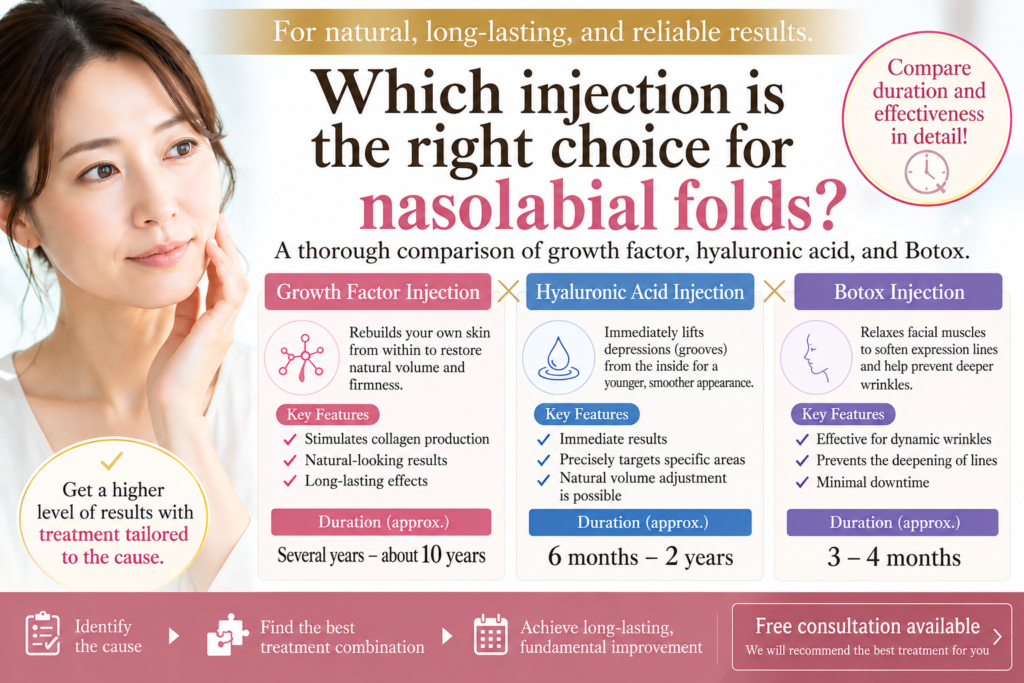
The right injection depends on whether you have a persistent skin crease, a hollow beside the nose, or muscle-related folds
For creases that remain visible even when the face is at rest, we may consider growth factor injections. For hollows or contour depressions beside the nose that you want to improve promptly, hyaluronic acid fillers may be appropriate. In selected patients whose folds are strongly affected by facial muscle movement, Botox may be considered.
Do any of these concerns sound familiar?
During a consultation, we do not simply assess how deep the folds look. We also check whether a crease remains at rest, whether there is a hollow beside the nose, and whether asymmetry appears mainly when smiling. In this article, we explain how our clinic chooses among these three injectable treatments, with real patient cases.
First, distinguish between skin creases, volume loss, and facial muscle movement
Look straight into a mirror and compare your face at rest with your face while smiling. The following three signs can help you understand the main factors contributing to your nasolabial folds.
CHECK 01
A crease remains visible even at rest
If a line remains after you stop smiling, reduced skin firmness or a crease that has become etched into the skin may be involved. At our clinic, growth factor injections are often our primary consideration.
CHECK 02
A hollow or step-like contour beside the nose is noticeable
When the area beside the nostril is hollow and the difference in height between the cheek and the fold creates a shadow, adding volume selectively with hyaluronic acid filler may be an option.
CHECK 03
Asymmetry becomes more pronounced only when smiling
If a fold is barely visible at rest but deepens more on one side when smiling, or if the upper lip lifts strongly, we may consider Botox after assessing the underlying muscle movement.
It is common to have more than one of these features.
For example, if an etched skin crease and a hollow beside the nose occur together, treating them in stages rather than trying to correct everything with one injection may produce a more balanced, natural-looking result.
Growth Factor vs. Hyaluronic Acid vs. Botox: A Comparison
Although all three treatments can be used when addressing nasolabial folds, they serve different purposes. First, let us compare what each treatment is intended to change.
| Treatment | Best suited for | Key advantages | When results appear | Considerations |
|---|---|---|---|---|
| Growth Factor |
Best suited forThose seeking gradual, natural-looking improvement, longer-lasting results, or improved skin firmness | Key advantagesSubtle-looking changes, potentially long-lasting results, improved skin firmness | When results appearResults develop gradually; at our clinic, many cases have shown improvement lasting for years | ConsiderationsResults are not immediate and may take time to become noticeable |
| Hyaluronic Acid | Best suited forThose who want hollows or shadows to become less noticeable promptly | Key advantagesImmediate volume adjustment; the filler can be dissolved when appropriate | When results appearChanges are often noticeable immediately after injection | ConsiderationsOverfilling can look unnatural, and the material is gradually absorbed over time |
| Botox | Best suited forFolds that become pronounced when smiling or smile asymmetry in selected patients | Key advantagesRelaxes specific facial muscles to reduce folds that become more prominent when smiling | When results appearGenerally within a few days to about two weeks | ConsiderationsMay not help much when sagging or volume loss is the main cause; suitable only in selected cases |
What we assess during your consultation
We also ask whether you want an immediate change or would prefer to prioritize natural-looking, longer-lasting improvement even if it takes more time.
Growth Factor Injections for Creases That Remain at Rest
Addressing reduced skin firmness and etched-in creases
Growth factor treatment involves injecting the dermal layer around the nasolabial folds to encourage collagen production. Unlike hyaluronic acid fillers, which add volume through the injected gel itself, growth factor injections aim to improve skin firmness so that creases visible even at rest become less noticeable.
Results develop gradually. At our clinic, we have observed many cases in which improvement has lasted for years, making duration a notable feature of this treatment. Results and duration vary from person to person.

Who may be suited to growth factor injections?
- People whose nasolabial folds remain creased when their face is at rest
- People whose fold lines do not readily smooth out after smiling
- People who want to address reduced skin firmness while preserving a natural appearance
- People who prioritize the potential duration of results over an immediate change
- People who would prefer not to receive hyaluronic acid fillers repeatedly
Advantages
- Aims to stimulate collagen and address reduced skin firmness and etched-in creases
- Gradual changes may be less noticeable to others
- At our clinic, many cases have shown results lasting for years
- May reduce the need for frequent maintenance treatments
Limitations and disadvantages
- Does not produce immediate results like hyaluronic acid fillers
- Results vary, and additional treatment may be considered for deeper creases
- There is no dedicated dissolving agent, so careful decisions about injection amount and placement are important
Our approach
We often consider growth factor injections when skin creases remain visible at rest and reduced skin firmness is a contributing factor. However, if the main concern is a hollow beside the nose, we do not try to correct it with growth factors alone. We monitor the progress and assess whether hyaluronic acid filler may be needed.
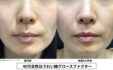
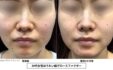
Case 01 | Woman in her 40s
Growth factor treatment for nasolabial creases visible even at rest
This case shows a crease that remains in the skin. The patient received one growth factor treatment, with photographs comparing before treatment and six months afterward.

Procedure: Growth factor injections for nasolabial folds / Sessions: 1 / Photos: Before and 6 months after / Fee: ¥180,000 for both sides (tax included) / Main risks: Swelling, bruising, discomfort, asymmetry, and others. Results and recovery vary by individual.
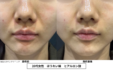
Case 02 | Woman in her 50s
Growth factor treatment for prominent, deep nasolabial folds
This patient received one growth factor treatment for more pronounced nasolabial folds. The photographs compare before treatment and six months afterward.

Procedure: Growth factor injections for nasolabial folds / Sessions: 1 / Photos: Before and 6 months after / Fee: ¥180,000 for both sides (tax included) / Main risks: Swelling, bruising, discomfort, asymmetry, and others. Results and recovery vary by individual.
Learn more about growth factor treatment / View before-and-after cases
Hyaluronic Acid Fillers for Hollows and Contour Depressions Beside the Nose
Restoring volume only where it is needed
Hyaluronic acid filler treatment involves injecting a gel-like material into hollows beside the nose or contour depressions along the nasolabial folds to support the area from beneath the skin. Changes are often visible immediately after injection, making this approach particularly suitable when shadows and volume loss are the main concerns.
With the products used at our clinic, the expected duration is approximately one to two years. Actual longevity depends on the product, injection site and amount, and the condition of the nasolabial folds.

Who may be suited to hyaluronic acid fillers?
- People with a noticeable hollow or shadow beside the nostril when viewed from the front
- People with a distinct contour step between the cheek and nasolabial fold
- People who would like to see a change immediately after treatment
- People who want to restore volume selectively and refine the contour
- People who still have a hollow beside the nose after growth factor treatment
Advantages
- Changes in hollows and contour depressions are often visible immediately
- Small amounts can be placed selectively for precise contour adjustment
- The firmness of the filler and injection depth can be chosen for the individual’s condition
- If necessary, dissolving the filler with hyaluronidase may be considered
Limitations and disadvantages
- The filler is gradually absorbed, so repeat treatment may be needed depending on the condition
- Excessive volume can cause fullness beside the nose or an unnatural appearance
- Fine creases etched into the skin may remain even after the hollow is filled
- Risks include lumps, irregularities, infection, and, rarely, vascular complications
Our approach
Rather than injecting uniformly along the entire nasolabial fold, we examine hollows beside the nose, contour differences from the cheek, and the condition of any previously injected filler. Using only the amount needed helps achieve a natural-looking result.
Case 03 | Woman in her 40s
Correction of a hollow beside the nose and the contour step of the nasolabial fold
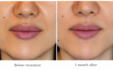
There was minimal etched-in skin creasing; the shadow was mainly related to facial structure and the overlying cheek tissue. One syringe of Volift XC was injected.

Procedure: Hyaluronic acid filler for nasolabial folds / Product and amount: 1 syringe of Volift XC / Photos: Before and immediately after treatment / Fee: ¥77,000 per syringe (tax included) / Main risks: Swelling, bruising, pain, fullness, surface irregularities, infection, vascular complications, and others. Results and recovery vary by individual.
View treatment details, amount used, and photo comparison timing
Learn more about hyaluronic acid filler for nasolabial folds / Compare growth factor injections and hyaluronic acid fillers
Botox Is Suitable for Only Some Types of Nasolabial Folds
Botox temporarily reduces the activity of targeted muscles. For nasolabial folds, we may consider it when a person has minimal folds at rest but the upper lip lifts strongly during smiling, making the fold beside the nose deeper, or when marked asymmetry appears only while smiling.
Visible nasolabial folds when smiling do not automatically mean Botox is the right treatment.If the main causes are creases visible at rest, hollows beside the nose, or overlapping cheek tissue, Botox alone is unlikely to produce a major improvement.
Who might be a candidate for Botox around the nasolabial folds?
- People whose nasolabial folds are not very noticeable at rest
- People whose folds deepen mainly on one side while smiling
- People whose upper lip lifts strongly when smiling, exposing more gum tissue
- People whose muscle movement contributes more than skin creasing or volume loss
Advantages
- Targets the muscle movement that makes certain folds deeper
- May help correct asymmetry that appears only when smiling
- Does not require adding volume
- Treatment is relatively quick, with generally limited downtime
Limitations and disadvantages
- Appropriate only for selected patients
- Does not substantially correct creases visible at rest, hollows beside the nose, or skin laxity
- Results are temporary; repeat treatment is necessary to maintain the effect
- Depending on the response, smiling or upper-lip movement may feel unnatural or restricted
Our approach
We do not inject Botox simply because a person’s folds deepen when smiling. We compare the face at rest, during a gentle smile, and during a broad smile. Only when muscle movement is an important contributing factor do we carefully determine the injection site and dose.
Case 04 | Woman in her 30s
Botox treatment for asymmetry of nasolabial folds while smiling
The left nasolabial fold was deeper. After assessing asymmetry caused by facial muscle movement, treatment was performed. The photographs compare before treatment and two weeks afterward.

Procedure: Botox injections for nasolabial folds / Photos: Before and 2 weeks after / Fee: ¥13,000 for both sides (tax included) / Main risks: Pain, swelling, bruising, allergic reactions, discomfort when smiling or moving the mouth, asymmetry, and others. Results and recovery vary by individual.
Learn who may or may not benefit from Botox for nasolabial folds
When Creases and Hollows Overlap, We May Treat Them in Stages
If someone has both an etched-in crease and a hollow beside the nose, trying to treat both with a single type of injection can lead either to excess volume or to a crease that remains noticeable.
More than one injection is not always needed from the outset
Even when the folds appear to be in the same place, skin creasing, volume loss, and facial muscle movement are separate contributing factors. At our clinic, we begin by treating the most significant factor, then assess whether anything else needs to be addressed.
Step 1: Identify the most noticeable factor
We assess whether the appearance is mainly influenced by a crease visible at rest, a hollow beside the nose, or smile asymmetry.
Step 2: Begin with treatment for the main cause
We consider growth factor injections for etched-in creases, hyaluronic acid fillers for hollows, and Botox for selected cases involving strong muscle movement.
Step 3: Address only what remains, if necessary
If the patient is satisfied after the first treatment, nothing further is needed. Only if a concern remains do we consider treatment for another contributing factor.
Combination case | Man in his 30s
Combination example: Hyaluronic acid filler after growth factor treatment
This patient had a pronounced crease etched into the skin, along with overlapping cheek tissue. We first treated the persistent crease with growth factor injections.
Six months later, the crease had become shallower, but he wished to refine the remaining fold further. We added one syringe of Volift XC. The photographs show three stages: before treatment, six months after growth factor injections, and after the hyaluronic acid filler injection.
By addressing the skin crease first and using filler only for the remaining hollow or contour depression, we can avoid adding unnecessary volume. If the patient is satisfied with growth factor treatment alone, no additional injection is performed.
View the case treated with hyaluronic acid filler after growth factor injections

Growth Factor Injections + Botox
If an etched-in crease is visible at rest and the muscles on one side also move excessively when smiling, we may treat the crease with growth factors and consider Botox for smile asymmetry.
Hyaluronic Acid Fillers + Botox
When a hollow beside the nose is accompanied by particularly strong upper-lip lifting, we may address the two causes separately. Botox is considered only when muscle involvement has been confirmed.
Injections alone may not address every concern
If cheek sagging is substantial and cheek tissue noticeably overlaps the nasolabial fold, improving the crease or hollow with injections will not necessarily correct all of the sagging. In such cases, we may also explain other options, such as a thread lift, based on the patient’s desired outcome.
Explore other treatment options for nasolabial folds
Side Effects, Risks, and Treatment Fees
All injections carry possible side effects, including swelling, bruising, redness, pain, and infection. There are also treatment-specific considerations.
- Growth factor injections:Changes develop gradually, and there is no dedicated dissolving agent. Injection amount and placement must be carefully assessed.
- Hyaluronic acid fillers:Possible complications include fullness, surface irregularities, lumps, infection, and, rarely, impaired blood flow.
- Botox:Depending on the dose and injection site, patients may experience changes in their smile, asymmetry, or difficulty moving the upper lip or mouth naturally.
* All prices include tax, consultation fees, injection needle fees, anesthesia fees, and other standard treatment charges. Fees were confirmed on September 5, 2026. The total depends on the number of syringes and the treatment selected. For current pricing, please see our fee schedule.
About Unapproved and Off-Label Treatments
Growth factor injections and type A botulinum toxin injections for nasolabial folds have not been approved in Japan for these specific purposes. We explain the products used, their approval status, how they are sourced, the availability of approved alternatives in Japan, overseas safety information, and eligibility under Japan’s relief system for adverse drug reactions on the individual treatment pages and during your consultation. For hyaluronic acid fillers, we use products from the Juvéderm VYCROSS range that are approved in Japan.
Frequently Asked Questions About Nasolabial Fold Injections
Which injection gives the most natural-looking result?
For patients with creases visible even at rest, growth factor injections may provide a subtle-looking change because results develop gradually. If the main cause is a hollow beside the nose, a carefully measured amount of hyaluronic acid filler may also look natural. A natural result depends not only on the treatment but also on the indication, injected amount, and treatment design.
Which treatment provides the fastest visible results?
Hyaluronic acid filler. Changes in hollows and contour depressions are often noticeable immediately after injection. However, swelling and bruising are possible, so we recommend scheduling treatment well before an important event.
Can growth factor injections and hyaluronic acid fillers be combined?
Yes, in some cases. At our clinic, we usually evaluate the results of growth factor treatment first. If a hollow or contour depression remains beside the nose after the skin crease has improved, we may use a small amount of hyaluronic acid filler to refine that area.
Can I still be treated if I have filler from a previous procedure?
Possibly, but we first assess the amount and location of remaining filler, any fullness, and facial asymmetry. Depending on what we find, we may recommend observation or consider dissolving the existing filler with hyaluronidase before deciding on further treatment.
Could Botox make my smile look unnatural?
If the dose or injection site is not appropriate, it may become difficult to smile naturally, and changes in mouth movement or facial asymmetry can occur. That is why we assess both the resting face and the smile, and consider Botox only when muscle movement is a major contributor.
Can I book a consultation without choosing an injection beforehand?
Absolutely. You are welcome to consult us while still deciding between growth factor injections and hyaluronic acid fillers, or wondering whether Botox is necessary. We examine the skin creases, hollows, and facial muscle movement, then explain the potential benefits, limitations, duration, risks, and costs.
Summary: Each Injection Addresses a Different Concern
Creases that remain visible at rest may be treated with growth factor injections; hollows or contour depressions beside the nose may be treated with hyaluronic acid fillers; and smile asymmetry or pronounced upper-lip movement may warrant Botox in selected patients.
Nasolabial folds can involve several overlapping factors, including skin creasing, volume loss, overlying cheek tissue, and facial muscle movement. Rather than recommending all three injections as a package, our clinic identifies the contributing factors and recommends only treatments that appear necessary.
You do not need to choose an injectable treatment before visiting us
It is perfectly fine to come in while still wondering whether growth factor injections or hyaluronic acid fillers would be more suitable, or whether Botox might also help. We assess your face at rest, while smiling and after smiling, as well as any persistent creases, hollows beside the nose, and overlapping cheek tissue.
We explain not just the expected benefits but also the limitations, duration of results, downtime, risks, and costs. You can then decide whether or not to proceed with treatment.
We do not pressure patients into unnecessary treatments or upgrades. We take time to explain the procedure, precautions, and fees so you can make an informed decision about your care.
References
この記事を読んだ人におすすめ





 03-6434-7678
 オンライン相談
 来院予約