
 電話で予約
 WEB予約
 LINEで予約



For those who notice a dimple along their smile line when smiling
Why Does a Dimple Form Along My Nasolabial Fold When I Smile?
Your smile lines may not bother you when your face is relaxed, but the moment you smile, a dimple-like indentation appears partway along the fold. In photographs, the shadow may look much darker on one side. Or perhaps a feature you barely noticed before has recently become more obvious. These are concerns we hear from patients.
This is related not only to the depth of the nasolabial fold itself, but also to the way the skin is pulled inward during a smile because of its attachments or adhesions to the facial expression muscles. The treatment approach depends on when the dimple appears and whether a crease remains even after you stop smiling.
- A small indentation appears only when you smile
- A depression or crease remains in the same spot when your face is relaxed
- The indentation looks deeper on just one side
This article explains how to distinguish these patterns and when Botox, hyaluronic acid fillers, or growth factor injections may be considered.
Why Does a Dimple Appear Along the Nasolabial Fold When You Smile?

A primary cause of dimpling is the attachment or adhesion between facial muscles and the skin.When the facial expression muscles contract during a smile, skin attached or adhered to those muscles can be pulled inward, producing a dimple. Stronger attachments or adhesions may create a deeper indentation while smiling.
The location and strength of these connections vary between individuals and are not necessarily symmetrical. This is why a dimple may appear on only one side or look deeper on one side.
A dimple situated along a nasolabial fold can become more apparent when movement of the muscles around the corners of the mouth is combined with an already prominent fold. Lighting and smartphone camera angles can also create a stronger shadow, making the indentation appear deeper than it is.
A small indentation that is visible only while smiling may be a dimple caused primarily by facial muscle movement. If the nasolabial fold remains visible at rest, or if a crease persists after smiling, an etched skin wrinkle or a depression extending from beside the nose toward the mouth may also contribute.
Learn about nasolabial folds that become more visible when smiling
Learn about creases that remain after smiling
Why a Dimple That Never Bothered You Before May Become More Noticeable
Even a small indentation that has been present since youth can become more obvious as skin collagen and elastin decrease with age, firmness and elasticity decline, and the cheeks lose volume.
When age-related or UV-related skin changes are compounded by dryness, nasolabial creases may also remain visible after smiling. In such cases, rather than an entirely new dimple forming, an existing indentation during smiling may be accentuated by a wrinkle that is visible even at rest.
Read more about the causes of prominent nasolabial folds
View our complete guide to nasolabial folds
Treatments That May Make Dimples Along Smile Lines Less Noticeable

Treatment depends on when the indentation is visible. If it becomes pronounced only during smiling, treatment targeting facial muscle movement may be considered. If a depression or crease remains at rest, hyaluronic acid fillers or growth factor injections may be options.
Because both factors can occur together, there is no fixed treatment sequence. We assess the face at rest, with a gentle smile, and with a broad smile before making a recommendation.
For reduced skin firmness or creases visible even at rest
Growth Factor Injections
Our clinic uses growth factor injections in the nasolabial fold area with the aim of promoting collagen and elastin production and improving skin firmness. This approach may be considered when folds remain visible at rest or reduced skin firmness contributes to the appearance.
Unlike hyaluronic acid fillers, this treatment does not immediately raise a depression by adding volume. Changes develop gradually. As skin firmness improves, dimpling that occurs during smiling may also become less noticeable.
Our clinic publishes some cases with follow-up spanning several years. However, the degree of improvement, duration of results, and number of sessions required vary from person to person.
Main risks:Swelling, bruising, discomfort, asymmetry, and uneven skin texture, among others.
Learn more about growth factor treatment for nasolabial folds
For a pronounced indentation that appears only when smiling
Botox (Botulinum Toxin)
If the skin is pulled inward mainly by facial muscle movement and the indentation is noticeable only when smiling, a small amount of Botox may be considered. By reducing the activity of the relevant muscles, it may make the indentation less apparent during smiling.
The muscles around the corners of the mouth also help create a smile. Excessive weakening can cause difficulty smiling, restricted mouth movement, an asymmetrical smile, or an unnatural expression. The target muscle and dose therefore need to be chosen carefully after evaluating facial movement.
The effects are temporary and generally diminish over several months. Botox alone may not provide sufficient improvement if a nasolabial fold is visible at rest or there is a deep depression beside the nose.
Main risks:Swelling, bruising, asymmetry, difficulty smiling, and restricted mouth movement, among others. Use for dimples along the nasolabial fold is not an approved indication in Japan.
Botox for nasolabial folds that become prominent when smiling
For a localized depression that is present even at rest
Hyaluronic Acid Fillers
If a depression is visible even when the face is relaxed and makes shadows more prominent during smiling, hyaluronic acid filler may help smooth the contour. A change in appearance can often be seen soon after injection.
When there are strong adhesions between the skin and underlying tissue in the dimpled area, filler alone may not provide enough improvement. In some cases, our clinic performs subcision using the tip of a needle to release the adhesions and then injects hyaluronic acid into the released area. Releasing the tethering and supporting the indentation from below with filler may make the dimple less noticeable.
More filler is not necessarily better. Excessive injection can make the area around the mouth look too full, so the amount is selected according to the position and depth of the depression.
Hyaluronic acid is gradually absorbed over time. How long the results last depends on the product used, injection site, and amount injected.
Main risks:Swelling, bruising, asymmetry, lumps, infection, and vascular complications, among others. Subcision can additionally cause pain or hematoma. In rare cases, vascular complications can lead to skin necrosis or blindness.
Hyaluronic acid vs. growth factor injections
Nasolabial fold treatment costs
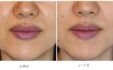
Clinical Case: Treating Nasolabial Folds and Dimpling with Growth Factors
This case involves a woman in her 50s with noticeable dimpling during smiling and asymmetry of the nasolabial folds. She received growth factor treatment. The photographs compare her appearance before treatment and three months afterward.

ProcedureGrowth factor injections for nasolabial folds
Treatment detailsInjections into the nasolabial fold area aimed at promoting collagen and elastin production to make the folds less noticeable.
PriceJPY 180,000 for both sides (tax included)
Main risksSwelling, bruising, discomfort, asymmetry, and uneven skin texture, among others.
Results and recovery vary from person to person. Listed prices may change; please check the current price list for the latest information.
See this case and its follow-up through six months
How We Choose Treatment: Look at the Face When Not Smiling, Too
- An indentation visible only during smiling is primarily associated with facial muscle movement.
- If a depression or wrinkle remains at rest, the underlying nasolabial fold also contributes.
- One-sided dimpling is not unusual; making both sides look exactly the same is not the sole goal of treatment.
- To soften the dimple while preserving a natural smile, we assess the face at rest, with a gentle smile, and with a broad smile.
Frequently Asked Questions
Can dimples along the nasolabial folds be treated?
Depending on the cause, treatments may make them less noticeable. We first assess whether an indentation appears only during smiling or remains visible at rest, and then consider Botox targeting facial muscles, hyaluronic acid fillers, or growth factor injections.
Why has my dimple become more noticeable recently?
With age, declining collagen, elastin, firmness, and elasticity, together with loss of cheek volume, can make a previously subtle indentation more visible. If a crease persists after smiling, an etched skin wrinkle may also be contributing.
Which looks more natural: Botox or hyaluronic acid fillers?
Botox may be considered when the area indents strongly only during smiling, while hyaluronic acid filler may be an option when a depression is visible at rest. For strong adhesions between the skin and underlying tissue, subcision may be followed by filler injection. Too much Botox can affect the smile, while excessive filler can create unwanted fullness, so we choose the method and amount based on the face both at rest and in motion.
Let Us Help You Explore Treatments for Dimples That Appear When You Smile
Whether one side looks deeper, shadows appear stronger in photos, or creases have recently begun to linger after smiling, tell us what concerns you. We assess your face at rest and while smiling, and explain which areas might benefit from treatment and which may be better left alone.
At our clinic, we do not pressure patients into unnecessary treatments or upselling. We take time to explain the treatment options and precautions so you can make an informed decision.








 03-6434-7678
 オンライン相談
 来院予約