
 電話で予約
 WEB予約
 LINEで予約


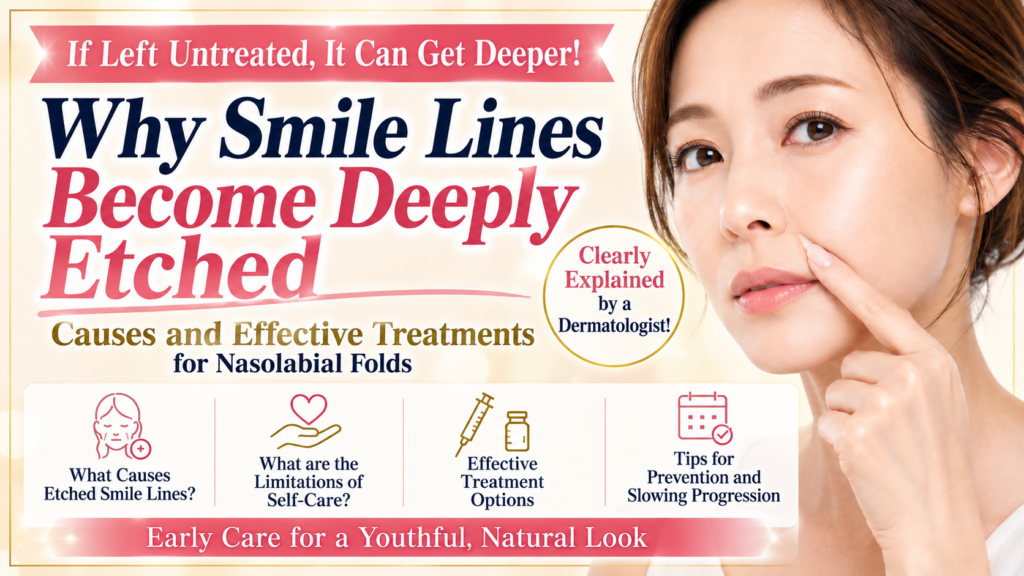
Why Smile Lines Become Deeply Etched: Causes and Treatments for Nasolabial Folds
 Author and Medical Reviewer:
Houreisen Skin Clinic — Specializing in Nasolabial Fold and Wrinkle Treatments
Osaka Houreisen Skin Clinic / Tokyo Houreisen Skin Clinic / Nagoya Houreisen Skin Clinic
Dr. Shinya Sasagawa, Representative of Shingetsukai Medical Corporation View Doctor’s Profile
“My smile lines used to disappear after I smiled, but now they seem to stay…”
“Lately, I can see lines or shadows around my mouth even when my face is relaxed…”
If this sounds familiar, you may be noticing the development of etched-in creases along your nasolabial folds, commonly called smile lines.
The key point is that nasolabial creases that remain visible even when your face is relaxed are often difficult to improve with moisturizing or massage alone.
When the lines are still shallow, skincare and changes to daily habits may help reduce how noticeable they look.
However, if the creases linger after smiling, the shadows look more prominent toward the evening, or foundation settles into the folds, factors such as reduced skin elasticity, sagging, and facial structure may be involved.
Have you noticed any of these changes?
• Smile lines remain visible for a while after you stop smiling.
• A line can be seen from the sides of your nose toward your mouth, even at rest.
• Shadows around your mouth appear deeper in the evening.
• Foundation tends to settle into your nasolabial folds.
• Your mouth area looks more tired in photographs than it used to.
• Moisturizing makes little difference to the crease itself.
As we age, changes in skin elasticity, facial bone volume, and the supporting ligaments can contribute to downward movement of the facial fat pads, making nasolabial folds more noticeable.
Repeated facial movements, together with changes in the skin and other age-related factors, can also contribute to the gradual appearance of more persistent creases in the same areas.
In this article, we explain why etched-in nasolabial creases develop and discuss the treatment options that may help improve their appearance.
目次
- 1. What Causes Deep Creases in Nasolabial Folds?
- 2. What Happens When Nasolabial Creases Become More Persistent?
- 3. Deeply Etched Nasolabial Creases May Require More Involved Treatment
- 4. Treatments We Offer for Etched-In Nasolabial Creases
- 5. Our Approach to Treating Etched-In Nasolabial Creases
- 6. Growth Factor Treatment
- 7. Hyaluronic Acid Filler Treatment
- 8. HIFU and Thread Lift Treatments
- 9. Skincare After Treatment and Reducing Future Skin Damage
- 10. Conclusion: Look Beyond the Surface When Assessing Deep Nasolabial Creases
1. What Causes Deep Creases in Nasolabial Folds?
Everyday facial expressions repeatedly fold the skin along the nasolabial area. Over time, these repeated movements can contribute to lines becoming more deeply etched, particularly when skin elasticity has declined.
At a younger age, skin typically has enough elasticity for expression-related lines to soften after smiling.
As skin firmness decreases with age and facial sagging becomes more noticeable, the creases may remain visible even after the face returns to a relaxed expression.
For a more detailed explanation, please see our related article:
What Causes Nasolabial Folds?
1) Age-Related Loss of Skin Elasticity

As we age, collagen and elastin within the skin gradually decrease or undergo structural changes.
These components play important roles in maintaining skin firmness and elasticity.
One familiar example is the way pillow marks may take longer to disappear from your face as you get older.
When skin elasticity declines, creases that form while smiling may take longer to fade, eventually remaining visible even at rest.
2) Facial Structure, Descending Fat Pads, Bone Changes, and Sagging Skin

Nasolabial folds are not simply a problem involving the skin’s surface.
When cheek fat and other soft tissues descend, they can create more pronounced shadows beside the nose and around the mouth.
In addition, natural facial anatomy and age-related changes in the underlying bones may make hollowing beside the nostrils, at the base of the nose (the pyriform aperture or alar base area), more visible.
In some cases, what looks like a deep wrinkle is actually a combination of a hollow, a contour difference, and a shadow, rather than a deeply etched skin crease alone.
If you are particularly concerned about hollowing beside the nose, see:
Hollowing Beside the Nose and Upper Nasolabial Folds
3) Repeated Facial Habits and a Head-Down Posture


View the Detailed Case Explanation and Follow-Up
Facial expressions and everyday habits, such as chewing mainly on one side or frequently resting your cheek on your hand, may influence how nasolabial folds appear.
Looking downward for long periods while using a smartphone or computer can make the cheeks and folds appear more prominent in that position. However, posture alone should not be assumed to be the cause of permanent creasing.
You do not need to avoid smiling simply because facial muscles play a role.
When elasticity has declined and sagging is present, repeated facial movements may make existing folds more apparent over time.
Patients sometimes tell us, “The lines used to appear only when I smiled, but recently I can still see them when my face is relaxed.” This can be a sign that a more persistent crease has developed, although an examination is needed to distinguish a skin wrinkle from a shadow caused by facial contours.
2. What Happens When Nasolabial Creases Become More Persistent?
As facial tissues change over time, folds that initially appear only with certain expressions may gradually become more visible.
At first, you might notice them only when tired or shortly after smiling. With further loss of elasticity or sagging, the lines may remain noticeable even when you are not making an expression.
1) Lines May Remain Visible Even When Your Face Is Relaxed
Creases that gradually become etched into the skin can remain visible at rest.
If you feel that you look tired when you are not, or that your mouth looks older than the rest of your face in photographs, persistent creases may be one contributing factor.
2) Lines May Appear to Extend Toward the Corners of the Mouth and Marionette Lines

As folds and surrounding facial contours change, the lines may seem to extend downward toward the corners of the mouth and connect visually with marionette lines.
At this stage, the concern may involve sagging across the lower face rather than nasolabial folds alone.
If you notice that your lines extend farther toward the mouth or that marionette lines have become more prominent, it is important to assess the overall causes of lower-face sagging.
Learn more about the differences here:
Nasolabial Folds vs. Marionette Lines: Differences and Treatment Options
3) Makeup Can Settle Into the Creases and Make Them Look More Noticeable
Foundation can accumulate in deeply etched creases.
Even if makeup looks smooth in the morning, it may gather around the fold by the afternoon and make the line more noticeable.
Adding more foundation to conceal the crease can sometimes make this more obvious.
Makeup techniques can help improve its appearance temporarily, but they do not correct the underlying crease itself.
For additional makeup advice, see:
Can Makeup Make Smile Lines More Noticeable? Three Tips for a Natural Finish
3. Deeply Etched Nasolabial Creases May Require More Involved Treatment
When a crease is still shallow, treatments aimed at supporting skin quality or small amounts of injectable treatment may be sufficient in some cases.
With deeper folds, however, it is important to assess several possible contributors, including decreased elasticity, cheek descent, hollowing beside the nose, and changes in facial structure.
When several factors are involved, a single treatment may not fully address the concern, and improvements may take time to become apparent.
That is why it can be helpful to have the cause assessed when you first notice that a faint line remains at rest or does not fade as quickly after smiling.
Situations in which self-care may help reduce the appearance of lines
• Smile lines become more noticeable mainly when the skin is dry.
• The lines are barely visible when your face is relaxed.
• There is little hollowing or shadowing around the folds.
Situations in which you may wish to discuss professional treatment
• Nasolabial folds remain noticeable even at rest.
• Foundation repeatedly settles into the creases.
• Hollowing or shadows beside the nose are also a concern.
• The folds appear more pronounced later in the day.
• Moisturizing or massage makes little difference.
• Lines around the mouth corners or marionette lines are becoming more noticeable.
4. Treatments We Offer for Etched-In Nasolabial Creases
Choosing the right treatment begins with understanding what makes the folds noticeable.
At Houreisen Skin Clinic, we assess skin elasticity, descending facial fat, shadows caused by facial anatomy, age-related skeletal changes, and facial movement patterns. We then discuss options that may produce a more immediate contour change, as well as treatments intended to support gradual improvement.
When a crease remains visible at rest, simply filling a hollow may not address every contributing factor. In some cases, treatment directed at skin quality may also be considered.
| Treatment | Potentially Suitable Concerns | Main Advantages | Important Considerations |
|---|---|---|---|
| Growth Factor Injections | Creases visible at rest, reduced skin firmness, and a preference for gradual-looking changes | Intended to encourage skin remodeling and gradual improvement in skin quality; longer-term change is the treatment goal | Results are not immediate, may take several months, and vary by individual |
| Hyaluronic Acid Fillers | Hollows or shadows that a patient would like to correct relatively quickly | Contour changes can be visible soon after injection, and the amount can be adjusted | Results are temporary and may require future treatment; injection-related risks must be considered |
| Thread Lifts and HIFU | Sagging cheeks, reduced jawline definition, and laxity around the lower face | Target sagging and help improve the overall contour of the cheeks and lower face | May not adequately improve an etched-in skin crease when used alone |
It is more important to choose a treatment based on the underlying cause than on the treatment name alone.
When One Particular Concern Is Most Prominent
• If the main concern is a crease etched into the skin: growth factor treatment may be considered.
• If a structural hollow or shadow is the main concern: hyaluronic acid fillers may be considered.
• If descending cheek fat and jawline sagging are the main concerns: thread lifts or HIFU may be options.
When Several Concerns Occur Together
• For hollowing combined with jawline sagging: thread lifts plus hyaluronic acid fillers may be considered.
• For etched-in creases combined with sagging beside the mouth: HIFU plus growth factor treatment may be discussed.
The treatment plan should always be tailored to the patient’s facial anatomy, goals, and medical suitability.
5. Our Approach to Treating Etched-In Nasolabial Creases
After evaluating the cause of the folds, we may consider a treatment plan that addresses both immediate concerns and longer-term skin changes.
1) Consultation
We first examine how the nasolabial folds appear when the face is relaxed and when the patient makes facial expressions.
The appropriate treatment differs depending on whether the folds appear only when smiling, remain visible at rest, involve significant hollowing beside the nose, or are mainly related to cheek sagging.
For example, when the right nasolabial fold is deeper than the left, possible contributors may include facial asymmetry, muscle use, chewing habits, and differences in fat distribution.
2) Identifying the Factors Behind the Crease
Several factors often overlap, including loss of elasticity, descending facial fat, structural hollows, and repeated facial movements.
3) Planning for Short-Term and Longer-Term Changes
Treatment priorities depend on whether you want to improve your appearance relatively soon, prefer subtle changes over time, or are mainly concerned about future progression.
For earlier contour improvement: Hyaluronic Acid Fillers may reduce hollows and shadows.
For gradual skin-focused treatment: Growth Factor Injections are used at our clinic with the aim of supporting skin elasticity.
For sagging: Thread Lifts or HIFU may help address cheek and jawline laxity.
Some patients may benefit from a combination, such as growth factor treatment for etched-in lines and localized hyaluronic acid filler for hollow cheeks or marionette lines.
6. Growth Factor Treatment

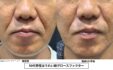
View the Detailed Case and Follow-Up
Growth factor treatment involves injecting a growth factor preparation into the dermal layer to act on cells involved in the skin’s repair and remodeling processes.
Fibroblasts are cells that produce collagen and elastin, which help support the skin’s structure and elasticity.
At our clinic, this treatment is intended to encourage gradual changes in the skin itself, rather than simply filling a depression.
Unlike hyaluronic acid filler, it does not provide an immediate filling effect.
Changes develop gradually, and at our clinic we generally assess the result over approximately 3 to 6 months.
Our aim is a natural-looking result with improvements that develop over time. The degree and duration of improvement vary, and long-term outcomes should not be assumed to be the same for everyone.
For patients with creases that remain visible at rest or with reduced skin elasticity, a treatment that targets skin quality may be considered after examination.
Who May Be Suitable for Growth Factor Treatment?
• People whose nasolabial creases remain visible when the face is relaxed
• People who prefer gradual, natural-looking changes
• People interested in longer-term skin-focused improvement rather than an immediate filling effect
• People concerned about reduced skin elasticity and etched-in lines
Who May Be Less Suitable for Growth Factor Treatment?
• People seeking an immediate visible change
• People whose main concern is an underlying structural hollow
• People with pronounced cheek descent or lower-face sagging
No single treatment is suitable for everyone.
The most important step is to determine whether the main issue is a crease in the skin, a hollow, or sagging tissue.
7. Hyaluronic Acid Filler Treatment

View the Detailed Case and Follow-Up
Hyaluronic acid fillers are injected into selected areas around the nasolabial folds to restore volume and reduce depressions or contour differences.
One major advantage is that a change in volume can be seen soon after injection. The clinician can also adjust the amount and placement to suit the individual face.
For this reason, fillers may be an option for people who want a more immediate appearance change ahead of a special occasion, reunion, or photography session. Some temporary swelling or bruising may still occur, so treatment should not be scheduled too close to an important event without discussing recovery time.
Hyaluronic acid fillers primarily add volume; they do not directly reverse all the underlying changes in skin quality that contribute to wrinkles.
Too much filler can make the mouth area look heavy or unnaturally full.
If filler is placed too superficially, a bluish discoloration known as the Tyndall effect, as well as unevenness or lumps, may occur.
Who May Be Suitable for Hyaluronic Acid Fillers?
• People who want a relatively immediate contour change
• People with prominent hollows beside the nose or along the nasolabial folds
• People who prefer gradual adjustment of the amount injected
Who May Be Less Suitable for Hyaluronic Acid Fillers?
• People whose main issue is a deeply etched skin crease rather than a hollow
• People with pronounced descent of cheek fat
• People who are concerned about an unnatural appearance from repeated injections
• People whose main priority is a skin-focused approach to gradual change
Hyaluronic acid filler is one option for achieving a relatively quick contour change, and it may be appropriate for certain types of nasolabial folds.
However, other treatments or a combination approach may be more suitable depending on the facial anatomy, medical assessment, and patient’s preferences.
8. HIFU and Thread Lift Treatments
If facial sagging is mainly caused by descended cheek fat, skin laxity, or changes in facial volume, treating an etched-in crease alone may not be sufficient.
In such cases, treatments that target broader facial laxity, such as HIFU or thread lifts, may be considered.
HIFU (High-Intensity Focused Ultrasound) delivers focused ultrasound energy to selected tissue depths to generate heat, with the aim of improving skin firmness and tightening sagging areas.
Thread lifting involves placing absorbable medical threads beneath the skin to reposition and lift sagging tissue.
Both approaches may help certain types of sagging, but additional treatment, such as growth factor injections or hyaluronic acid fillers, may be needed when a persistent skin crease or structural hollow is also present.

View the Detailed Case and Follow-Up
If sagging of the cheeks and jawline is a major concern, a combined treatment approach may sometimes be appropriate.
For more information, see:
When Can a Thread Lift Help Improve Nasolabial Folds?
9. Skincare After Treatment and Reducing Future Skin Damage
Appropriate ongoing skincare is important after treatment for etched-in nasolabial creases.
Dryness, ultraviolet exposure, friction, and repeated facial movements can continue to affect the appearance of the skin. Good skincare cannot stop normal facial aging, but it can help maintain skin health.
The foundations of home care are moisturizing, daily sun protection, and avoiding unnecessary rubbing or irritation.
Based on our experience in nasolabial fold and wrinkle care, Houreisen Skin Clinic has developed the NASORA skincare line.
If you are interested in maintaining your skin after treatment or reducing the appearance of fine lines caused by dryness, please see the following article.
Doctor-Supervised Wrinkle Skincare: NASORA Wrinkle Lift Cream for At-Home Care
10. Conclusion: Look Beyond the Surface When Assessing Deep Nasolabial Creases
Deeply etched nasolabial creases are often difficult to improve with moisturizing or massage alone.
Self-care remains valuable both before and after professional treatment.
It can help with dryness-related fine lines and protect the skin from avoidable environmental damage.
However, when a crease is already deeply etched, the most useful next step is to identify the underlying contributors and consider treatment accordingly.
Etched-in skin creases and reduced elasticity: A skin-focused option such as growth factor treatment may be considered.
Hollows and shadows requiring a quicker contour change: Hyaluronic acid fillers may be considered.
Sagging cheeks or heaviness around the mouth: Thread lifts or HIFU may be options for addressing broader facial laxity.
The key is not to choose a treatment by name alone, but to assess whether the most noticeable feature is an etched-in skin crease, a hollow, or sagging tissue.
If self-care has not made enough difference, a consultation can help clarify which factors are involved.
Treatment is less likely to meet your expectations if it does not address the main cause of your nasolabial creases.
If your wrinkles linger after smiling, shadows remain around your mouth at rest, or moisturizing and massage make little difference, it is worth assessing whether reduced elasticity, hollowing, or sagging is the main concern.
At Houreisen Skin Clinic, we explain the treatment options based on your individual condition and preferences, without pressuring you into a procedure.







 03-6434-7678
 オンライン相談
 来院予約