
 電話で予約
 WEB予約
 LINEで予約




Written and medically reviewed by: Dr. Shinya Sasagawa, Representative of Shingetsukai Medical Corporation
View Doctor Profile
Many people are concerned about sagging or bulging beside the corners of the mouth, often called “ponyo” in Japanese, but are unsure what causes it or which treatments may help.
When the jawline looks less defined or shadows appear around the mouth, it is natural to wonder whether reducing facial fat would be the best solution.
However, jowls beside the mouth are not caused simply by having too much fat. They develop through a combination of descending facial fat, reduced skin firmness, weakening of supporting ligaments, and changes in muscles and facial bones. A hollow beside the corner of the mouth can also make the surrounding fullness look more pronounced.
This article explains why jowls form, what you can do at home, and which cosmetic dermatology treatments may help.
Why Do Jowls Form Beside the Mouth?
Fullness and sagging beside the mouth involve not only cheek fat but also the skin, ligaments, muscles, and bones that support it.
1. Cheek Fat Descends with Age
As cheek fat gradually shifts downward with age, it can gather beside the mouth and become visible as a bulge or sagging area. Fat contributing to this fullness along the lower cheeks and jawline is often referred to as jowl fat.


2. The Ligaments Supporting the Skin and Fat Weaken
Facial skin and fat are supported by connective-tissue structures called retaining ligaments. Think of them as invisible supports for the face.
As these structures provide less support with age, the overlying skin and fat can descend, contributing to jowls and a less defined jawline.

Major Facial Retaining Ligaments and Their Roles
Temporal retaining ligaments
Near the temples, these structures connect tissues such as the skin, subcutaneous fat, and superficial musculoaponeurotic system (SMAS) to deeper fascia or periosteum.
Infraorbital retaining ligament
This helps anchor the skin and orbicularis oculi muscle near the orbital rim, supporting the boundary between the lower eyelid and cheek.
Zygomatic retaining ligaments
These structures help anchor the skin, fat, and muscles over the cheekbone, supporting the upper cheek and contributing to the position of the malar fat pad.
Upper masseteric retaining ligaments
Near the upper part of the masseter muscle, these structures connect the skin and cheek fat to deeper fascia and help support tissues extending toward the mouth.
Masseteric retaining ligaments
Near the anterior border of the masseter, these structures connect deeper fascia with skin and fat, helping maintain cheek support and jawline definition.
Parotid retaining ligaments
Near the ear and parotid gland, these structures link the skin to fascia covering the gland and help support the lower face.
Mandibular retaining ligaments
These strong connective-tissue structures attach tissues near the jawbone and help define and support the jawline.

3. Skin Loses Firmness and Elasticity
Collagen and elastin are important for maintaining skin firmness and elasticity. Aging and cumulative ultraviolet (UV) exposure can reduce or damage these components.
As the skin becomes less elastic, it provides less support to the cheeks, making jowls beside the mouth more noticeable.

4. Changes in Facial Muscle Balance
The depressor anguli oris (DAO), which pulls the mouth corners downward, and the platysma, which extends from the neck into the lower face, can both exert a downward pull around the mouth.
When the skin and ligaments provide less support, this downward pull may become more noticeable, contributing to downturned mouth corners and reduced jawline definition.

5. Age-Related Changes in Facial Bone Structure
Facial bones also change with age. When bone volume decreases in areas such as the upper or lower jaw, the underlying support for skin and fat can diminish, making the overlying tissues appear looser.
These changes can affect not only jowls but also nasolabial folds, the under-eye area, and hollow cheeks, sometimes contributing to an older-looking facial appearance.
Why Facial Bone Volume Changes
Bone is constantly being broken down and rebuilt. As this balance changes with age, both bone volume and bone shape can change.
In women, declining estrogen around menopause can contribute to bone loss. Loss of teeth may also lead to resorption of the supporting alveolar bone and changes in jaw shape.
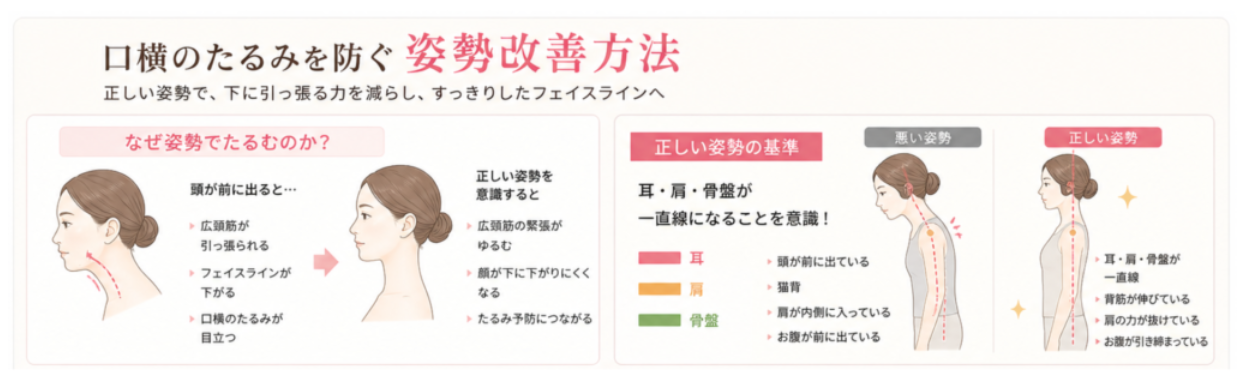
6. Posture and Daily Habits Can Make Jowls More Noticeable
Looking down at a smartphone, for example, may make fullness beneath the chin and around the mouth appear more prominent.
For patients who clench their teeth and have enlarged masseter muscles, we also assess the overall facial contour, including the jaw angles.

7. Hollows and Creases Can Develop Beside the Mouth Corners
Some people who are concerned about “jowls” are actually noticing a hollow or deep skin crease near the modiolus, a point where several facial muscles meet beside the mouth.
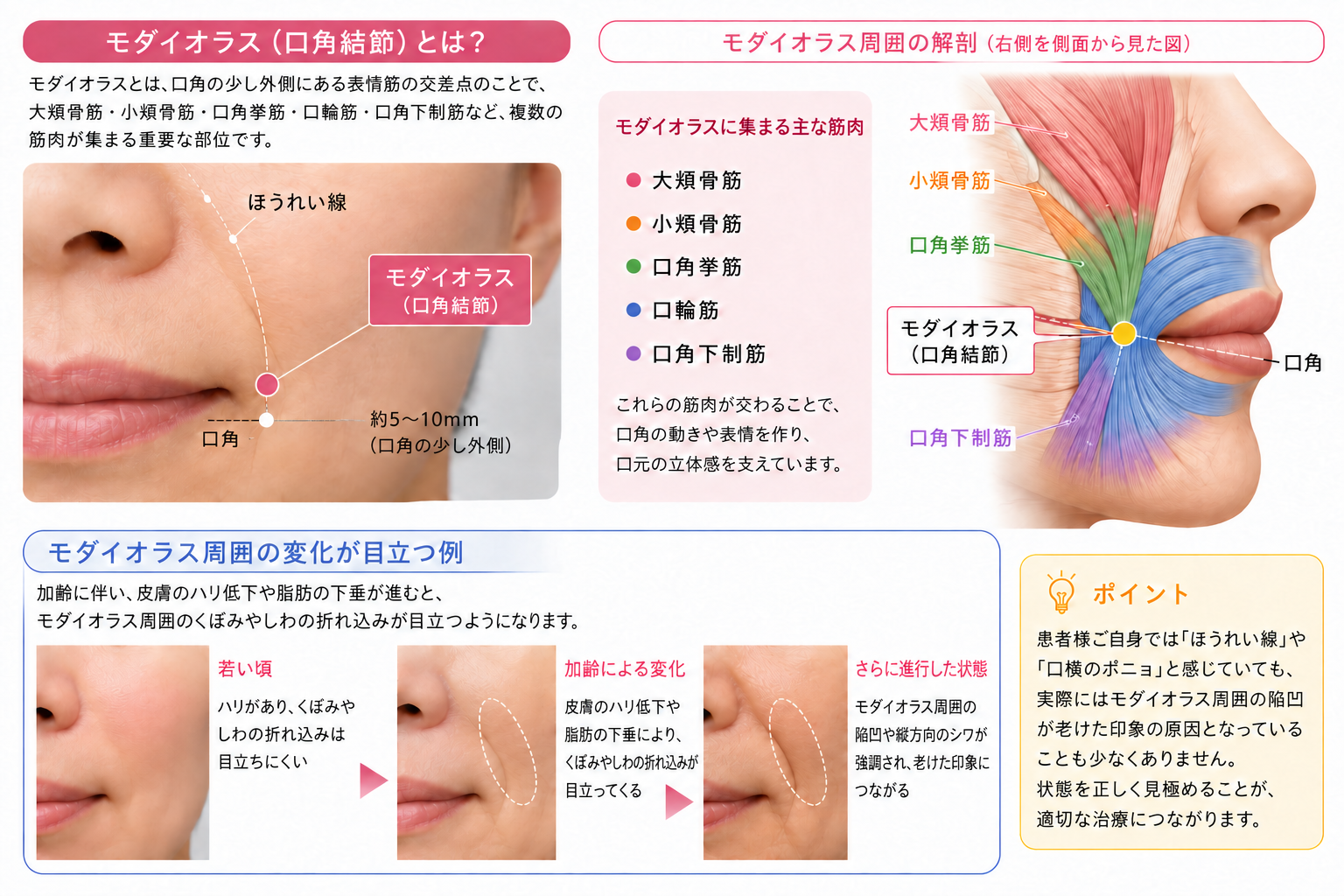
The modiolus is located just outside the corner of the mouth. It is involved in movements such as lifting and lowering the mouth corner and closing the lips.
A hollow or crease in this area may become more pronounced as skin elasticity decreases and facial fat descends. When smiling, a vertical crease may also appear just above and outside the mouth corner.

What looks like a bulge beside the mouth may actually be a hollow next to it.
When selecting treatment for this area, we consider not only fat distribution but also skin firmness, facial muscle movement, and the relationship to nasolabial folds and marionette lines.
At-Home Care for Jowls Around the Mouth
Self-care alone is unlikely to reverse descended fat or a deep hollow. However, protecting the skin from UV damage and keeping it moisturized are useful ways to support healthy-looking skin.
Protect Your Skin from UV Exposure and Keep It Moisturized
UV radiation damages collagen and elastin and contributes to wrinkles and sagging. Use sunscreen regularly, along with a hat or parasol when appropriate.
Dry skin can make fine lines more visible and create an appearance of reduced firmness. Moisturize after cleansing, and apply additional cream to dry areas as needed.
Learn more about UV protection
Moisturizing products available at our clinic: NASORA Enrich Lotion / NASORA Wrinkle Lift Cream
Avoid Vigorous Facial Massage
Gentle touch may temporarily ease puffiness or muscle tension, making the face feel less swollen. However, massage cannot return descended fat to its original position or fill a hollow beside the mouth.
Rubbing or repeatedly pulling the skin can cause irritation. Avoid massage that is painful or excessively forceful.
Read about the benefits and precautions of facial massage
Avoid Spending Long Periods Looking Down
Try to hold your smartphone closer to eye level and avoid keeping your neck extended forward. Take breaks if you remain in the same position for a long time, and relax your neck and shoulders.

Treatments for Jowls Available at Our Clinic
Since first publishing this article, we have seen more patients seeking advice about sagging beside the mouth. Below, we introduce treatments available at our clinic, together with actual patient cases.
The right approach depends on whether you want to reduce excess fat, lift descended cheek tissue, or improve skin firmness.
We discuss your desired results while considering the treatment burden, recovery, and possible risks.
Thread Lift | Lifting Descended Cheek Tissue
A thread lift uses absorbable medical threads placed beneath the skin to lift and reposition cheek tissue. It may be suitable when descended cheek fat overlaps the area beside the mouth or when the jawline appears less defined. Lifting may also help soften folds or shadows caused by this overlap.
A lifting effect can often be seen immediately after treatment. At our clinic, we also aim to support tissue remodeling around the threads, although the extent and duration of collagen-related changes vary.
Woman in Her 40s | Jowl Treatment with 12 Threads
This patient had received growth factor treatment for her nasolabial folds one month earlier and was subsequently concerned about sagging beside her mouth. Six threads were placed on each side, for a total of 12.
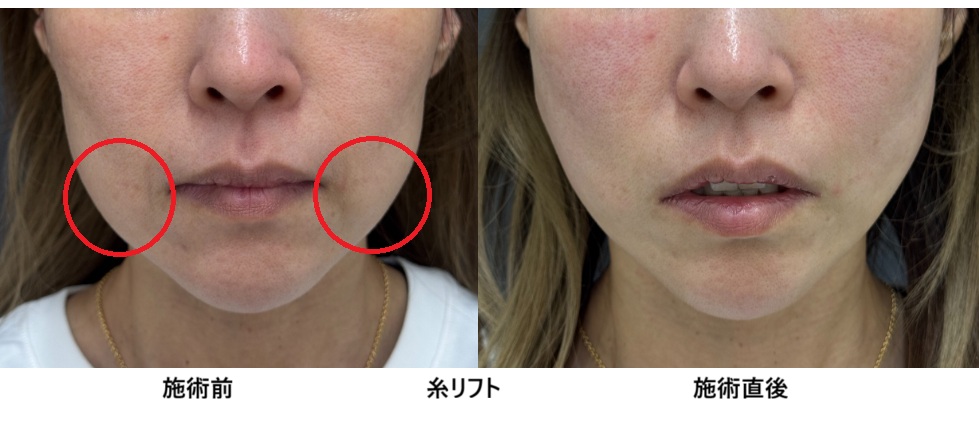
Treatment and follow-up: 12-thread lift. The images show the appearance before and immediately after treatment. Growth factor injections for the nasolabial folds had been performed one month earlier.
Standard price: PCL threads: ¥22,000 each; PLCL threads: ¥27,000 each. For 12 threads, the total is ¥264,000–¥324,000 (tax included), depending on thread type. The earlier growth factor treatment is charged separately.
Main risks: Swelling, bruising, pain, tightness, difficulty opening the mouth, asymmetry, dimpling, infection, or thread exposure. Nerve injury is also possible in rare cases.
At our clinic, many patients find that their appearance looks more natural within about one week. How long the result lasts varies, and the need for further treatment is assessed during follow-up.
View this case with front and side photos and follow-up details
Thread lift: effects, discomfort, and pricing
HIFU | Firming the Area Beside the Mouth and Jawline
High-intensity focused ultrasound (HIFU) delivers focused ultrasound energy to heat targeted tissue and improve firmness around the cheeks and jawline.
It can be an option for patients concerned about mild sagging or fullness beside the mouth.
Results often develop gradually, with changes generally becoming most noticeable around 2–3 months after treatment. We review progress over approximately six months before discussing whether further treatment is appropriate.
HIFU Treatment for Sagging Cheeks and the Area Around the Mouth
This patient was concerned about sagging skin and fullness in the cheeks. Treatment with ULTRAcel Zi was followed by a more defined appearance around the mouth at four months.
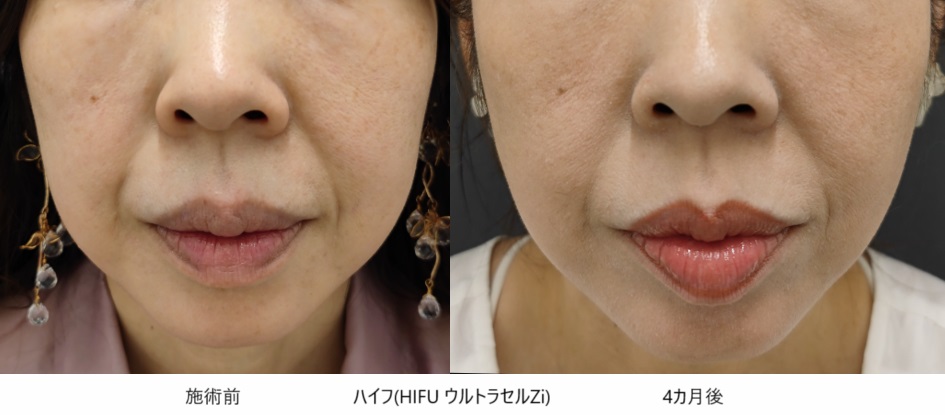
Treatment: HIFU skin-tightening treatment using ULTRAcel Zi.
Standard price: Cheeks: ¥54,800; cheeks and under-chin area: ¥69,800 (tax included). Prices depend on the treatment area and plan.
Main risks: Redness, swelling, pain, blisters, burns, hyperpigmentation, loss of cheek volume, or numbness.
View the full follow-up for this HIFU case
HIFU treatment details, devices, and pricing
Fat-Dissolving Injections | Gradually Reducing Localized Fat
Fat-dissolving injections deliver medication to a targeted area to reduce localized fat. Our clinic uses Deolipo (Kabelline).
This approach does not require an incision. Because a single session may produce only a limited change, multiple treatments are usually considered based on the response.
Price and recommended sessions: 8 mL: ¥35,000 (tax included). As a general guide, 4–6 sessions are performed at 1–2-week intervals. If 8 mL is used at each session, the total for 4–6 sessions is ¥140,000–¥210,000. The final cost depends on the amount used and the number of sessions.
Main risks: Swelling, bruising, pain, redness, lumps, uneven contours, hollow cheeks, or allergic reactions. Swelling may occasionally persist.
Read more about fat-dissolving injections
When Hollows or Wrinkles Beside the Mouth Are Also a Concern
Reducing fat alone will not correct a hollow or deep crease around the modiolus. Treatment is selected according to the cause, which may involve skin wrinkles, volume loss, or descended cheek tissue.
Growth Factor Injections for Wrinkles Etched into the Skin
For patients with reduced skin firmness or dermal thinning whose wrinkles remain visible even at rest, we may recommend growth factor injections. These treatments aim to encourage collagen production, improve skin firmness and thickness, and make wrinkles less noticeable.
Results are not complete immediately after injection and may develop over several months. Growth factor treatment is not appropriate for every area; in some cases, hyaluronic acid or another treatment may be more suitable.
Growth factor injections: treatment details, pricing, and risks
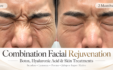
Woman in Her 40s | Vertical Crease Extending from the Mouth Corner
This patient tended to tense the muscles around her mouth and was particularly concerned about the nasolabial fold on the left. A vertical crease extending from the modiolus area was also visible. Growth factor injections were administered to the nasolabial folds, and the wrinkles appeared less prominent after six months.

Treatment and follow-up: Growth factor injections to the nasolabial folds. Photos were taken before treatment and six months afterward.
Standard price: Both nasolabial folds: ¥180,000 (tax and anesthesia included). Additional injection treatment, if required: ¥90,000.
Main risks: Swelling, bruising, unusual sensation, asymmetry, lumps, unwanted fullness, or uneven contours.
See this case at 1, 3, and 6 months after treatment
Woman in Her 30s | Growth Factor Treatment for Nasolabial Folds
Growth factor injections may also be used for wrinkles in the nasolabial folds. This patient had become concerned about folds visible in photographs after turning 30. At the six-month follow-up, the folds appeared less pronounced.

Treatment and follow-up: Growth factor injections to the nasolabial folds. Photos were taken before treatment and six months afterward.
Standard price: Both nasolabial folds: ¥180,000 (tax and anesthesia included). Additional injection treatment, if required: ¥90,000.
Main risks: Swelling, bruising, unusual sensation, asymmetry, lumps, unwanted fullness, or uneven contours.
View the detailed progress and explanation for this case
Hyaluronic Acid for Hollows Caused by Volume Loss
Hyaluronic acid fillers are an option for hollows related to insufficient soft-tissue volume or facial anatomy. Adding volume to selected areas can help soften shadows beside the mouth.
However, the area around the mouth moves frequently during facial expression. Too much filler may cause an unnatural bulge when smiling. It is important to adjust the amount gradually while considering the balance between the nasolabial folds, mouth corners, and marionette lines.
Price and expected duration: First syringe: ¥77,000; each additional syringe: ¥69,800 (tax included). Changes may be seen immediately, and the fillers used at our clinic typically last around 1–2 years, depending on the area and individual factors.
Main risks: Swelling, bruising, pain, asymmetry, lumps, or infection. Vascular compromise is a rare but serious risk.
Hyaluronic acid: cases by treatment area, products, and pricing
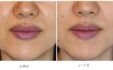
Woman in Her 60s | Filler for Nasolabial Folds and Hollows Below the Mouth Corners
This patient was concerned about nasolabial folds and sagging around the mouth. Hyaluronic acid was injected into the nasolabial folds and marionette lines to improve the hollows around the mouth. No unusual sensation was reported.

Treatment and follow-up: Hyaluronic acid injections into the nasolabial folds and marionette lines. Photos were taken before treatment and one month afterward.
Standard price: First syringe: ¥77,000; each additional syringe: ¥69,800 (tax, cannula, and anesthesia included). The total varies with the number of syringes used.
Main risks: Pain, swelling, bruising, unusual sensation, asymmetry, lumps, infection, allergic reactions, or vascular compromise.
See frontal and side-view photos for this case
Treating the Whole Mouth Area for Better Facial Balance
For example, even well-defined double eyelids may seem out of balance if they do not harmonize with the nose, lips, and facial contour. The same principle applies to treating jowls.
After improving jowls, a patient may become more aware of nasolabial folds or hollows beside the mouth. At our clinic, we consider the overall balance between the area beside the mouth, the nasolabial folds, marionette lines, and jawline.
Some patients may benefit from a single treatment, while others may achieve a more balanced result through a combination of approaches. Examples include:
HIFU + Growth Factor Injections for Nasolabial Folds
This approach combines HIFU for firmness in the cheeks and jawline with growth factor injections for wrinkles etched into the skin of the nasolabial folds. It may suit patients concerned about both jowls and nasolabial lines.
Thread Lift + Jalupro Super Hydro
This combination uses a thread lift to reposition descended cheek tissue and Jalupro Super Hydro to support skin hydration and firmness. It may be suitable for patients who notice both jowls and dry or less resilient skin.
Price and recommended sessions: Jalupro Super Hydro: ¥69,800 for 2.5 mL per session (tax included). Three sessions, approximately one month apart, are a general guide; the total for three sessions is ¥209,400. Maintenance may be considered every 6–12 months afterward.
Main risks: Temporary swelling or bumps at injection sites, redness, bruising, pain, or allergic reactions.
Jalupro Super Hydro: expected effects and treatment intervals
Another option is to assess the results of HIFU and growth factor injections for the nasolabial folds for about six months, then consider a thread lift if jowls remain a concern.
It is not necessary to undergo every treatment from the beginning. We discuss your priorities and budget, review the results over time, and decide together whether additional treatment would be helpful.
Concerned About Jowls Around Your Mouth? Contact Us
Jowls are not caused by fat alone. They may result from descending fat, weakening ligaments, loss of skin elasticity, and changes in muscles and facial bones. Rather than focusing only on fat reduction, it is important to choose treatment based on the balance of the entire face.
Jowls, nasolabial folds, marionette lines, and hollows near the modiolus are close together and can be difficult to distinguish on your own. If you are unsure what causes your sagging, are concerned about creases near the mouth corners, or want to know what preventive care to start, you are welcome to discuss these concerns during a consultation.
Tell us what bothers you most, such as fullness beside the mouth or a crease that becomes visible when you smile. We will assess your facial anatomy and explain suitable options, expected changes, costs, and precautions.
If you have questions before visiting, you can also reach us through our contact form.





 03-6434-7678
 オンライン相談
 来院予約