
 電話で予約
 WEB予約
 LINEで予約



Written and Medically Reviewed by
Dr. Shinya Sasagawa
Chief Medical Director and Cosmetic Dermatologist, Houreisen Skin Clinic
Chairman, Shingetsukai Medical Corporation
Meet Our Doctors
Specialists in Nasolabial Fold and Wrinkle Treatments
Houreisen Skin Clinic Osaka / Houreisen Skin Clinic Tokyo / Houreisen Skin Clinic Nagoya
“My cheeks look darker than they used to,” or “Light brown patches have started spreading across both cheeks.” If you have noticed changes like these, you may have melasma.
Melasma is a type of hyperpigmentation associated with increased melanin production, influenced by factors such as sun exposure and female hormones. It can be treated with oral medications, topical treatments, and certain laser procedures. However, the approach differs from treatment for ordinary sun spots. The first step is to have a dermatologist identify what type of pigmentation you have.
What Is Melasma? How Is It Different from Other Dark Spots?
Melasma is a skin condition that causes light to dark brown patches, most commonly around the cheekbones. It is particularly common in women in their 30s to 50s, although men can also develop it. It may also appear on the forehead, above the upper lip, or on the chin.
One characteristic of melasma is that similar patches often appear on both cheeks, with relatively indistinct borders. However, melasma is not always symmetrical, and not every symmetrical patch of pigmentation is melasma.

| Type of Pigmentation | Typical Characteristics |
|---|---|
| Melasma | Brown pigmentation that spreads in patches, mainly across the cheeks. It often appears on both sides of the face. |
| Sun Spots (Solar Lentigines) | Relatively well-defined brown spots that develop on sun-exposed areas of the skin. |
| Post-Inflammatory Hyperpigmentation (PIH) | Brown discoloration remaining after inflammation caused by acne, eczema, irritation, or other skin conditions. |
| Acquired Dermal Melanocytosis (ADM) | Small gray-brown or bluish spots, sometimes appearing around the cheekbones. Pigment-producing cells are present in the dermis. |
In some cases, melasma may occur alongside solar lentigines or ADM on the same cheek. Diagnosis is based not only on the color and distribution of the pigmentation, but also on when it appeared, previous treatments, and any history of skin inflammation.
Learn more about different types of dark spots and their treatments
What Causes Melasma? Changes Occurring Within the Skin
Melanin, the pigment responsible for skin color, is produced by cells called melanocytes in the epidermis. In melasma, these cells become more active and produce excess melanin, making areas such as the cheeks appear brown.
While increased melanin production has long been the main focus, more recent research has also identified damage to the basement membrane between the epidermis and dermis, as well as an increase in small blood vessels in the dermis of melasma-affected skin.
The basement membrane is a thin structure that supports the epidermis from below. When it is damaged, pigment may migrate into the dermis, potentially contributing to persistent discoloration. Researchers are also investigating whether substances released from blood vessels in melasma-affected areas influence melanocyte activity.
In other words, melasma involves not only surface pigmentation but also changes in the underlying skin. For this reason, treatments targeting the basement membrane and dermal blood vessels, in addition to those that suppress melanin production, are being studied.
What Makes Melasma Worse? Prevention and Home Care
Protect Your Skin from UV Rays and Visible Light
Ultraviolet (UV) radiation stimulates melanin production and is a major factor in worsening melasma. Visible light from sunlight can also contribute, so protection against UV rays alone may not be enough.
Choose a broad-spectrum sunscreen that protects against both UVA and UVB, with an SPF of at least 30, and apply an adequate amount evenly. When outdoors, reapply approximately every two hours, as well as after sweating or wiping your face with a towel. Hats and parasols can also help reduce sun exposure.
Tinted sunscreens containing iron oxides may offer additional protection against visible light.

Avoid Excessive Rubbing During Cleansing
Rubbing your cheeks vigorously while washing or removing makeup, or repeatedly massaging the skin, can cause irritation and inflammation. This may lead to additional pigmentation and make dark patches appear more noticeable.
Use an appropriate amount of cleanser or makeup remover and avoid scrubbing with your fingers. Gently pat your skin dry with a towel. If you experience dryness or stinging, review your skincare products and moisturize appropriately.
Skincare products containing niacinamide may be helpful because they act on the process by which melanin is transferred to surrounding skin cells. However, skincare products alone may not be sufficient to improve more pronounced melasma.
The Effects of Female Hormones and Stress
Melasma sometimes appears during pregnancy or becomes darker after starting oral contraceptive pills. Changes in female hormone levels are thought to affect melanocyte activity. Some people notice that their melasma fades after childbirth, while in others it persists.
Melasma may also become more noticeable during periods of significant stress. Stress-related hormonal changes may play a role, although the exact mechanisms remain unclear.
If you take oral contraceptive pills, do not stop taking them on your own because of melasma. Consult the doctor who prescribed them.
Oral and Topical Medications for Melasma
Alongside consistent sun protection, oral and topical medications may be used to reduce melanin production. Depending on the severity of the pigmentation and the condition of your skin, medications alone may lead to improvement.
Oral Tranexamic Acid
Tranexamic acid is commonly used as an oral treatment for melasma. It is thought to reduce stimulation of melanocytes by inhibiting the activity of plasmin, an enzyme involved in pathways that can promote excess melanin production. Clinical studies have also reported improvements in melasma.
Vitamin C and L-cysteine may help suppress melanin production, while vitamin E has antioxidant properties. Although their effects are generally less pronounced than those of tranexamic acid, they may be used alongside it to support melasma treatment.
The dosage and duration of tranexamic acid treatment are determined according to your skin condition and overall health. Before taking it, please tell your doctor if you have a history of blood clots; take oral contraceptives or other hormonal medications; smoke; are aged 40 or older; have high blood pressure, dyslipidemia, diabetes, or kidney problems; or have any other relevant medical conditions. Your doctor will assess your risk of thrombosis and review any other medications before deciding whether tranexamic acid is appropriate for you.
Topical Hydroquinone and Tretinoin
Hydroquinone is a topical agent that inhibits tyrosinase, an enzyme involved in melanin production. It is used to help lighten melasma.
Tretinoin is a vitamin A derivative that promotes epidermal cell turnover and helps improve pigmentation. It may be used together with hydroquinone.
Both products can cause redness, peeling, or stinging, so the concentration and frequency of use should be adjusted to your skin’s condition. Continuing treatment despite persistent irritation may make pigmentation worse. Avoid these topical treatments during pregnancy, and consult your doctor before use if you are planning to become pregnant or are breastfeeding.
Is Laser Toning Effective for Melasma?
Laser toning uses low-energy laser pulses applied evenly across the face to gradually reduce melanin and lighten melasma. The energy settings and treatment method differ from the targeted laser treatment typically used for darker, well-defined sun spots.
Laser treatment may be considered when oral or topical medications and sun protection do not provide sufficient improvement. Because irritation can worsen melasma, the laser settings and intervals between sessions must be adjusted according to your skin’s response. Temporary redness and stinging may occur after treatment. In rare cases, hyperpigmentation or patchy loss of pigmentation can develop.
At our Osaka clinic, we offer PTP laser toning using the Tri-Beam system. The price is ¥8,800 per session (tax included). Treatment is generally performed every two to four weeks, with approximately five to ten sessions considered initially. The number of sessions needed depends on the degree of improvement.
Treatments Focusing on the Basement Membrane and Blood Vessels
Melasma is thought to involve not only increased melanin production but also changes in the basement membrane and blood vessels within the dermis. At our clinic, we assess not only the depth of pigmentation but also cheek redness, dullness, and skin firmness. Where appropriate, we may combine the following treatments.
Potenza Prime VMLS Mode: Addressing Redness and Vascular Factors
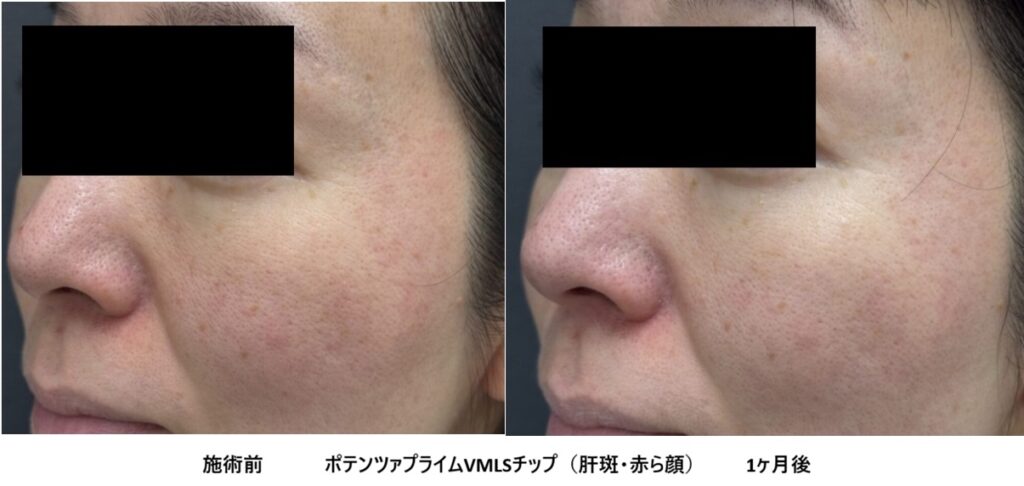
Potenza Prime’s VMLS mode delivers radiofrequency (RF) energy into the dermis through fine microneedles. It is one treatment option for melasma with a vascular component. At our clinic, we use it in selected patients with melasma accompanied by redness or uneven skin tone.
In one of our cases, a woman in her 40s with melasma accompanied by redness received VMLS treatment. At the one-month follow-up, the redness and dullness on her cheeks had improved.
View the full details of this case
The price is ¥39,800 per full-face session (tax included, including anesthesia and a soothing mask). Approximately three to five treatments at four-week intervals are used as a general guide, with the number of sessions and treatment settings adjusted according to progress. Temporary redness, swelling, stinging, or bruising may occur after treatment.
Sunekos: Focusing on the Basement Membrane and Skin Firmness
Sunekos is an injectable product containing non-cross-linked hyaluronic acid and six amino acids. Laboratory research has examined its effects on the production of type IV collagen, a component of the basement membrane. At our clinic, it may be considered for patients who have melasma together with dullness or reduced skin firmness.
Because damage to the basement membrane has been observed in melasma-affected skin, we may combine Sunekos with laser toning, Potenza Prime, or oral medications in selected cases, with the aim of supporting the skin’s underlying structure. Its role in directly treating melasma is still being investigated.
We use Sunekos Performa, priced at ¥33,000 for 2 mL or ¥55,000 for 4 mL (tax included). Multiple injection sessions are usually performed, and the appropriate volume and number of sessions are discussed during consultation. Redness, swelling, or bruising may occur after treatment.
Learn more about Sunekos treatment and patient cases
Which Should Be Treated First When Melasma and Sun Spots Overlap?
It is not uncommon for melasma and solar lentigines to occur on the same cheek.
In such cases, treating darker spots with a targeted laser before addressing melasma may also stimulate the overlapping melasma, potentially making it darker.
For this reason, our clinic generally starts by managing melasma with oral or topical medications and, when appropriate, laser toning. Once the melasma has stabilized, we consider targeted laser treatment for any remaining sun spots. When performing spot treatment, we also avoid areas affected by melasma.
Can Melasma Return After Treatment?
Even after melasma improves, it can become darker again because of sun exposure, hormonal influences, and other factors.
As pigmentation becomes less noticeable, we review whether oral medications can be reduced, whether topical skincare and sun protection are sufficient for maintenance, and whether laser treatments can be spaced further apart. If improvement is limited, we first reassess whether other types of pigmentation are present or whether the skin is being irritated before adding further treatments.
If you are unsure whether your dark spots are melasma or another type of pigmentation, or if your pigmentation has become darker after previous treatment, please contact us. We will review your skin condition and treatment history.
Contact Us About Treatment Options




 03-6434-7678
 オンライン相談
 来院予約