
 電話で予約
電話で予約 WEB予約
WEB予約
 LINEで予約


 Author:
Nasolabial Fold and Wrinkle Treatment Specialty Clinic
Osaka Houreisen Cosmetic Dermatology/Tokyo Houreisen Skin Clinic/Nagoya Houreisen Skin Clinic
Medical Corporation Shingetsukai Representative Director Shinya Sasagawa Doctor profile here
To give you the conclusion first, HIFU is best suited for “sagging prevention,” “tightening the facial contour,” and “improving mild looseness.”
On the other hand, deep established nasolabial folds, hollowness beside the nose, and etched creases are often difficult to improve significantly with HIFU alone.
In aesthetic medicine, what matters is determining whether your sagging is the type that can be improved with HIFU, or whether a combination with other treatments such as growth factor injections or hyaluronic acid would be more appropriate.
HIFU stands for “High Intensity Focused Ultrasound.” It is an aesthetic medical treatment that delivers ultrasonic thermal energy into deeper layers of the skin to tighten and lift the face and neck.
Without cutting the skin surface, HIFU applies heat from the dermis to the fat layer and the area around the SMAS layer. This promotes tissue contraction and collagen production, helping to improve sagging and looseness around the facial contour.
However, HIFU is a treatment that “tightens sagging.” It is not a treatment that removes every type of wrinkle or nasolabial fold.
In actual consultations, some patients who request HIFU say, “I want to improve my nasolabial folds with HIFU.”
However, when using HIFU for nasolabial folds, proper assessment of suitability is especially important.
Nasolabial folds often become noticeable due to a combination of factors, including skin sagging, reduced skin firmness, fat position, bone structure, hollowness beside the nose, and facial expression habits. For this reason, some people may see enough improvement with HIFU alone, while others may need to consider a different treatment.
If you would like to learn more about the causes of nasolabial folds, please also refer to the causes of nasolabial folds.
Do any of these concerns sound familiar?
- You think HIFU will also make your nasolabial folds lighter
- You are concerned about both facial contour sagging and nasolabial folds
- You are hesitant about injections, so you want to start with an energy-based treatment
- You are worried because you have heard that HIFU can cause hollow cheeks
- You are interested if it works, but you are not sure whether it is right for you
If this applies to you, it is important to separate “concerns that HIFU can improve” from “concerns that are difficult to improve with HIFU alone.”
目次
- Treatment effects expected from HIFU
- What we value when performing HIFU
- Can HIFU improve nasolabial folds?
- Differences between HIFU, growth factor injections, hyaluronic acid, and thread lifts
- HIFU case example
- Effects after HIFU treatment
- When HIFU results appear and how long they last
- Expected effects of medical body HIFU
- Number of HIFU treatment sessions
- Pain during HIFU treatment
- Side effects and disadvantages of HIFU
- Key points for preventing side effects
- People who cannot receive HIFU treatment
- Downtime after HIFU treatment
- How to spend time after HIFU treatment
- Can HIFU alone improve the concern, or is another treatment needed?
- HIFU treatment fees
- Summary
- Frequently asked questions
- Related links
Treatment effects expected from HIFU
HIFU delivers ultrasonic thermal energy from the deeper skin layers to the SMAS layer, aiming to improve sagging and lift the face.
The heat stimulation also promotes collagen production, so improvement in skin firmness and elasticity can be expected.
However, it is important not to overestimate what HIFU can do.
HIFU is a very useful treatment for tightening sagging, but it does not directly fill deeply etched wrinkles, skin creases, or hollowness beside the nose.
Therefore, for nasolabial folds that are already firmly established, dramatic improvement with HIFU alone may be difficult.
On the other hand, HIFU can be very effective when wrinkles are not yet deeply established, when looseness around the facial contour is the main concern, or when the goal is to prevent future sagging.
People who are suited for HIFU
- Those concerned about looseness around the facial contour
- Those who want the cheeks and under-chin area to look slimmer
- Those with mild sagging
- Those who want to start with an energy-based treatment rather than injections
- Those who want to prevent future sagging
- Those who want to avoid significant downtime
People who may be difficult to improve with HIFU alone
- Those who have deep nasolabial folds even at rest
- Those with strong hollowness beside the nose
- Those whose foundation settles into the nasolabial folds
- Those with etched skin creases
- Those strongly affected by volume loss or bone structure
- Those who already have hollow cheeks
In these cases, it is more realistic to consider treatments such as growth factor injections, hyaluronic acid, or thread lifts rather than trying to improve everything with HIFU alone.
If you want to understand the overall approach to nasolabial fold treatment, please also refer to the complete guide to causes and treatments for nasolabial folds.
What we value when performing HIFU
With HIFU, the device used is important, but what matters even more is where, at what depth, and how the energy is delivered.
In actual clinical practice, satisfaction can vary even with the same HIFU treatment.
At our clinic, we use ULTRAcel Zi, one of the latest-generation HIFU devices.
Compared with previous devices, ULTRAcel Zi allows treatment to be performed more quickly and with less discomfort, helping reduce the burden on patients.
Patients who have undergone treatment at our clinic have commented that “it was less painful than expected,” “I felt tightening,” and “my facial contour looked sharper.”
Of course, results vary from person to person, but at our clinic, we place importance on customized treatment design based on each patient’s facial structure rather than simply following a manualized pattern.
HIFU is not a treatment where stronger energy is always better.
If excessive energy is delivered to areas prone to hollowness, the face may end up looking older rather than lifted.
That is why it is extremely important to determine which areas should be tightened and which areas should be avoided.
At our clinic, we perform HIFU while taking care to avoid hollowing the cheeks as much as possible, while still tightening the areas that need treatment.
To date, we have not experienced any severe burns caused by HIFU at our clinic.
That said, as HIFU is a medical procedure, it is not possible to say that side effects are impossible. We perform treatment with careful attention to safety, based on an understanding of anatomical structures.
Can HIFU improve nasolabial folds?
Patients considering HIFU often ask, “Can HIFU improve my nasolabial folds?”
HIFU is a treatment designed for tightening.
Therefore, if nasolabial folds are mainly caused by sagging or cheek looseness, improvement can be expected.
On the other hand, if the nasolabial folds are deeply etched, or if reduced skin firmness, hollowness beside the nose, or bone structure has a strong influence, HIFU alone may not provide sufficient improvement.
For this reason, if you try to improve everything with HIFU alone, the result may feel less noticeable than expected.
If you are considering HIFU for nasolabial folds, reading why lift-up treatments alone do not solve nasolabial folds may help you better understand how to choose the right treatment.
Differences between HIFU, growth factor injections, hyaluronic acid, and thread lifts
When treating nasolabial folds and sagging, it is important to understand the different roles of each treatment.
Rather than asking, “Which treatment is best?” it is better to ask, “Which treatment matches the cause of my concern?” This approach is less likely to lead to disappointment.
| Treatment | Suitable concerns | Strengths | Points to note |
|---|---|---|---|
| HIFU | Mild sagging, facial contour looseness, prevention | Tightens without surgery. Minimal downtime. | Limited effect when used alone for deep nasolabial folds or etched creases. |
| Growth factor injections | Nasolabial folds, reduced skin firmness, natural improvement, long-lasting results | Aims to improve the skin foundation. Suitable for natural, gradual, long-term improvement. | Not immediate. Results vary between individuals. |
| Hyaluronic acid | Hollows, volume loss, those who want immediate improvement | Immediate and easy to adjust. | Depending on the injection method, unnatural fullness or puffiness may occur. |
| Thread lift | Cheek sagging, mouth-area looseness, facial contour laxity | Physically lifts sagging tissue. | Nasolabial folds themselves may not improve sufficiently with thread lifts alone. |
| RF treatment | Skin tightening, sagging, pores, skin quality improvement | Useful for skin tightening and improving texture. | Deep grooves and hollows may require another treatment. |
At our clinic, we assess nasolabial folds and wrinkles comprehensively and propose treatments according to their causes.
If sagging is the main cause, HIFU or thread lifts may be appropriate. If reduced firmness or etched creases are the main issue, growth factor injections may be considered. If hollowness is strong, hyaluronic acid may be suitable. Treatment should be planned according to each patient’s condition.
If you want to learn more about the difference between growth factor injections and hyaluronic acid, please refer to the comparison between hyaluronic acid injections and nasolabial fold growth factor treatment.
HIFU case example
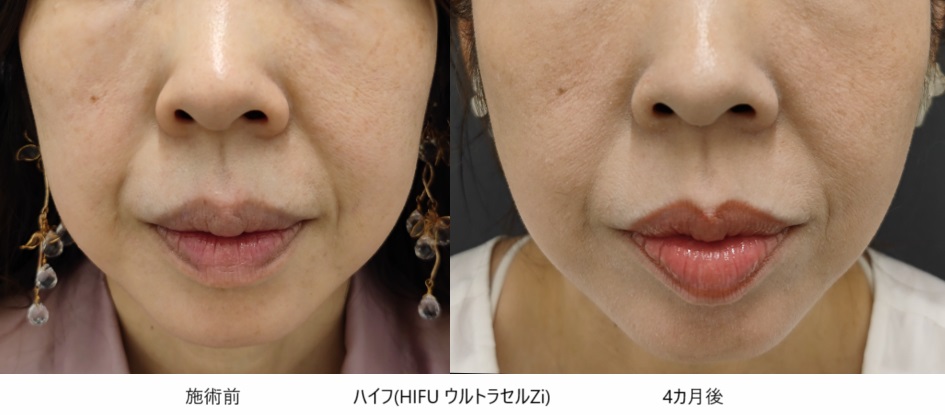
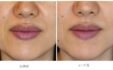
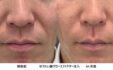
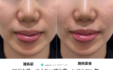
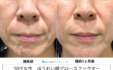
Below is a case example of a patient who underwent HIFU at our clinic.
Case photos make the change easy to understand, but the same irradiation method is not suitable for everyone.
For patients prone to hollow cheeks or those whose main concern is deep nasolabial folds, both the irradiation design and treatment selection must be considered carefully.
See the treatment details and progress for this case
Effects after HIFU treatment
Lifting and tightening effect
HIFU is a treatment designed to tighten sagging and provide a lifting effect.
Some patients feel tightness immediately after treatment, but immediate changes may also include temporary changes in swelling.
After that, fat reduction and heat-induced collagen production gradually progress, and the lifting effect begins to appear over time.
Improvement in firmness and elasticity
HIFU can also improve skin firmness and elasticity by stimulating collagen production through heat.
However, it is not primarily a skin quality improvement treatment. If your main concerns are pores, redness, dullness, or fine wrinkles, RF treatment, skin boosters, water-light injections, Potenza, or Morpheus8 may be more suitable.
If you want to understand the difference from RF treatment, please also refer to DENSITY and the explanation of immediate and long-term effects after Morpheus8 treatment.
Small-face effect
When looseness under the chin or around the facial contour tightens, some patients feel that the face looks smaller.
However, if there is a large amount of fat, strong bone structure influence, or advanced sagging, HIFU alone may not provide sufficient improvement.
Also, if excessive energy is delivered to patients with little cheek fat, the cheeks may look hollow, so careful selection of the treatment area is important.
When HIFU results appear and how long they last
Some patients feel tightening immediately after treatment, but the main changes usually appear gradually around one month later as collagen production and tissue repair progress.
The duration of effect is generally around 3 to 6 months.
However, this varies depending on age, degree of sagging, fat distribution, lifestyle, and irradiation design.
Expected effects of medical body HIFU
Medical body HIFU delivers thermal energy to fat cells in the treated area, aiming for partial slimming and tightening.
It is suitable for localized looseness in areas such as the upper arms, above the knees, waist, and inner thighs.
However, it is not a treatment for significant weight loss.
Body HIFU should be considered a supportive treatment for refining partial body lines rather than a replacement for dieting.
If there is a large amount of fat, oral medications, dietary management, exercise, fat-dissolving injections, or other options may be more appropriate depending on the goal.
Number of HIFU treatment sessions

Facial HIFU is often performed every 3 to 6 months.
However, it is not appropriate to simply deliver strong energy in the same way every time.
It is important to adjust the treatment range and energy output while checking sagging, cheek volume, and the overall facial balance.
Improper irradiation or excessive frequency can make the cheeks look hollow, so at our clinic, we assess the facial condition each time and determine the necessary treatment range.
Number of medical body HIFU sessions
The necessary number of medical body HIFU sessions varies depending on the area and amount of fat.
In general, multiple sessions every 2 weeks to 1 month are performed to aim for partial tightening.
However, suitability depends on body shape and fat distribution, so the number of sessions should be decided after assessing the condition during consultation.
Pain during HIFU treatment

During HIFU treatment, you may feel the following sensations:
- A prickling heat sensation
- A deep aching sensation
- A sensation that resonates against the bone
- A brief heavy or dull feeling depending on the area
Areas close to bone, such as the cheekbones, chin, and forehead, tend to feel more bone-related discomfort.
However, ULTRAcel Zi, which we use at our clinic, allows treatment with relatively less discomfort compared with previous devices.
Many patients tell us that it was less painful than expected, making it easier to receive even for those who are worried about pain.
Of course, pain sensitivity varies from person to person. If the discomfort is strong, we can adjust the energy output or irradiation method during treatment.
Pain after HIFU treatment
After HIFU, some patients feel mild muscle-soreness-like discomfort several days to several weeks later.
This is one of the reactions that may occur as heat-stimulated tissue repairs itself, and in many cases it improves over time.
However, if strong pain, numbness, or sensory abnormalities persist, please consult the medical institution where you received treatment as soon as possible.
Side effects and disadvantages of HIFU

HIFU is a treatment with relatively little downtime, but as it is a medical procedure, side effects are possible.
Although HIFU is a “non-surgical treatment,” it is still a medical treatment that delivers thermal energy into deeper tissues.
Swelling and puffiness
Swelling or puffiness may occur after treatment, but in many cases it settles within a few days to about one week.
In rare cases, a sense of discomfort may last for about one month.
Skin dryness
After treatment, the skin may temporarily become dry due to the effects of heat energy.
Heat can also temporarily reduce the skin barrier function, making the skin more vulnerable to UV damage, so it is important to moisturize well and protect the skin from UV rays.
Redness
Temporary redness may occur after treatment, but in many cases it settles on the same day or within a few days.
If redness is strong or lasts longer than expected, please consult a medical institution.
Burns and blisters
In rare cases, burns or blisters may occur depending on irradiation conditions and skin condition.
We have not experienced severe burns at our clinic to date, but the risk is not zero.
To perform HIFU safely, not only device performance but also anatomical understanding and appropriate energy settings are important.
Numbness or sensory abnormalities due to nerve injury
Because HIFU delivers thermal energy into deeper tissues, numbness or sensory abnormalities may occur if treatment is performed without considering the course of the nerves.
Most cases are temporary, but in rare cases symptoms may persist, so HIFU should be performed carefully at a medical institution.
Hollow cheeks
One of the most important risks to be aware of with HIFU is hollow cheeks.
If excessive energy is delivered to people with little facial fat or naturally thin faces, the result may look hollow and aged rather than tightened.
This is not because HIFU itself is bad, but because the irradiation design does not match the patient’s face.
At our clinic, for patients who are prone to hollow cheeks, we adjust the treatment range and energy output and focus on areas such as the facial contour and under-chin region.
Key points for preventing side effects

HIFU is a medical procedure that delivers thermal energy into deep tissues.
In recent years, burns and nerve injuries caused by HIFU procedures at esthetic salons have become a problem, and Japan’s Ministry of Health, Labour and Welfare has indicated that HIFU irradiation is an act that may cause harm to the human body if not performed by a physician.
Therefore, HIFU should not be chosen based on price alone. It is important to confirm whether the treatment is being performed safely at a medical institution.
The following points are important for preventing side effects:
- Receive treatment at a medical institution
- Confirm suitability under a physician’s consultation
- Assess whether your face is prone to hollow cheeks
- Design irradiation to avoid nerve pathways
- Customize irradiation according to facial structure rather than using a uniform pattern
- Avoid excessively high energy output
At our clinic, we use ULTRAcel Zi and adjust the treatment area, depth, and energy output according to each patient’s facial structure and sagging condition.
People who cannot receive HIFU treatment

People who fall under the following categories may not be able to receive HIFU treatment or may require careful judgment.
- Those who are pregnant
- Those who are breastfeeding
- Those who may be pregnant
- Those with a pacemaker
- Those with metal plates or implants in the treatment area
- Those prone to keloids
- Those with severe dermatitis, infection, or herpes in the treatment area
- Those with severe diabetes or conditions that affect wound healing
- Those with nerve disorders or sensory abnormalities
Also, if you have previously undergone hyaluronic acid injections, thread lifts, fat grafting, gold thread treatment, or similar procedures, the irradiation range may need to be adjusted depending on the treatment area and timing.
If you have any concerns, please consult a physician in advance.
Downtime after HIFU treatment

HIFU generally has a short downtime, and you can usually apply makeup and go home after treatment.
It is a treatment that is easy to receive with minimal impact on daily life. However, some patients may experience redness, swelling, dryness, or muscle-soreness-like discomfort.
If you have an important event coming up, it is safer to receive treatment about one week in advance.
How to spend time after HIFU treatment

Things to be careful about after treatment
- Avoid strong facial massage on the day of treatment
- Avoid long baths and saunas
- Avoid intense exercise and heavy alcohol consumption
- Moisturize thoroughly
- Use sunscreen and protect the skin from UV rays
- Consult the clinic promptly if you feel strong discomfort
After treatment, you may temporarily feel heat or dryness.
UV exposure can also prolong redness or dryness, so it is important to protect your skin with sunscreen, hats, and other UV protection.
Can HIFU alone improve the concern, or is another treatment needed?
HIFU is suitable for tightening sagging and improving the facial contour.
However, if your main concern is nasolabial folds or wrinkles, it is important to determine whether HIFU alone is sufficient.
Especially in cases where nasolabial folds are visible even at rest, hollowness beside the nose is strong, or etched creases are present, HIFU alone may feel insufficient.
In such cases, combining growth factor injections, hyaluronic acid, thread lifts, or other treatments may be more appropriate.
At our clinic, growth factor treatment is one of the main options we consider for nasolabial fold treatment.
Growth factor treatment aims to improve the skin foundation while achieving natural improvement and long-term prevention of wrinkles.
For this reason, we may propose combining HIFU for tightening with growth factor injections or hyaluronic acid for the nasolabial folds.
If you want to compare injection treatments for nasolabial folds, please refer to which injection is best for nasolabial folds? A comparison of growth factor, hyaluronic acid, and Botox.
People who can expect improvement with HIFU alone
- Those whose main concern is facial contour looseness
- Those whose nasolabial folds are still shallow
- Those with relatively full cheeks or heaviness in the lower face
- Those who want to start with an energy-based treatment rather than injections
- Those who want to prevent sagging
People who should also consider other treatments such as growth factor injections or hyaluronic acid
- Those whose nasolabial folds remain visible even at rest
- Those with strong hollowness beside the nose
- Those with etched skin creases
- Those who saw little change in nasolabial folds after HIFU
- Those who want natural, long-lasting improvement
- Those who also want to immediately refine certain areas
HIFU treatment fees
Our HIFU treatment fees vary depending on the treatment area and number of shots.
Please refer to the fee page below for details.
Summary
HIFU is suitable for sagging prevention, tightening the facial contour, and improving mild looseness.
At our clinic, we use ULTRAcel Zi and perform customized irradiation according to each patient’s facial structure and sagging condition.
Because pain and downtime are relatively mild, HIFU is also a treatment that is easy to consider as a first step in sagging care.
On the other hand, deep nasolabial folds, hollowness beside the nose, and etched creases may be difficult to improve sufficiently with HIFU alone.
For this reason, we may propose combining treatments such as growth factor injections, hyaluronic acid, or thread lifts according to the underlying cause.
What matters is not choosing based on trends or price, but determining whether HIFU is suitable for your current facial condition.
HIFU is not suitable for every type of nasolabial fold or wrinkle.
The appropriate treatment changes depending on whether sagging is the main cause, whether the nasolabial folds themselves are deep, or whether reduced skin firmness is the main issue.
At our clinic, we examine your facial condition and propose a suitable treatment plan from options such as HIFU, growth factor injections, hyaluronic acid, and thread lifts. The first step is to understand the cause of your nasolabial folds.
Frequently asked questions
Can I see results with one HIFU treatment?
Some patients feel tightening even after one session, but results vary depending on sagging and fat volume.
Deep nasolabial folds and etched creases are often difficult to improve sufficiently with HIFU alone.
Can HIFU erase nasolabial folds?
HIFU does not completely erase nasolabial folds.
If sagging is making the folds more noticeable, improvement can be expected. However, if etched creases, hollowness beside the nose, or bone structure have a strong influence, treatments such as growth factor injections or hyaluronic acid may be more appropriate.
Can HIFU cause hollow cheeks?
Yes, HIFU can cause hollow cheeks.
Especially when excessive energy is delivered to people with little facial fat or thin faces, the cheeks may appear hollow.
At our clinic, we adjust the treatment range and output according to each patient’s face and perform HIFU with attention to minimizing hollowing.
Is HIFU painful?
Depending on the area, you may feel a prickling sensation or a feeling that resonates against the bone.
However, ULTRAcel Zi is a device that can reduce discomfort relatively well, and if you are worried about pain, we can adjust the energy output during treatment.
Which is better, HIFU or DENSITY?
HIFU and DENSITY are suitable for different purposes.
HIFU tightens deeper layers, while RF treatments such as DENSITY are good at improving skin tightening and firmness.
Therefore, the appropriate treatment depends on whether you want to improve facial contour sagging or also improve skin quality.
Can HIFU and growth factor injections be combined?
HIFU and growth factor injections may be combined depending on the condition.
HIFU is used for tightening, while growth factor treatment is intended to improve the skin foundation. They have different roles.
For patients concerned about both sagging and nasolabial folds, we may consider tightening the contour with HIFU while treating the nasolabial folds with growth factor injections.

Related links
Complete guide to the causes and treatments of nasolabial folds
Why lift-up treatments alone do not solve nasolabial folds
Which injection is best for nasolabial folds? Growth factor, hyaluronic acid, and Botox compared
Growth factor treatment for nasolabial folds: longer-lasting than hyaluronic acid?
DENSITY: a lift-up laser designed to minimize hollowing





 03-6434-7678
 オンライン相談
  来院予約
来院予約