
 電話で予約
 WEB予約
 LINEで予約


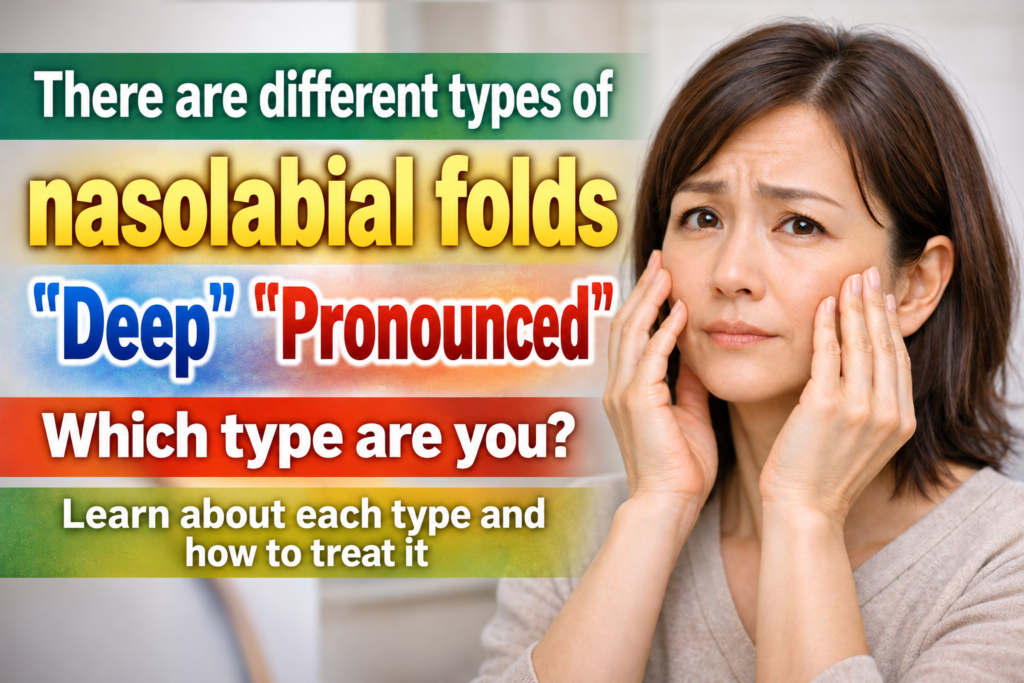
NASOLABIAL FOLD TYPE GUIDE
Nasolabial folds:
“Deep” or “Pronounced” — the treatment differs.
Even when a nasolabial fold looks like a single line, the most suitable treatment depends on what causes it. For some people, a difference in contour between the cheek and mouth creates a shadow. For others, repeated folding has left an etched crease in the skin itself. Many patients have a combination of both. The important first step is not choosing a treatment by name, but identifying what makes the nasolabial fold noticeable.

What You Should Know First
Some patients come to us seeking to improve their nasolabial folds with a particular treatment already in mind.
However, the first thing I assess during a consultation is not whether hyaluronic acid filler or growth factor treatment would be better.
I first determine whether what we see is a shadow caused by a contour difference between the cheek and mouth, an etched crease in the skin, or a combination of both. That is where the assessment begins.
The treatment priorities differ between the Deep Type and the Pronounced Type.
Deep Type
A noticeable contour difference or shadow along the nasolabial fold.
Possible contributing factors include a hollow beside the nose, fuller cheeks, facial fat, and sagging.
Pronounced Type
A distinct line remains in the skin even when the face is relaxed.
Repeated folding during smiling has gradually left an etched crease in the skin.
Combination Type
Both a contour difference or shadow and a persistent crease in the skin are present.
We commonly see this combination in clinical practice.
“Deep” and “Pronounced” are not standardized medical diagnoses.
They are practical classifications used at Houreisen Skin Clinic to help assess each patient’s nasolabial folds and explain treatment options clearly.
Quick Self-Check: Which Type Are You?
It can be difficult to tell just by looking in the mirror. If possible, compare photographs taken in good lighting from the front and at an angle, both with a relaxed expression and while smiling.
Signs to Look For
* This is only a rough guide. It is not a diagnosis based on a full assessment of bone structure, facial fat, skin, expressions, and previous treatment history.
| Appearance | Deep Type | Pronounced Type |
|---|---|---|
| Most noticeable feature | Contour differences, hollows, shadows | Etched creases in the skin |
| With a relaxed expression | Often looks more like a shadow than a distinct line | A fine line remains visible in the skin |
| When smiling | The cheek moves forward, making the contour difference more apparent | The skin folds sharply in the same place |
| Makeup | A shadow may remain without foundation necessarily collecting in the fold | Foundation is more likely to settle along the crease |
| Main treatment focus | Addressing hollows, contour differences, and sagging | Addressing reduced skin firmness and etched creases |
A photograph alone cannot definitively tell us that a shadow calls for hyaluronic acid filler or that a line calls for growth factor treatment.
Even on the same face, the underlying causes may differ between sides—for example, a more pronounced contour difference on the right and a more prominent etched crease on the left.
TYPE DIAGNOSIS
You do not need to choose a treatment
before booking an appointment.
It is perfectly fine if you are unsure whether hyaluronic acid filler or growth factor treatment is right for you. We will first assess the relative contributions of contour changes, shadows, etched creases, and sagging, then explain the options suited to your current condition.
We will never pressure you into treatments you do not need.
What Is the Difference Between “Deep” and “Pronounced”?
Nasolabial folds generally refer to the creases or boundaries extending from the sides of the nose toward the corners of the mouth.
In clinical practice, even when a patient describes their nasolabial folds as “deep,” the feature making them noticeable usually falls into one of two broad categories.
One is the contour difference and shadow created by a difference in height between the cheek and the area around the mouth. The other is an etched crease formed when the skin repeatedly folds along that boundary and eventually remains marked even at rest.
“Deep” refers to a three-dimensional contour difference. “Pronounced” refers to how strongly a crease is etched into the skin.
Deep Type is influenced mainly by facial anatomy, hollows beside the nose, cheek fullness, and sagging.
Pronounced Type is often associated with repeated facial movements and reduced skin firmness.
In practice, three-dimensional contour changes and etched skin creases often occur together.
For more information about classifications based on fold shape, including other patterns, see Types of Nasolabial Folds and How to Address Them.
Deep Type: Nasolabial Folds Defined by Contour Changes and Shadows
The Deep Type features a difference in contour along the nasolabial fold that creates a visible shadow.
Patients may describe this as “The area between my nose and cheek looks dark rather than having a clear line” or “The groove looks deep when viewed from an angle.”


Common Contributing Factors for the Deep Type
When the bone around the base of the nostril is set farther back, a shadow is more likely to form beside the nose.
Greater cheek volume can create a height difference between the cheek and the area around the mouth.
As cheek tissues descend and overlap the nasolabial fold, the contour difference may become more noticeable.
When nasolabial folds have been noticeable from a young age, facial anatomy and cheek shape may contribute more than aging.
Even younger patients may have prominent Deep Type nasolabial folds because of their facial structure or cheek fullness.
With this type, a three-dimensional shadow alone can make the face appear older, even without a crease etched into the skin.
An important precaution with the Deep Type is to avoid simply injecting a large amount of filler directly into every visible fold.
Without determining whether the main cause is the bone structure beside the nose, cheek fullness, or sagging, injections may add volume around the fold while leaving the original contour difference in place, potentially creating an unnatural appearance.
If facial anatomy is a major factor, see Facial Features That Make Nasolabial Folds More Noticeable.
For hollows beside the nostrils, read Hollows Beside the Nose and Upper Nasolabial Folds for a more detailed explanation.
Pronounced Type: Etched Creases in the Skin
The Pronounced Type is characterized less by the size of a contour difference or shadow and more by a distinct line that remains in the skin itself.
At our clinic, we use the term “etched crease” to describe a wrinkle that develops as the same area repeatedly folds during smiling and gradually stops smoothing out completely.

If a line remains for a while after you smile, becomes more noticeable toward evening, or catches foundation, the etched-crease component may be prominent.
Common Contributing Factors for the Pronounced Type
Smiling, talking, and other movements repeatedly fold the skin in the same place over many years.
Aging and UV exposure can reduce skin elasticity, making folded skin less able to return to its original shape.
Fine lines tend to show more clearly in thin skin, and dryness may temporarily accentuate them.
Loss of fat or underlying structural volume may leave excess skin that folds more easily.
For the Pronounced Type, hyaluronic acid filler alone may not fully smooth out the line.
Although filler can restore surrounding volume, an etched crease in the skin itself may still remain.
This does not mean hyaluronic acid filler cannot be used for the Pronounced Type. If contour differences or structural hollows are also present, combining filler with other treatments may be appropriate.
If makeup settles into your lines, see Why Foundation Settles into Nasolabial Folds.
For more on etched creases, read Causes of Etched Nasolabial Creases and Treatment Options.
The Combination Type Is Also Common
Although we have described the Deep Type and Pronounced Type separately, not everyone fits neatly into just one category.
In clinical practice, many patients have both a contour difference beside the nose or cheek and an etched crease in the skin along that boundary.

Even in your 20s or 30s, a natural structural hollow combined with thin skin or habitual facial movements may make Combination Type nasolabial folds more noticeable.
From the 40s onward, factors such as facial structure, reduced skin firmness, descent of facial fat, and sagging may overlap, leading to a combination pattern over time.
For the Combination Type, it is important not to expect a single treatment to address every contributing factor.
We consider which issue should be addressed first—etched creases, hollows beside the nose, cheek contour differences, or sagging—and may recommend treatment in stages.
For folds that extend toward the corners of the mouth, see Causes of Long Nasolabial Folds and How to Improve Them.
If you are concerned about differences between the two sides of your face, see Asymmetrical Nasolabial Folds.
What Happens When Treatment Does Not Match the Cause?
A treatment is not necessarily ineffective in itself. However, if it does not address the main cause of the concern, the results may fall short of expectations.
Even if skin firmness improves, a structural hollow or major contour difference may remain, leaving the shadow largely unchanged.
The surrounding area may become fuller while the etched line remains, leaving the patient feeling that “the wrinkle is still there despite the injections.”
Multiple treatments or excessive filler in a single session can add more volume than necessary, potentially creating an unnatural look.
Results depend not only on the treatment itself, but also on diagnosis, treatment sequence, injection volume, and follow-up assessment.
At our clinic, we prioritize natural-looking improvement by providing only the treatments and amounts needed, rather than trying to erase everything in one session.
How to Choose Nasolabial Fold Treatment by Type
Treatment options for nasolabial folds include growth factor injections, hyaluronic acid fillers, and thread lifts.
Rather than asking which treatment is universally best, the key is understanding the different role each one plays.
Growth Factor Treatment
This treatment aims to stimulate collagen and elastin production in the skin, gradually improving etched nasolabial creases for a natural-looking result.
- Most suitable considerations
- Pronounced Type, Combination Type with etched creases, and patients who prioritize natural-looking results and long-term follow-up
- Potential benefits
- Rather than adding immediate volume, the treatment aims to improve the condition of the skin gradually over time.
- Important considerations
- Results are not immediate. At our clinic, we generally perform the final follow-up assessment at around six months. There is no specific enzyme that can dissolve the treatment.
Hyaluronic Acid Filler
This treatment adds only the volume needed to address structural hollows beside the nose or contour differences with the cheeks, providing a more immediate improvement in shadows and facial contours.
- Most suitable considerations
- Deep Type, hollows beside the nose, distinct contour differences, and patients seeking an immediate change in shape
- Potential benefits
- Changes are often visible immediately after treatment, and hyaluronidase may be considered to dissolve the filler if necessary. However, complete restoration of the original condition cannot be guaranteed.
- Important considerations
- If an etched crease is pronounced, the line in the skin may remain even after volume is added.
Thread Lift
A thread lift aims to reposition sagging cheek tissue and reduce the weight of tissue overlapping the nasolabial folds.
- Most suitable considerations
- Patients with significant cheek sagging who are concerned about the mouth area or facial contour as well as nasolabial folds
- Potential benefits
- May help improve the overall appearance from the cheeks to the jawline, not just the nasolabial folds
- Important considerations
- A thread lift alone may not fully address structural hollows beside the nose or etched creases in the skin.
To compare injectable treatments, see Growth Factors vs. Hyaluronic Acid vs. Botox for Nasolabial Folds.
To compare recovery and downtime, see Downtime Comparison: Growth Factors, Hyaluronic Acid, and Thread Lifts.
Houreisen’s Dual Approach for the Combination Type
When both etched creases and contour differences are present, we may first use growth factor treatment to improve the skin, assess the final results, and then add a small amount of hyaluronic acid filler if necessary.

Improve the skin first, then restore only the volume needed
We first address etched creases with growth factor treatment. If structural hollows or contour differences remain afterward, we consider using the minimum necessary amount of hyaluronic acid filler.
We believe this staged approach can make it easier to aim for a natural appearance while avoiding excessive filler from the outset.
However, we do not use the same treatment sequence for everyone with the Combination Type. When sagging is significant, a thread lift or another treatment may be considered first.
Real Cases: Growth Factor Treatment for Nasolabial Folds
These case photographs are provided not to guarantee outcomes, but to help you understand the kinds of changes treatment aims to achieve.
Even when patients have similar nasolabial folds, the contributions of contour differences, etched creases, sagging, and facial asymmetry vary from person to person.

Naturally improve nasolabial folds without dramatically changing facial features
Male patients often tell us that they look tired or older than their age. This case aimed to soften the appearance of the nasolabial folds naturally without changing the overall character of the face.
View the Full Case Details and Progress →
Address etched creases even when sagging is also present
Growth factor treatment may be an option for patients with sagging when reduced skin firmness or etched creases are also prominent. Because it does not address every aspect of sagging, other treatments may be considered when necessary.
View the Full Case Details and Progress →View More Growth Factor Treatment Cases for Nasolabial Folds →
* Case photographs do not guarantee results. Treatment outcomes, the number of sessions required, recovery, and duration of results vary from person to person.
What I Assess During a Consultation
I assess the relative contributions of the causes before choosing a treatment.
Nasolabial folds are not always caused by just one factor. Skin, bone structure, fat, facial muscles, and sagging can all play a role.
During consultations, I generally check the following, in this order:
- Whether a line remains when the face is relaxed
- Whether a contour difference or shadow is visible from an angle as well as from the front
- Whether there is a structural hollow beside the nose
- How the cheeks move while smiling and where the skin folds
- How cheek fullness, facial fat, sagging, asymmetry, and previous filler treatments contribute to the appearance
Based on these observations, I decide whether to address etched skin creases first, restore volume to structural hollows, or prioritize treatment for sagging.
My goal is not simply to have patients undergo growth factor treatment. For some people, hyaluronic acid filler may be more appropriate; others may benefit from a thread lift or a combination of treatments.
What matters is understanding whether your folds are closer to the Deep, Pronounced, or Combination Type, and which concern should take priority, before deciding on treatment.
Dr. Shinya Sasagawa, Representative of Shingetsukai Medical Corporation
OSAKA / TOKYO / NAGOYA
Before deciding “Which treatment should I choose?”,
let’s identify what is causing the concern.
Treatment priorities differ for the Deep, Pronounced, and Combination Types. If any of the following sounds familiar, I recommend identifying the causes before selecting a procedure.
You are not sure whether hyaluronic acid filler or growth factor treatment is right for you
You are concerned about both hollows beside the nose and lines etched into the skin
Nasolabial folds remain visible longer after smiling than they used to
You have had treatment before, but the shadows or lines did not change as much as expected
You are concerned not only about nasolabial folds, but also about sagging cheeks or the entire mouth area
You are welcome to consult us even if you are still deciding whether to undergo treatment. We will listen to your concerns and goals, then explain only the options that may be appropriate.
During an online consultation, we can review photographs and explain possible contributing factors and potential treatment approaches.
Summary
At Houreisen Skin Clinic, we distinguish between the “Deep Type,” in which contour differences and shadows are most noticeable, and the “Pronounced Type,” in which a crease is etched into the skin.
For the Deep Type, treatment needs to account for three-dimensional features such as structural hollows beside the nose, cheek fullness, facial fat, and sagging.
For the Pronounced Type, repeated folding during facial expressions and reduced skin firmness play a role, so improving the condition of the skin is an important consideration.
Many patients have the Combination Type, with both shadows and etched creases. Growth factor injections, hyaluronic acid fillers, thread lifts, and other approaches should therefore be selected according to the causes and treatment goals.
Rather than choosing a treatment by name alone, identifying what makes your nasolabial folds noticeable is important for reducing the risk of unnatural-looking results or unmet expectations.
Frequently Asked Questions
Can I tell whether I have the Deep Type or the Pronounced Type myself?
If contour differences or shadows are most noticeable, you may have the Deep Type. If a distinct line remains in the skin even when your face is relaxed, the Pronounced Type may be more likely. However, many people have a combination of both, and the contributing factors may differ between the left and right sides. A self-check can help, but a clinical examination is needed to determine the most appropriate treatment.
Does the Deep Type always require hyaluronic acid filler?
Not necessarily. Hyaluronic acid filler may produce a more visible change when the main cause is a structural hollow beside the nose or a significant contour difference. However, when etched creases or reduced skin firmness are also present, combining it with growth factor treatment or other approaches may help achieve a more natural result.
Is hyaluronic acid filler ineffective for the Pronounced Type?
Not at all. Filler can be useful when surrounding hollows or contour differences are also present. However, if a crease is etched into the skin itself, adding volume alone may leave the line visible. Treatment aimed at the skin may also need to be considered.
Which treatment should come first for the Combination Type?
It depends on which factors are most significant. When etched creases are prominent, our clinic may first use growth factor treatment to improve the skin, assess progress at around six months, and then add a small amount of hyaluronic acid filler if needed. If sagging is significant, a thread lift or another treatment may be considered first.
Can I have treatment even if my nasolabial folds are still faint?
In some cases, yes. People in their 20s and 30s sometimes consult us because they are concerned that faint folds may become more noticeable in the future. However, treatment cannot be guaranteed to prevent future progression. Changes may also be less noticeable when folds are mild, so we assess the expected benefits and whether treatment is necessary at this stage before making a recommendation.
Can a thread lift alone eliminate nasolabial folds?
If sagging cheeks are the main cause, a thread lift may help reduce the appearance of nasolabial folds. However, a thread lift alone may leave structural hollows beside the nose or creases etched into the skin. In such cases, we may consider combining it with injectable treatments.
Related Articles
- What Causes Nasolabial Folds?
- Classification of Nasolabial Folds by Shape and Treatment Options
- Causes of Etched Nasolabial Creases and How to Improve Them
- Hollows Beside the Nose and Upper Nasolabial Folds
- Comparing Injectable Treatments for Nasolabial Folds
- Growth Factor Treatment for Nasolabial Folds
- What to Know Before Growth Factor Treatment to Avoid Regrets
- How to Choose the Right Nasolabial Fold Treatment for You







 03-6434-7678
 オンライン相談
 来院予約