
 電話で予約
 WEB予約
 LINEで予約


Written and Medically Reviewed by: Dr. Shinya Sasagawa
President of Shingetsukai Medical Corporation
Aesthetic Dermatologist
Houreisen Skin Clinic – Osaka, Tokyo, and Nagoya
“My nasolabial folds remain visible for a while after I smile.”
“My smile lines used to disappear as soon as I stopped smiling, but recently they seem to linger.”
These are concerns that patients sometimes bring to us during consultations.
It is completely natural for nasolabial folds, also known as smile lines, to become more pronounced when smiling. However, if you have noticed that your smile lines remain more visible after smiling than they used to, factors such as reduced skin firmness and elasticity or sagging cheeks may be contributing.
Having treated many patients with nasolabial fold concerns, I assess not only the appearance of the folds while smiling, but also how they look after the facial muscles relax and the face returns to a neutral expression.
In this article, I will explain why nasolabial folds may remain visible after smiling, how to check their condition yourself, and what treatments may help improve them. I will also introduce actual patient cases from our clinic.
Is It Normal for Nasolabial Folds to Deepen When Smiling?
When you smile, your cheeks lift, making the nasolabial folds extending from the sides of your nose toward the corners of your mouth more noticeable. This is a natural facial movement seen even in children and young adults. Having visible smile lines while smiling does not necessarily mean that treatment is needed.
However, even when people smile in a similar way, the appearance of their nasolabial folds can differ depending on facial bone structure, cheek volume, and facial asymmetry. For some people, the folds become less noticeable as soon as they stop smiling. For others, the creases remain visible even after returning to a neutral expression. At our clinic, we examine the folds both at rest and while smiling, and ask patients which areas they would like to improve.
Why Do Nasolabial Folds Remain Visible After Smiling?
1. Loss of Skin Firmness and Elasticity
When you smile, the muscles in your cheeks and around your mouth move, causing the overlying skin to fold and making the nasolabial folds deeper.
Smile lines that were barely noticeable after smiling when you were younger may gradually become more visible with age. One possible reason is a decline in skin firmness and elasticity.
Collagen and elastin are important components of the skin that help maintain its firmness and elasticity. Aging and ultraviolet exposure can gradually affect the amount and structure of these components.
Think about what happens when you fold a piece of paper. Even after unfolding it, a crease remains.
The same concept can help explain why nasolabial folds sometimes remain visible after smiling. As the skin loses firmness and elasticity, lines that previously disappeared when the face relaxed may become more likely to remain, much like a crease in folded paper.
In addition, dry skin can make fine lines appear more noticeable.
2. Sagging Cheeks
As we age, the skin of the cheeks can become looser, and the underlying cheek fat may gradually shift downward. This can cause the cheek tissue to overlap the nasolabial folds.
As a result, the folds may become deeper when smiling and remain more noticeable even after smiling.
In clinical practice, many patients have nasolabial folds that are influenced not only by creases within the skin but also by sagging of the cheeks. In some cases, both loss of skin elasticity and cheek sagging contribute to the appearance of the folds.
Therefore, identifying the underlying causes is important when considering how to improve nasolabial folds that remain visible after smiling.
Learn More About the Causes and Types of Nasolabial Folds
How to Check Nasolabial Folds That Remain After Smiling
Take a moment to examine your nasolabial folds in the mirror. We recommend observing your face in the following three conditions.
1. When Your Face Is Relaxed
First, relax the muscles around your mouth and observe your face in its natural resting position. If your nasolabial folds are clearly visible even at rest, factors such as established skin creases or sagging cheeks may be involved.
2. While Smiling
Next, smile as you normally would. Notice which parts of your nasolabial folds become deeper and whether there is any difference between the left and right sides. Nasolabial folds becoming more pronounced only while smiling is not abnormal in itself.
3. After You Stop Smiling
Relax the muscles around your mouth again and return to your usual neutral expression. The important point is to compare the appearance of your folds with how they looked before you smiled.
| Appearance of Nasolabial Folds | Possible Explanation |
|---|---|
| The folds deepen only when smiling and are barely noticeable at rest. | These may be natural nasolabial folds associated with facial expressions. |
| Fine lines remain visible after smiling. | Reduced skin firmness and elasticity or dryness may be contributing factors. |
| The nasolabial folds are clearly visible even when the face is relaxed. | Established skin creases or sagging cheeks may be contributing. |
If you would like to compare your smile lines using your smartphone, try taking three photographs: (1) with your face relaxed, (2) while smiling naturally, and (3) after smiling, once your facial muscles have relaxed. Taking the photographs under similar lighting, from the same angle and distance, will make the differences easier to assess. If you find it difficult to reproduce a particular expression during your consultation, showing us photographs taken in everyday situations can also be helpful.
Can You Improve Smile Lines That Remain After Smiling at Home?
The first steps we recommend are proper moisturizing and protection against ultraviolet (UV) exposure.
If fine lines are becoming more noticeable because of dry skin, regular moisturizing may help reduce their appearance. UV exposure can also damage collagen and other skin components, contributing to wrinkles and sagging over time.
We recommend using sunscreen regularly and maintaining consistent UV protection.
However, moisturizing and sun protection alone are unlikely to significantly improve deeply established nasolabial folds or pronounced cheek sagging.
There is also no need to avoid smiling or force yourself to change your facial expressions simply because you are concerned about smile lines. Being able to smile naturally is important, too.
Medical Aesthetic Treatments for Nasolabial Folds That Remain After Smiling
In aesthetic medicine, treatment options are selected according to the underlying causes of the nasolabial folds.
At our clinic, we assess not only the patient’s face at rest but also how the nasolabial folds appear when smiling gently and when smiling broadly. This is because even if the nasolabial folds become less noticeable, we do not consider the result satisfactory if the patient’s smile looks unnatural.
1. Botox for Nasolabial Folds Caused by Strong Facial Muscle Movement
Botox is a treatment that temporarily reduces muscle activity to improve expression-related wrinkles.
One reason nasolabial folds become deeper while smiling is the movement of the muscles around the mouth and cheeks. By adjusting the activity of these muscles, Botox may help reduce the appearance of nasolabial folds that deepen during smiling in selected patients.
Since facial muscle movement and smiling patterns vary from person to person, we observe patients while they smile and assess which muscles are involved before considering treatment.
However, depending on the injection site and dosage, Botox can cause difficulty smiling or facial asymmetry. We therefore carefully adjust treatment with the aim of preserving a natural smile.
Actual Patient Case | Woman in Her 30s (Growth Factor Injections + Botox)
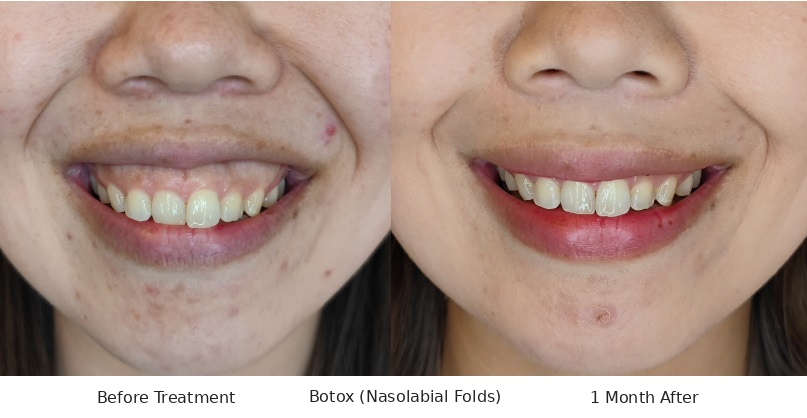
This case features a woman in her 30s who received a combination of growth factor injections and Botox.
Before treatment, her nasolabial folds became particularly noticeable when smiling, and she also had a gummy smile. After treatment, improvements were observed in both the appearance of her nasolabial folds while smiling and the visibility of her gums.
In this case, growth factor injections were used to address the nasolabial folds themselves, while Botox was used to adjust muscle movement during smiling. By combining these two treatments, we aimed to achieve a more natural-looking improvement.
View the Treatment Details and Progress of This Case
We have also treated women in their 20s who were concerned about nasolabial folds while smiling using a combination of growth factor injections and Botox when facial muscle activity was a contributing factor. See the before-treatment and 3-month smile comparison of a woman in her 20s who received combination treatment. The changes seen in this case reflect the combined treatment and should not be interpreted as the effects of Botox alone.
Treatment Details, Current Standard Pricing, and Potential Risks
Treatment: Combination of growth factor injections and Botox injections for nasolabial folds.
Current Standard Pricing: Growth factor injections for both sides: ¥180,000 (tax included). Nasolabial fold Botox for both sides: ¥13,000 (tax included). The actual total cost varies depending on the injection areas and number of treatments. These prices do not represent the amount paid by this patient at the time of treatment.
Main Risks and Side Effects: Growth factor injections may cause pain, swelling, bruising, discomfort, asymmetry, or uneven skin texture. Botox may cause pain, swelling, bruising, changes in facial expression, difficulty smiling, reduced mobility around the mouth, or asymmetry.
The effects of Botox generally last approximately 3–6 months.
Learn More About Botox Treatment for Nasolabial Folds When Smiling
2. Growth Factor Injections for Nasolabial Folds That Remain in the Skin
Growth factor injections may be recommended for patients who have developed fine nasolabial fold lines that remain visible after smiling, particularly when reduced skin firmness and elasticity are contributing factors.
Growth factor treatment aims to gradually reduce the appearance of nasolabial folds by stimulating the production of collagen and other components within the skin. Unlike hyaluronic acid fillers, which can produce noticeable changes immediately after injection, growth factor treatment is intended to provide gradual, natural-looking improvement over time.
At our clinic, treatment is usually performed in one session, and we generally assess the results over approximately six months.
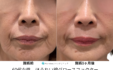
Actual Patient Case | Woman in Her 30s, Case 43 (Growth Factor Injections)
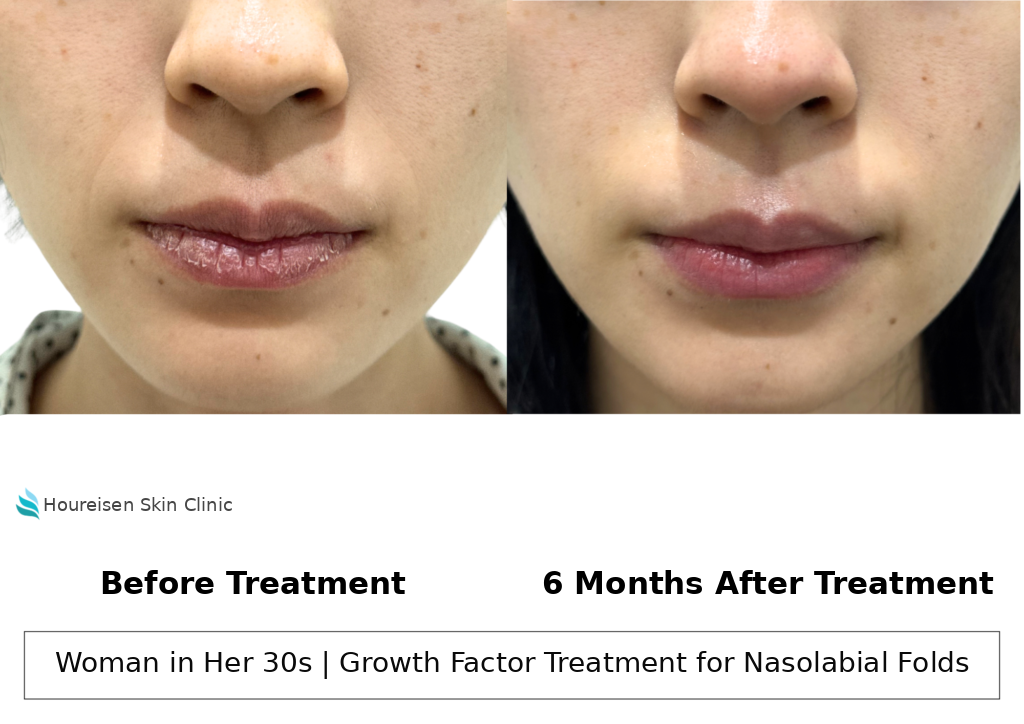
This case features a woman in her 30s who had been concerned about her nasolabial folds since her teenage years and visited our clinic seeking natural-looking improvement.
Before treatment, her nasolabial folds were visible even with a neutral facial expression. Comparing the photographs taken before treatment and six months afterward, the nasolabial folds on both sides appear less pronounced.
The photographs shown here compare the patient’s face at rest, without smiling. They do not directly demonstrate changes in her smile, but this case provides a useful reference when considering wrinkles that remain visible after smiling.
At our clinic, growth factor treatment is customized to each patient’s nasolabial folds. We carefully adjust the formulation, concentration, injection volume, injection placement, and treatment design according to the individual patient’s condition.
Rather than using a uniform approach, we provide personalized treatment tailored to each patient.
View This Patient’s Progress: Before Treatment, 1 Month, 3 Months, and 6 Months
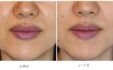
Smile Comparison | Woman in Her 20s (Growth Factor Injections – 6 Months After Treatment)
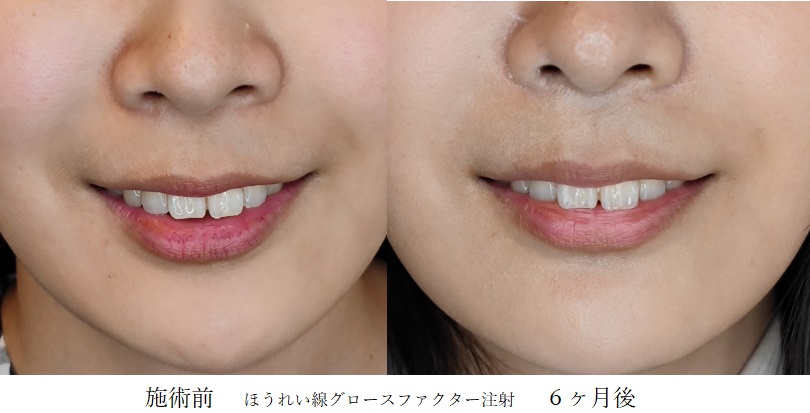
This patient was a woman in her 20s whose nasolabial folds were relatively shallow at rest, but who was concerned about their appearance when smiling. She received growth factor treatment, and the photographs taken six months later show that her nasolabial folds were less noticeable even while smiling. Botox was not used in this case.
View the Treatment Progress of This Woman in Her 20s Through 6 Months
Smile Comparison | Woman in Her 50s (Growth Factor Injections – 3 Months After Treatment)
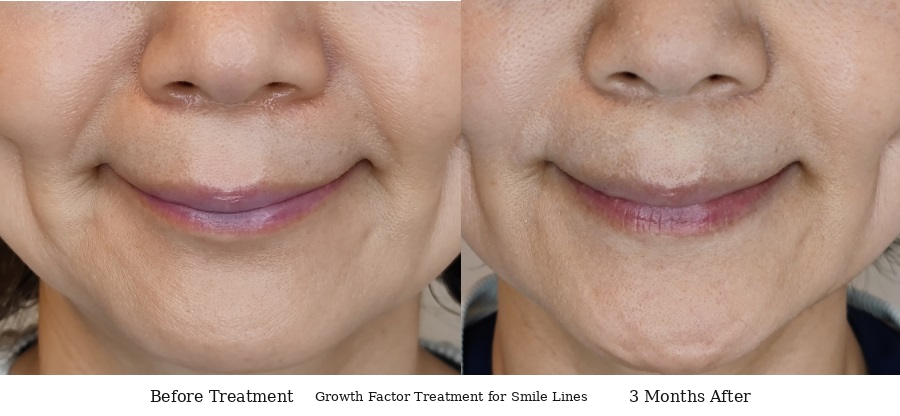
This case features a woman in her 50s with relatively full and sagging cheeks, which made her nasolabial folds appear deeper. Three months after treatment, improvement was observed not only when her face was relaxed but also when she smiled. However, when cheek sagging is pronounced, there may be limitations to how much improvement can be achieved through nasolabial fold injections alone.
View This Woman’s Treatment Progress Through 3 Months
When there is significant facial asymmetry, we carefully assess the differences in the depth of the folds and depressions on each side before adjusting the injections. You may also find it helpful to review this case of a woman in her 50s with a more prominent right nasolabial fold and dimple .
Treatment Details, Current Standard Pricing, and Potential Risks
Treatment: Growth factor injections for nasolabial folds (usually one treatment session).
Current Standard Pricing: ¥180,000 for both sides or ¥110,000 for one side (tax included).
Main Risks and Side Effects: Pain, swelling, bruising, discomfort, asymmetry, and uneven skin texture. Treatment results and recovery vary between individuals.
Learn More About Growth Factor Treatment
3. Hyaluronic Acid Fillers for Nasolabial Folds Visible Even at Rest
Hyaluronic acid injections may be an effective option for patients whose nasolabial folds are clearly visible even when they are not smiling.
Hyaluronic acid fillers are injected into areas with depressions or volume loss to reduce the appearance of nasolabial folds. One of their main advantages is that noticeable improvement can often be seen immediately after treatment.
However, injecting larger amounts of hyaluronic acid does not necessarily produce a more natural or attractive result. Excessive filler can lead to unnatural fullness. Therefore, we carefully adjust the injection sites and volume according to the depth of the folds, facial asymmetry, and the balance of surrounding facial features.
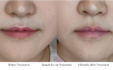
Woman in Her 30s | Smile Comparison: Before Treatment / 2 Weeks After Hyaluronic Acid Injections


View the Treatment Details and Progress of This Case
Treatment Details, Current Standard Pricing, and Potential Risks
Treatment: Hyaluronic acid filler injections for nasolabial folds.
Current Standard Pricing: ¥77,000 for the first syringe; ¥69,800 per additional syringe (tax included).
Main Risks and Side Effects: Pain, swelling, bruising, asymmetry, uneven skin texture, infection, and vascular complications. The number of syringes required, treatment results, and duration of effects vary from person to person.
Learn More About Hyaluronic Acid Filler Injections
4. Skin Tightening and Lifting Treatments for Significant Cheek Sagging
When cheek sagging is pronounced and the cheek tissue overlaps the nasolabial folds, we may also consider treatments such as HIFU, DENSITY, or thread lifts.
These treatments primarily aim to tighten or lift the skin. However, they do not directly treat creases that have already formed within the skin. Therefore, even if cheek sagging improves after lifting treatment, the nasolabial folds may still remain visible.
We assess the degree to which cheek sagging contributes to the appearance of the folds before recommending a suitable treatment.
Learn Why Nasolabial Folds May Remain Even After a Facelift or Lifting Treatment
Frequently Asked Questions
Q. Can Nasolabial Folds That Remain After Smiling Be Improved?
The appropriate treatment depends on what is causing the nasolabial folds to remain visible.
If fine lines are mainly caused by dryness, moisturizing may help make them less noticeable. However, deeply established wrinkles are unlikely to improve significantly through skincare alone.
In such cases, medical aesthetic treatments such as growth factor injections may be considered. If cheek sagging or facial muscle activity is contributing to the folds, different treatment options may be recommended according to the individual patient’s condition.
Q. Can I Prevent Nasolabial Folds by Avoiding Smiling?
There is no need to stop yourself from smiling simply because you are concerned about nasolabial folds.
It is natural for nasolabial folds to deepen when smiling. We recommend starting with regular moisturizing and UV protection. If you already have wrinkles that concern you, consider treatment options that are appropriate for your individual skin and facial condition.
Concerned About Smile Lines That Remain After Smiling?
If your nasolabial folds have started to remain visible after you smile, you may worry that they will continue to become deeper over time.
The most important step is understanding why your nasolabial folds have become more noticeable. At our clinic, we evaluate not only your usual facial expression but also how your folds appear while smiling and after your facial muscles relax. Based on these findings, we discuss suitable treatment options.
I believe that preserving a patient’s natural smile is just as important as reducing the appearance of their nasolabial folds.
“My smile lines remain visible after I stop smiling.”
“My nasolabial folds have become more noticeable than before.”
“I want to improve my smile lines as naturally as possible.”
If you have any of these concerns, please feel free to contact us for a consultation.
Book a Consultation or Treatment
Related Articles
- How to Treat Wrinkles That Remain After Smiling: Smile Lines vs. Nasolabial Folds
- How Can I Improve My Nasolabial Folds? Where Should I Start?




 03-6434-7678
 オンライン相談
 来院予約