
 電話で予約
電話で予約 WEB予約
WEB予約
 LINEで予約



“My makeup looks great in the morning, but by the afternoon, foundation has settled into my nasolabial folds. What can I do?”
We occasionally receive questions like this.
In short, if the main causes are the amount of foundation you are applying or skin dryness, simply adjusting your application technique and skincare routine may make the problem much less noticeable.
On the other hand, if lines or shadows along the nasolabial folds remain even after you remove your makeup, moisturize, and relax your face, changing foundation alone may not be enough to resolve the issue.
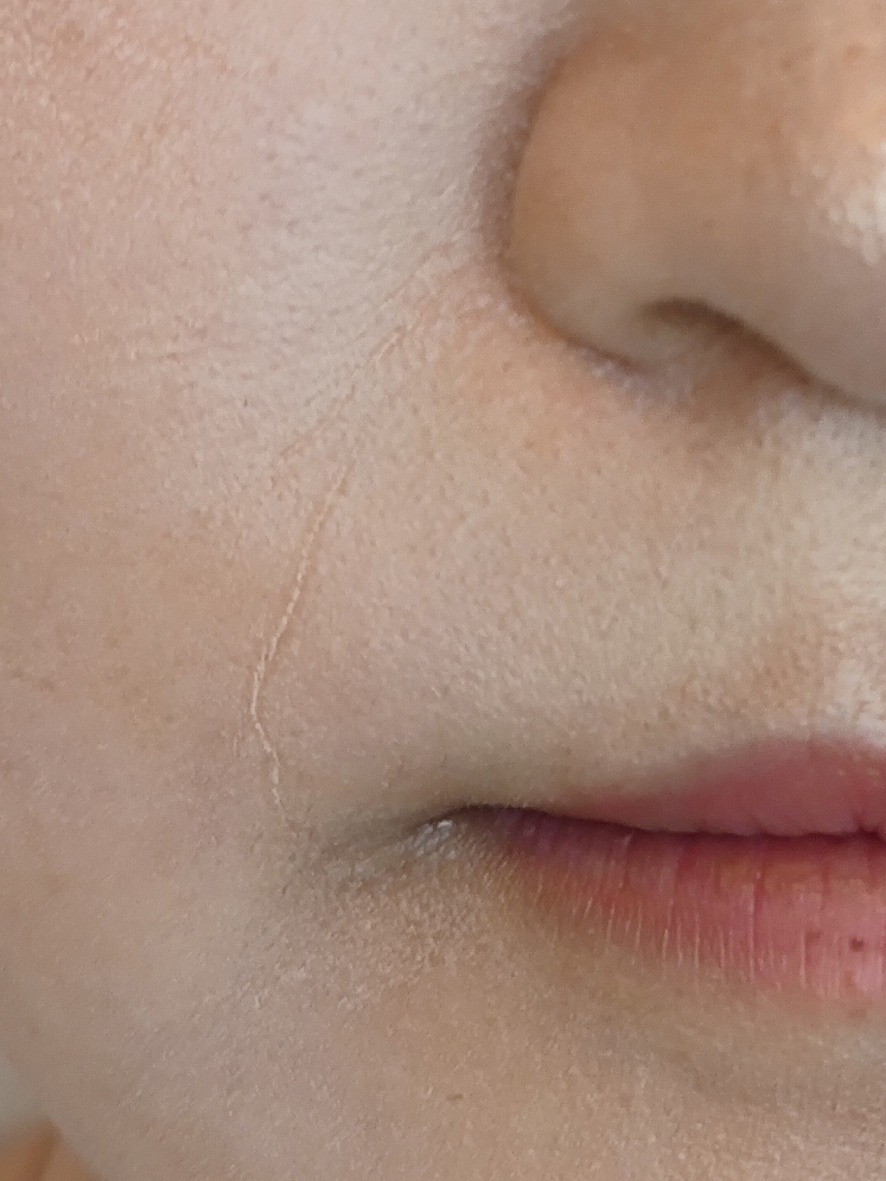
When foundation collects in the crease, nasolabial folds can appear deeper and more defined than they actually are.
What You Will Learn in This Article
目次
- 3 Reasons Foundation Settles into Nasolabial Folds
- How to Prevent Makeup from Creasing in Nasolabial Folds Starting Today
- How to Tell Whether It Is a Makeup Issue or a Wrinkle That Remains at Rest
- What Self-Care Can and Cannot Do
- Choosing Treatment Based on Where Foundation Collects Along the Nasolabial Fold
- Frequently Asked Questions About Nasolabial Folds and Foundation
- References
- Summary | First Determine Whether the Main Issue Is Makeup or an Underlying Wrinkle or Depression
3 Reasons Foundation Settles into Nasolabial Folds
1. Too Much Foundation Is Being Applied to an Area That Moves with Facial Expressions

The nasolabial fold area bends repeatedly when you talk, eat, and smile. Even if your makeup looks smooth in the morning, movement around the mouth can gradually push foundation into the crease.
If you keep layering foundation in an attempt to hide the folds, the base makeup becomes thicker and may actually make the crease look more obvious. Around the mouth, try using only the small amount of product left on your sponge after applying foundation to the rest of your face.
For step-by-step application tips, see our guide to makeup techniques for concealing nasolabial folds.
2. Dryness Is Preventing Foundation from Adhering Evenly
When the skin is dry and the stratum corneum becomes disrupted, foundation is less likely to sit evenly on the surface and can collect more easily in fine lines and creases.
After cleansing, apply your usual moisturizer and allow it to absorb before building your base makeup in thin layers. If excess oil or moisturizer remains on the skin, gently press with a tissue rather than rubbing before applying makeup. This can help prevent the base from becoming too thick.
For everyday care such as moisturizing and sun protection, you may also find our guide to nasolabial fold prevention and self-care helpful.
3. Lines or Depressions Remain Even After Makeup Is Removed
If a crease remains when your face is relaxed even after removing foundation, the skin may have developed a persistent fold line. Foundation may also collect at the border of a depression beside the nose or where fuller cheek tissue creates a step in the facial contour.
Nasolabial folds are influenced by multiple factors, including the skin, facial fat, bone structure, and facial movement. For that reason, two people with similar-looking folds may not benefit from the same approach.
For more information about lines that have become etched into the skin, see our article on the causes and treatment of etched nasolabial fold wrinkles.
Foundation settling into the folds does not automatically mean that treatment is necessary. The important first step is to distinguish between a makeup issue, dryness, and a wrinkle or depression that remains even when your face is relaxed.
How to Prevent Makeup from Creasing in Nasolabial Folds Starting Today
Instead of adding more foundation, start by reducing the amount of product that remains directly over the nasolabial folds.
Let moisturizer absorb before applying makeup
If a large amount of moisturizer is still sitting on the skin, your base makeup is more likely to shift. Give it time to settle into the skin rather than rubbing or rushing the process.
Do not add fresh foundation directly onto the nasolabial folds
After applying foundation to the cheeks and forehead, use only the small amount left on the sponge around the mouth. Avoid trying to “fill in” the crease with a thick layer of product.
Move your mouth once, then blend away only the product that has collected in the crease
As a finishing step, make a light facial expression and gently blend any foundation that has gathered in the nasolabial fold with a sponge.
Do not keep layering product over makeup that has already creased
During the day, first remove or redistribute excess product with a tissue or sponge, then add only a very thin layer where needed.
How to Tell Whether It Is a Makeup Issue or a Wrinkle That Remains at Rest
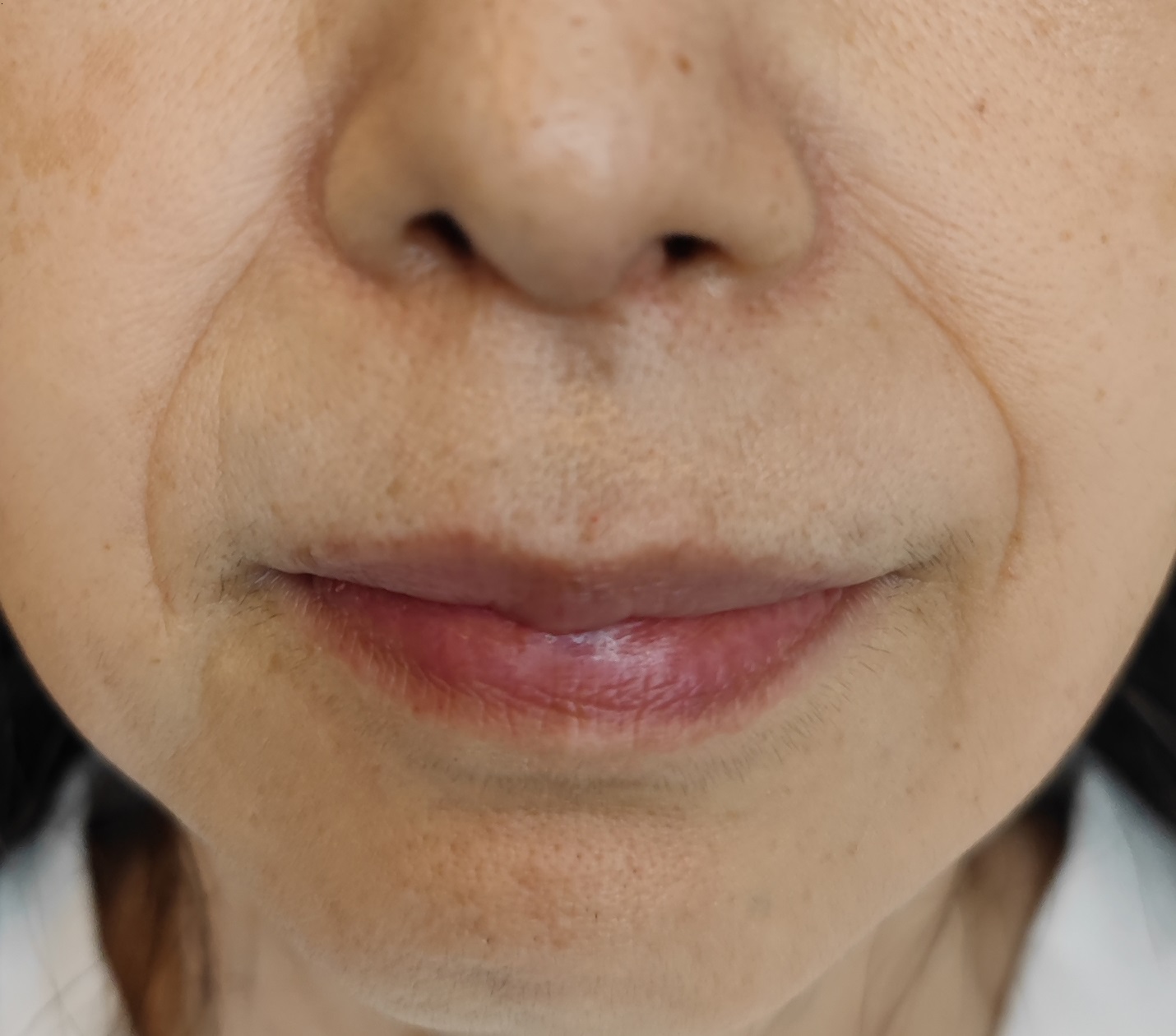
The following is not a diagnostic test, but it can help you decide whether to focus on your makeup routine or consider discussing the issue with a doctor.
Remove your makeup and moisturize as usual
It can be difficult to assess the area immediately after rubbing the skin or while it is dry, so wait until your skin has settled.
Look at the area around your mouth from the front and at an angle with your face relaxed
Check whether you are seeing an actual skin crease or a shadow created by a depression beside the nose or a step between the cheek and the fold. Avoid judging the area only under strong overhead lighting, which can wash out fine lines.
Smile once, then relax your face and see whether the crease remains
The likely cause differs depending on whether the line appears only when you smile or whether a fold remains in the skin after your face returns to a relaxed expression.
When it makes sense to review your makeup first
If there is little or no visible crease on bare skin and foundation only collects there after several hours, start by adjusting how much product you use and how you apply it.
When it may be helpful to have the cause assessed in a consultation
If a wrinkle or depression remains while your face is relaxed even after moisturizing, makeup alone may be unable to fully smooth the area. Treatment can then be considered depending on how much it bothers you and what kind of result you want.
We also explain the different ways these folds can appear in our guide to types of nasolabial folds.
Treatment depends on whether the problem is a wrinkle, a depression, or a shadow
Below, we explain the difference between Growth Factor treatment, which is used to improve skin wrinkles, and hyaluronic acid filler, which directly lifts depressed areas.
Compare the treatment optionsWhat Self-Care Can and Cannot Do

What self-care can help with
Moisturizing and sun protection can help protect the skin and reduce the dry, rough condition that makes fine lines look more noticeable. Avoiding heavy layers of makeup and unnecessary friction can also help.
What self-care alone usually cannot do
Self-care cannot reliably erase a skin crease that remains when the face is relaxed, nor can it lift a depression beside the nose or a step in the contour between the cheek and the nasolabial fold.
Vigorous massage can cause redness and irritation. Massage or facial muscle exercises alone may also be insufficient to meaningfully improve nasolabial folds that remain visible at rest. Even if you want to improve them quickly, avoid applying excessive force.
For more information, see our articles on precautions when doing facial exercises and nasolabial folds and facial massage.
Choosing Treatment Based on Where Foundation Collects Along the Nasolabial Fold
When considering treatment, Growth Factor treatment is not inherently better than hyaluronic acid filler, nor is filler inherently better than Growth Factor treatment. The choice depends on why foundation is collecting in the area and how you want the appearance to improve, including how quickly you want to see a change.
A wrinkle remains in the skin
If a crease remains even when your face is relaxed and foundation settles directly into that line, a treatment designed to gradually improve skin firmness and thickness may be considered.
There is a depression beside the nose or in the upper part of the fold
If foundation collects along the border of a depression or contour step, a treatment that restores missing volume and directly lifts the depressed area may be more suitable.
| Comparison | Growth Factor | Hyaluronic Acid |
|---|---|---|
| Primary role | Growth FactorGradually improves the skin’s underlying structure over a longer period | Hyaluronic AcidRestores lost volume and directly lifts depressed areas |
| Best suited for | Growth FactorPeople whose skin crease remains even after makeup is removed | Hyaluronic AcidPeople concerned about a depression or contour step beside the nose or in the upper nasolabial fold |
| When results appear | Growth FactorChanges generally develop gradually over about 3–6 months. Some patients notice a change at around 1 month, but we usually evaluate the result at approximately 6 months | Hyaluronic AcidResults are usually noticeable immediately after treatment |
| Important considerations | Growth FactorDeep depressions or larger contour steps may not be adequately lifted with Growth Factor treatment alone | Hyaluronic AcidThe duration of effect is shorter than with Growth Factor treatment |
For a more detailed comparison, see Growth Factor vs. hyaluronic acid. For an overview of injectable options, see our comparison of injectable treatments for nasolabial folds.
Growth Factor | Gradually Improving Skin Firmness
Our Growth Factor treatment for nasolabial folds is an injectable treatment designed to encourage biological responses associated with increased collagen and elastin in the skin. By improving skin firmness and thickness, the goal is to make wrinkles less noticeable. The degree and timing of improvement vary from person to person.
Unlike hyaluronic acid filler, this treatment does not immediately fill a depression according to the volume injected. Changes develop gradually over approximately 3–6 months. Some patients may notice a change after about 1 month, but at our clinic we generally compare photographs at around 6 months to assess the result and determine whether any additional treatment is appropriate.
We may consider this option when foundation is collecting mainly because of an etched skin crease, or when a patient prefers a gradual, natural-looking change rather than an immediate correction. If the main issue is a deep depression beside the nose or a larger contour step, we may prioritize hyaluronic acid filler or combine the two treatments where appropriate.
Learn more about Growth Factor treatment for nasolabial folds
For information about swelling and bruising immediately after treatment, see downtime after Growth Factor injections. For more detailed information about adverse effects, see Growth Factor side effects and risks.
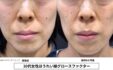
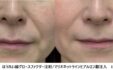
Case 1 | Woman in Her 20s — Before Treatment and 4 Months After
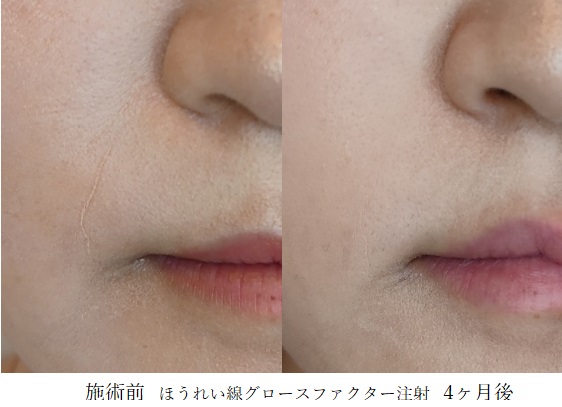
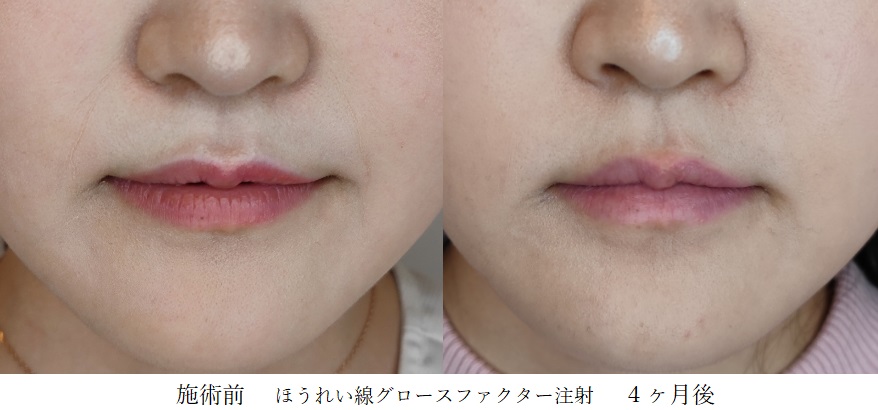
This patient is a woman in her 20s. She felt that her nasolabial folds were more noticeable than those of friends her age and was particularly concerned that foundation would collect in the folds after smiling. She was also self-conscious because people around her had commented that nasolabial folds were something she was known for. She underwent Growth Factor injections for the nasolabial folds. These images compare her appearance before treatment and 4 months afterward. The lines that remained visible while her face was relaxed are less noticeable than before treatment.
Results and recovery vary from person to person.
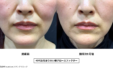
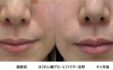
View the treatment details and progress for this caseCase 2 | Woman in Her 50s — Before Treatment and 3 Months After
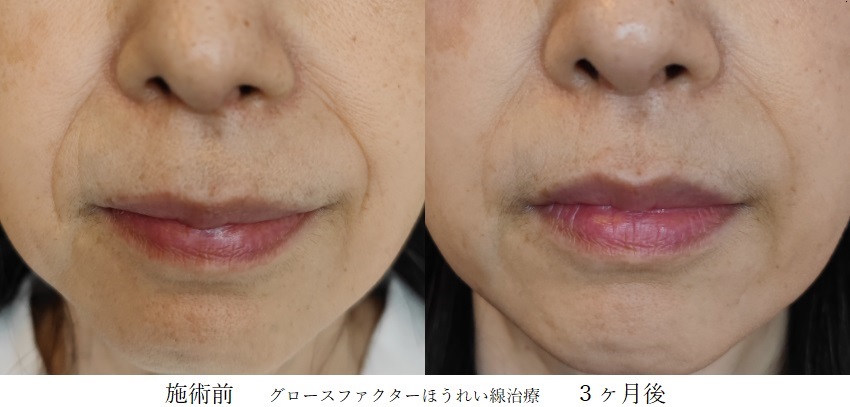
This patient is a woman in her 50s. Her nasolabial folds had become deeper with age, and she was concerned that they were noticeable not only when she smiled but also when her face was relaxed. This case involved deeply etched wrinkles. Three months after Growth Factor treatment for the nasolabial folds, the wrinkles appear less pronounced than before treatment.
Results and recovery vary from person to person.
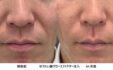
View the treatment details and progress for this caseCase 3 | Woman in Her 50s — Before Treatment and 3 Months After
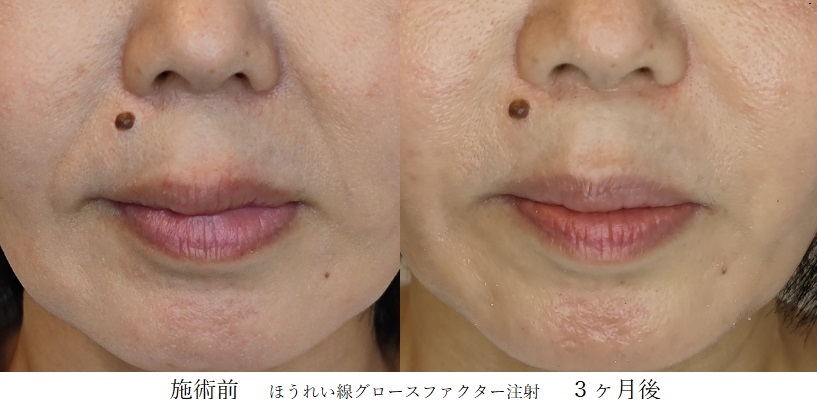
This case includes fuller cheeks and facial asymmetry. The patient worked night shifts and was concerned that her nasolabial folds looked particularly pronounced after a night shift. There were both line-like wrinkles where foundation collected and shadowing caused by the volume of the cheeks. After Growth Factor treatment, both the nasolabial folds and the asymmetry were less noticeable at 3 months.
Results and recovery vary from person to person. The linked case page shows follow-up through 6 months after treatment.
View the treatment details and progress for this caseHyaluronic Acid | Directly Lifting Depressions for Faster Contour Correction
Hyaluronic acid filler is an injectable treatment that restores lost volume and directly lifts depressions beside the nose or in the upper part of the nasolabial fold. Because the effect is visible immediately after treatment, it may be suitable for patients who want to improve the contour more quickly.
However, the location, depth, and amount of filler are important. Injecting too much in an area that does not correspond to the actual depression can make the lower face look heavy or even make the nasolabial fold appear more prominent. At our clinic, we assess the relationship between the depression and the cheek from both the front and oblique angles.
If there is a strong etched wrinkle in the skin, the surface line may remain even after the underlying depression has been lifted. In such cases, we consider the separate roles of hyaluronic acid filler and Growth Factor treatment.
Learn more about hyaluronic acid injections for nasolabial folds
Symptoms that require immediate medical attention after hyaluronic acid injections
If you experience severe pain that is different from ordinary post-injection discomfort, pain that worsens over time, white or purple discoloration of the skin at or around the injection site, any change in vision, drooping of the eyelid, difficulty moving an arm or leg, or difficulty speaking, do not wait to see if it improves. Contact the medical facility where you received treatment immediately. Even if there is no pain, you should still contact the clinic if any of the other symptoms occur.
For more detailed information, see side effects and risks of hyaluronic acid injections.
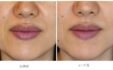
Case | Woman in Her 30s — Before Treatment and 1 Month After Injection
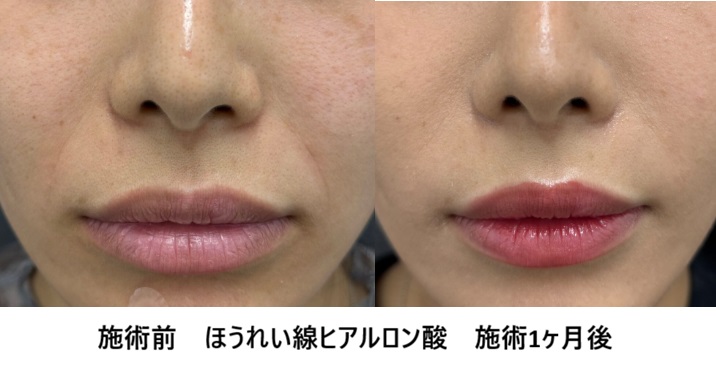
This patient is a woman in her 30s who was concerned that foundation would collect in her nasolabial folds as the day went on or after smiling. Hyaluronic acid filler was injected into the depression extending from beside the nose to the upper part of the nasolabial fold. These images compare her appearance before treatment and 1 month after injection. The wrinkle and depression from beside the nose to the upper nasolabial fold are less noticeable than before treatment.
Results and recovery vary from person to person.
View the treatment details and progress for this caseFor the latest treatment fees, please check our price list. All listed prices include tax and include consultation fees, injection needle fees, anesthesia fees, and related standard charges. The total cost varies depending on the product used, the amount required, and the treatment area. Please note that a consultation fee of ¥5,500 may apply in cases of repeated consultation-only visits, unusually prolonged consultations, or depending on the nature of the consultation.
Frequently Asked Questions About Nasolabial Folds and Foundation
Q. Is foundation settling into my nasolabial folds simply a sign of aging?
Age-related loss of skin firmness can be one factor, but it is not the only cause. The amount of foundation used, dryness, facial movement, natural bone structure, a depression beside the nose, and the way cheek tissue overlaps the fold can all contribute. It can also be noticeable in younger people.
Q. Will changing my foundation improve the problem?
If the main issue is applying too much product or skin dryness, reviewing the amount you use, how you apply it, and whether the product suits your skin may make the creasing less noticeable. If a wrinkle or depression remains while your face is relaxed even after moisturizing, foundation alone may not be enough to resolve it.
Q. If the wrinkle remains after I remove my makeup, do I definitely need treatment?
No. Whether to have treatment depends on how much the area bothers you. Continue basic care such as moisturizing and sun protection, and consider treatment only if the fold is difficult to manage with makeup and you would like further improvement.
Q. Which is more suitable for me: Growth Factor treatment or hyaluronic acid filler?
Growth Factor treatment may be considered when the main issue is an etched wrinkle in the skin. Hyaluronic acid filler may be considered when the main issue is a depression or contour step beside the nose or in the upper part of the nasolabial fold. If both factors are present, the treatments may be combined only where needed.
Q. Can I book a consultation even if I have not decided on a treatment?
Yes. You do not need to choose a treatment before making an appointment. During the consultation, we assess your face at rest and when smiling, including skin wrinkles, depressions beside the nose, and contour differences between the cheeks and nasolabial folds. We then explain suitable options along with their advantages and disadvantages. You are welcome to take the recommendations home and decide later.
References
- Fisher GJ, Kang S, Varani J, et al. Mechanisms of photoaging and chronological skin aging. Arch Dermatol. 2002;138(11):1462-1470.
- Varani J, Dame MK, Rittie L, et al. Decreased collagen production in chronologically aged skin: roles of age-dependent alteration in fibroblast function and defective mechanical stimulation. Am J Pathol. 2006;168(6):1861-1868.
- Pharmaceuticals and Medical Devices Agency (PMDA). Juvéderm Vista Volift XC electronic package insert.
Summary | First Determine Whether the Main Issue Is Makeup or an Underlying Wrinkle or Depression
When foundation settles into nasolabial folds, the first step is not to apply a thicker layer. Instead, use a small amount of foundation after moisturizing and check whether a wrinkle or depression remains after you remove your makeup.
If the folds are barely noticeable on bare skin, prioritize adjustments to your makeup routine and care for dryness. If a skin crease remains while your face is relaxed, Growth Factor treatment may be considered. If the main issue is a depression or contour step beside the nose or in the upper part of the fold, hyaluronic acid filler may be considered. In many cases, however, more than one factor contributes to the appearance.
At our clinic, we do not start by deciding on a treatment name. We first examine where foundation collects and how the area changes between a relaxed expression and a smile, then recommend only the treatment that is actually needed.
You Do Not Have to Decide on Your Own Whether to Keep Concealing the Folds with Makeup or Consider Treatment
During your consultation, we assess skin wrinkles, depressions beside the nose, contour differences between the cheeks and folds, and changes with facial expression. We explain not only the improvement that may be expected, but also the limitations of treatment, downtime, risks, and cost.
You do not need to choose a treatment before making an appointment. We will not pressure you into treatment that is unnecessary. If you simply want to understand what is causing the appearance, you are welcome to consult with us.



 03-6434-7678
 オンライン相談
  来院予約
来院予約