
 電話で予約
 WEB予約
 LINEで予約


For those concerned about smile lines and a sagging jawline
HIFU is best suited to improving mild sagging, tightening the jawline, and addressing early facial laxity.
Patients often ask us, “If I have HIFU, will it reduce my smile lines as well as tighten my jawline?”
HIFU is a treatment designed to tighten mild sagging in the cheeks, under the chin, and along the jawline. When sagging cheek tissue overlaps the nasolabial folds, tightening the facial contours may make the shadows along those folds less noticeable.
However, if you have wrinkles that remain at rest, hollowing beside the nose, or makeup collecting in the smile-line creases, HIFU alone is unlikely to produce a clearly visible improvement.
Do any of these concerns sound familiar?
Even when two people have the same concern—prominent smile lines—the right treatment may differ. For one person, cheek sagging may be the main cause; for another, it may be a crease in the skin or a hollow beside the nose. This guide explains what HIFU can realistically improve, and what it generally cannot address on its own.
Where Does HIFU Work in the Face?
HIFU stands for High-Intensity Focused Ultrasound. This treatment focuses ultrasound energy at selected depths to create small, localized areas of thermal effect within tissue.
Depending on the mode and focal depth, it can target different layers, including subcutaneous tissue and areas near the SMAS (superficial musculoaponeurotic system). Its main appeal is the potential to tighten the cheeks, under-chin area, and jawline without cutting the skin.
However, HIFU does not directly fill a hollow beside the nose or erase a crease already etched into the skin. For smile lines, the key question is how much cheek sagging or tissue heaviness contributes to their appearance.

Primary purpose
Tightening the cheeks and jawline
It may reduce mild heaviness in the cheeks and under the chin, helping the facial contours appear more defined.
Effect on the skin
Improving the appearance of firmness and elasticity
The tissue response to controlled heating may gradually improve the appearance of skin firmness and elasticity.
Limitations for smile lines
Existing creases and hollows beside the nose may remain
Even if the jawline looks firmer, HIFU is unlikely to directly correct static wrinkles or hollows beside the nose.
If your main goal is to improve skin firmness, texture, or the appearance of pores, a different device-based treatment, such as RF, may be more suitable. See our guide to DENSITY (radiofrequency treatment) for more information.
Who Is a Good Candidate for HIFU—and Who May See Limited Results?
Having smile lines does not automatically mean that HIFU is right for you. A shadow caused by sagging cheeks is different from a crease in the skin or a hollow near the nose; each may require a different treatment approach.
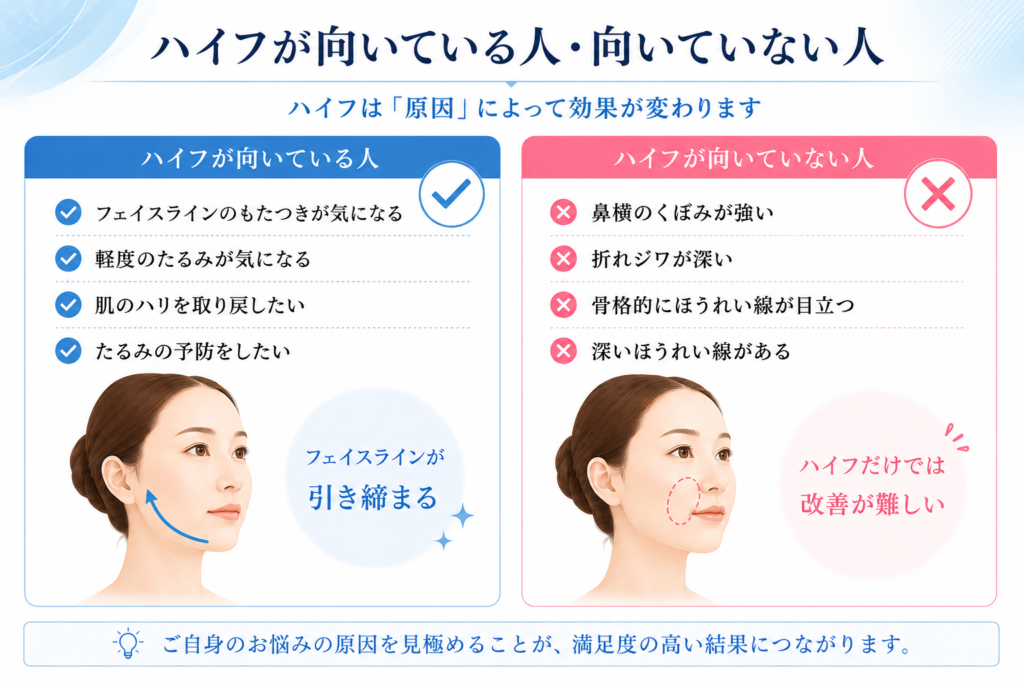
HIFU may be worth considering if:
HIFU alone may offer limited improvement if:
For a closer look at what makes smile lines prominent, read about the causes of nasolabial folds. To understand what lifting treatments may not address, see why lifting treatments alone may not resolve smile lines.
How We Assess Patients and Plan HIFU Treatment
We use ULTRAcel Zi (ULTRAcel[Zi:]) at all our clinic locations. It is the successor to the previous-generation ULTRAcel Q+ system.
ULTRAcel Zi improves on the previous Q+ model in treatment stability and ease of operation. Its system rapidly stabilizes the temperature inside the cartridge. LEDs on the handpiece allow the operator to check the treatment mode, depth, shot duration, transducer position, and cartridge temperature in real time. These features help the practitioner monitor the device and deliver treatment consistently across different facial areas.
Treatment speed has also improved. We selected this device partly because it makes treatments easier to complete in less time than with the earlier model, while allowing us to take patient comfort into account. Pain sensitivity varies, so we monitor your response and adjust the energy level or technique as needed.
The device name alone does not determine the outcome. With HIFU, treating a wider area at a higher setting is not necessarily better. What matters is where to tighten and which areas to avoid.
Our approach: preserve desirable cheek volume while targeting areas that need tightening
We assess cheek thickness, the position of sagging tissue, hollowing, facial asymmetry, and jawline heaviness from frontal and oblique views before selecting the treatment area, depth, and energy settings.
The central cheek has natural fullness that often contributes to a youthful appearance. For patients with limited cheek fat, we avoid excessive treatment in this area and instead focus on areas such as the jawline and under the chin where heaviness is more noticeable.
For patients with more fat in the cheeks or under the chin, who may feel the lower face looks heavy, linear HIFU can be considered. Dot mode may be selected when the aim is to tighten subcutaneous tissue or regions near the SMAS. We adjust mode, depth, treatment area, and energy according to each patient’s anatomy and goals.
If your primary concern is a static crease or hollow beside the nose, repeated HIFU may produce little change in the nasolabial folds. In that case, we explain its limitations and discuss treatments that target the folds more directly.
Our HIFU Treatment Case
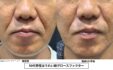
This patient, a woman in her 50s with sagging cheeks and heaviness around the mouth, received one ULTRAcel Zi session targeting the cheeks and under-chin area. The comparison photo was taken four months after treatment.
HIFU was chosen in this case to tighten the cheeks and under-chin area, not to fill an etched nasolabial crease. This is one individual outcome and does not guarantee the same result for other patients.
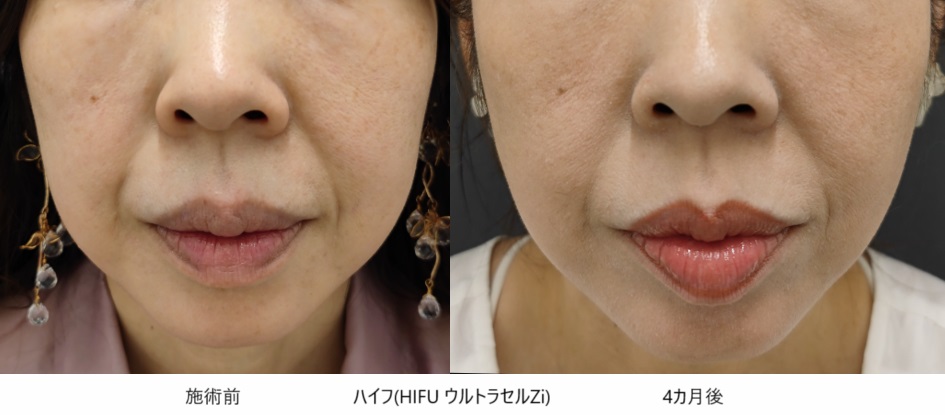
One HIFU (ULTRAcel Zi) session: before treatment and four months afterward.
When Do HIFU Results Appear, and When Should You Consider Another Session?
Some patients notice a feeling of tightness immediately after HIFU. As the treated tissue responds over the following weeks and months, the facial contours may gradually appear more defined.
The timing and duration of results depend on the device, treatment depth and energy, degree of sagging, and amount of facial fat. Rather than assuming you will need repeated sessions from the outset, we assess the outcome after the first treatment before recommending another.

We assess how your face has changed before planning another session
When HIFU is repeated, we do not necessarily treat the same areas at the same energy level each time. Your face may have changed: cheek fat may have decreased, the jawline may be more defined, or the cheeks may have become more prone to hollowing.
There is no single ideal retreatment interval for everyone. Rather than rushing into another session while the previous result remains, it is important to reassess your current skin laxity and facial fat distribution.
Immediately afterward
Some patients notice mild tightening just after treatment.
Over the following weeks to months
The contours may look gradually more refined as the tissue responds.
Longer-term follow-up
Results vary from person to person. We decide whether another treatment is appropriate after reassessment.
Pain During and After HIFU Treatment
HIFU does not involve incisions, but because it delivers thermal energy to deeper tissue, it is not necessarily painless.

What HIFU may feel like during treatment
You may feel prickling heat, a sensation extending deeper into the tissue, or a brief dull ache near bone. Areas around the cheekbones, chin, and forehead may be particularly sensitive.
Pain tolerance varies. We do not expect patients to endure unnecessary discomfort; instead, we monitor their reactions and adjust energy or technique as needed.
Afterward, the treated area may be tender when pressed or feel sore, much like a muscle ache. These symptoms usually settle over time. If severe pain or numbness persists, contact the treating medical facility promptly.
Side Effects, Downtime, and How We Reduce the Risk of Hollow Cheeks
HIFU generally involves relatively little downtime, but it still applies heat to tissue and can cause side effects. The fact that it is non-surgical does not mean it is risk-free. It is important to understand the possible reactions before treatment.

Relatively common reactions
Redness, swelling, puffiness, dryness, warmth, tenderness, and soreness resembling muscle aches may occur.
Less common but potentially serious complications
Possible complications include burns and blisters, bruising or bleeding beneath the skin, pigmentation changes, welts, areas of firmness or scarring, numbness or other sensory changes, nerve injury, and unintended fat reduction. Eye-related complications, including floaters and cataracts, have also been reported after treatment around the eyes.
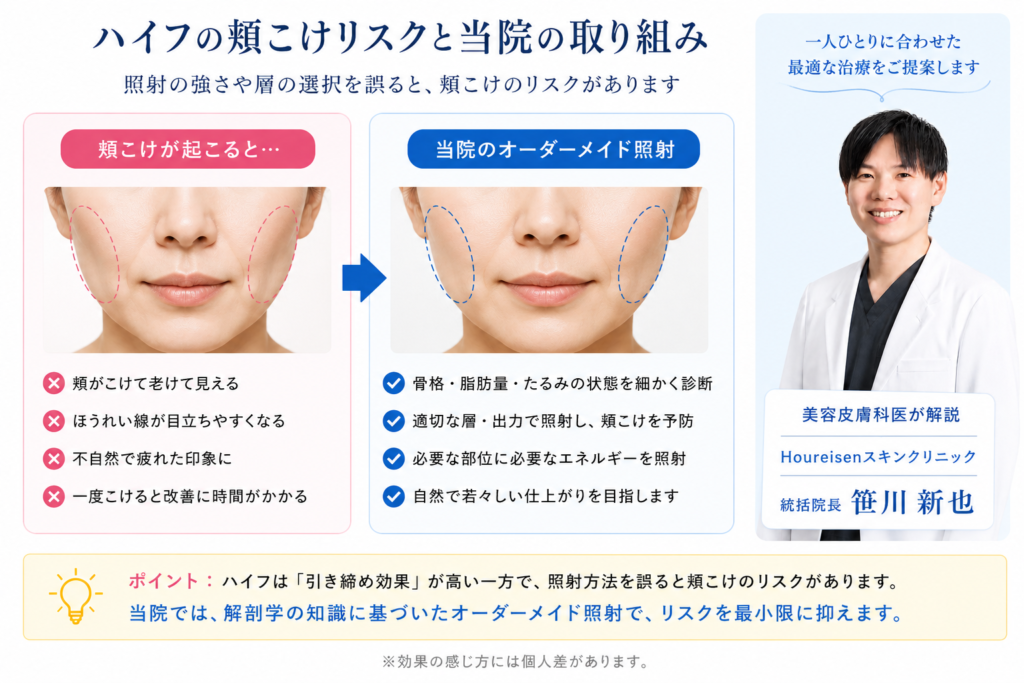
Assessing natural fat volume and treatment areas to reduce the risk of cheek hollowing
Overtreating the cheeks of a person with little facial fat or a naturally slim face may cause unintended fat loss and leave the cheeks looking hollow or older.
We therefore avoid treating every part of the cheek in the same way. Depending on facial anatomy, we may avoid hollow-prone areas and instead focus on the jawline and under the chin.

Have HIFU at a medical clinic after an appropriate assessment
Japan’s Ministry of Health, Labour and Welfare has stated that HIFU procedures capable of causing thermal coagulation in human tissue are medical acts that should be performed by a physician. Treatment at a medical institution should involve a doctor’s assessment and specific instructions, with careful attention to facial anatomy and the pathways of nerves.
If you develop persistent severe pain, blisters, numbness, or altered sensation, contact the medical institution where you were treated rather than waiting for symptoms to pass.

Who may be unable to receive HIFU or need additional assessment
- You are pregnant or may be pregnant.
- You use a pacemaker or certain other implanted medical devices.
- There is metal, gold thread, an implant, or a similar material in or near the proposed treatment area.
- You have significant dermatitis, an infection, herpes, or another active skin condition in the treatment area.
- You have a medical condition that affects wound healing or sensation.
If you have previously had hyaluronic acid fillers, thread lifts, or fat transfer, please tell us when and where those procedures were performed. We will assess whether HIFU is appropriate and whether the treatment area needs to be modified.

Possible reactions after treatment
Redness, puffiness, dryness, tenderness to pressure, and soreness similar to muscle aches may occur. These reactions often settle over time, although their intensity and duration vary from person to person.
Many patients can apply makeup after treatment. However, if you have an important event coming up, it is sensible to schedule treatment with sufficient time to spare.

How to care for your skin after HIFU
Avoid irritation
On the day of treatment, avoid vigorous massage or rubbing the treated area.
Avoid excessive heat
Avoid prolonged hot baths, saunas, strenuous exercise, and heavy alcohol consumption.
Protect your skin
Moisturize and use sun protection. Contact us if you experience marked dryness or redness.
When Treatments Other Than HIFU May Be More Appropriate
When treating nasolabial folds, the question is not which procedure is universally “best.” It is whether a treatment addresses the specific cause that makes your folds visible.
Tightening the jawline with HIFU may still leave a skin crease or hollow beside the nose. Conversely, injections may improve the folds but not fully address sagging cheeks or a heavy jawline. You do not need every treatment at once; a gradual approach focused on your main concern may be more appropriate.
| Treatment | Main purpose | Typical changes | Limitations and precautions |
|---|---|---|---|
| TreatmentHIFU | Main purposeTightens mild sagging or heaviness in the cheeks, under the chin, and along the jawline | Typical changesMay refine facial contours without surgery and usually involves relatively little downtime | Limitations and precautionsLimited effect on deep folds, hollows beside the nose, or fixed creases when used alone. Risks include redness, swelling, pain, burns, and sensory changes. |
| TreatmentGrowth factor injections | Main purposeAim to stimulate collagen production in the skin to address smile lines and loss of firmness | Typical changesGradual, natural-looking changes; our clinic has documented cases with results lasting several years | Limitations and precautionsNot an immediate treatment; outcomes vary. Risks include swelling, bruising, pain, asymmetry, lumps, and excessive tissue growth. |
| TreatmentHyaluronic acid fillers | Main purposeRestore volume and smooth hollows or steps beside the nose through injection | Typical changesChanges may be noticeable soon after injection | Limitations and precautionsRisks include swelling, bruising, pain, lumps, infection, and vascular compromise. |
| TreatmentThread lift | Main purposePhysically lift descended cheek tissue | Typical changesMay lift the cheeks and improve jawline definition | Limitations and precautionsSmile lines themselves may not improve sufficiently with threads alone. Risks include swelling, bruising, pain, pulling sensations, indentations, and infection. |
| TreatmentRadiofrequency (RF) treatment | Main purposeTighten the skin and improve its firmness and texture | Typical changesUses a different heating mechanism and targets different tissue depths from HIFU | Limitations and precautionsDeep creases or hollows may require another treatment. Risks include redness, swelling, burns, pigmentation changes, and altered sensation. |
When combining treatments, we begin by addressing the main cause.
If both sagging and smile lines bother you, we may consider tightening facial contours with HIFU while treating the folds themselves with growth factor injections or hyaluronic acid fillers. Depending on the situation, improving the skin’s underlying support first and adding treatment only where needed later can help achieve a natural-looking outcome.
To learn more about injectable options, see our comparison of growth factors, hyaluronic acid, and Botox. If you are deciding between these two treatments, read the differences between hyaluronic acid and growth factor injections.
HIFU Treatment Prices
ULTRAcel Zi HIFU prices at our clinic depend on the treatment area and number of shots. The following prices include tax and are the same at all clinic locations.
Prices may change. Please check our current price list before your appointment.
Frequently Asked Questions About HIFU
Can one HIFU session produce results?
Some patients notice tightening of the cheeks or jawline after a single session. The degree of improvement depends on sagging, facial fat, and the treatment area. We assess the result of the first session before deciding whether another is appropriate.
Can HIFU completely remove nasolabial folds?
No. HIFU does not erase every type of smile line. It may make folds less noticeable when cheek sagging contributes to their appearance. However, static wrinkles, hollows beside the nose, or strong skeletal factors may respond better to another type of treatment.
Can HIFU make my cheeks look hollow?
Yes, it is possible. Excessive treatment of naturally slim cheeks or cheeks with little fat can cause unintended fat reduction and make them look more hollow. It is important to assess facial fat and avoid areas prone to hollowing.
Is HIFU painful?
You may feel prickling heat or a deeper sensation near tissue or bone. Sensitivity varies, so we monitor your response and adjust treatment settings and technique accordingly.
Which is better: HIFU or DENSITY?
HIFU uses focused ultrasound, while DENSITY uses radiofrequency (RF). They deliver heat in different ways and target different tissue depths. We recommend a treatment after assessing facial contour concerns, skin thickness, fat volume, and desired changes.
Can HIFU be combined with growth factor injections?
In some cases, yes. HIFU is used to tighten the cheeks and jawline, whereas growth factor injections aim to stimulate collagen production in the skin to improve nasolabial folds. Whether both are needed, and in what order, depends on the relative contribution of sagging and wrinkles.
Summary: What HIFU Can and Cannot Do
HIFU is used to tighten mild sagging in the cheeks, under the chin, and along the jawline. Better facial contours may make shadows along the smile lines less noticeable, but HIFU alone is unlikely to substantially change wrinkles that remain at rest or hollows beside the nose. Patients with little cheek fat also require careful selection of treatment areas.
What HIFU does best
Tightening mild laxity and heaviness in the cheeks, under the chin, and along the jawline
What HIFU does not directly correct
Static nasolabial creases, hollows beside the nose, and etched skin folds
What matters when choosing treatment
Identify whether the folds or the facial contours bother you most, then select a treatment that matches the cause






 03-6434-7678
 オンライン相談
 来院予約