
 電話で予約
 WEB予約
 LINEで予約




Understanding why nasolabial folds become more noticeable
“Why are my smile lines more noticeable than those of other people my age?”
The appearance of nasolabial folds is not determined by age alone. A combination of factors—including the skin, facial muscles, cheek fat, and bone structure—can make wrinkles, shadows, and hollows beside the nose more apparent. Understanding the different causes can help you distinguish between what to address with daily care and what may benefit from medical treatment.
Do any of these concerns sound familiar?
Find information based on what you notice
For treatment options when your smile lines are most prominent during smiling, see our article on Botox for nasolabial folds.
Some people only began to notice their smile lines when they stopped wearing a mask in public or saw themselves in photographs and mirrors.
Although nasolabial folds often become more noticeable with age, they can also stand out in people in their 20s or 30s because of their facial structure, expressions, or fat distribution. Because there may be more than one cause, the right approach is not always a single treatment.
Below, we break down eight possible causes, explain how to identify contributing factors, and outline treatment options. For a broader overview, see our complete guide to the causes and treatments of nasolabial folds.
Three steps you can start taking today
Protect your skin from UV exposure every day
Use sunscreen, hats, and other sun protection routinely—not just on sunny days—to help reduce UV-related skin damage.
Moisturize skin that is prone to dryness
In addition to toner or lotion, use a suitable moisturizer or cream to help prevent moisture loss, depending on your skin’s needs.
Review rapid weight loss and excessive facial exercises
Avoid drastic changes in weight and self-directed facial exercises that put excessive strain on your mouth area. Stop if you notice discomfort or worsening lines.
The main role of self-care is to help prevent worsening related to factors such as dryness and UV exposure. Established wrinkles visible at rest, hollows beside the nose, and shadows caused by cheek volume may not respond sufficiently to self-care alone.
Nasolabial folds become visible through a combination of causes
The appearance of nasolabial folds reflects the interaction of skin, muscles, fat, bone structure, and supporting ligaments. Identifying the contributing factors can help narrow down which daily care measures and medical treatments to consider.
Visible skin creases
Reduced skin firmness, dryness, hollows around the nose and folds, and repeated mouth movements during smiling or speaking can all contribute.
Shadows and changes in contour
Cheek fat volume, sagging, and hollows beside the nose may create deeper-looking shadows.
More noticeable when smiling
This pattern is often related to the movement and activity of facial expression muscles.
Asymmetry between sides
Facial structure, chewing habits, and differences in facial expressions may contribute.
For a more detailed classification, see types of nasolabial folds. For an overall review of causes, see what causes nasolabial folds.
Eight reasons nasolabial folds become more noticeable
Cause 1Skin aging and loss of firmness
When the skin loses firmness due to factors such as UV exposure and dryness, expression lines may begin to remain visible even when the face is relaxed.
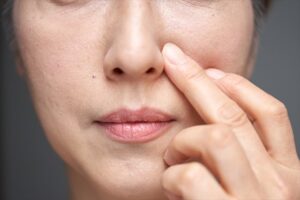
Beneath the skin’s surface lies the dermis, a layer containing collagen, elastin, and hyaluronic acid that provides structural support to the skin.
Patients sometimes ask about the difference between collagen and hyaluronic acid. In simple terms, collagen acts like a network of fibers, while hyaluronic acid is a gel-like substance that holds water.
Accumulated damage from UV exposure, dryness, smoking, stress, and glycation can reduce skin firmness and elasticity, making wrinkles more visible. As the skin becomes less able to support the cheeks, shadows related to sagging may also become more pronounced.
Everyday measures include moisturizing, sun protection, balanced nutrition, adequate sleep, and not smoking. People with dry or dehydrated skin should pay particular attention to moisturizing.
For a more complete overview of home care, see our guide to preventing and caring for nasolabial folds.
Cause 2Repeated movement of facial muscles around the mouth
Repeated movements while eating, speaking, and smiling, combined with a loss of skin firmness, can make lines persist over time.

The muscles around your mouth repeatedly contract and relax as you eat and speak. Expression lines tend to form over areas that move frequently. As the skin loses elasticity, those lines may remain even after your face returns to a relaxed expression.
Think of folding a piece of paper along the same line over and over: the crease eventually remains even when you flatten the paper. Similarly, repeated movements of the mouth together with changes in the skin can make creases more persistent.
One thing you can observe is whether a crease remains after you smile gently in front of a mirror and then relax your face. However, this observation alone cannot determine the cause or whether treatment is necessary.
Be cautious if facial exercise routines put considerable strain on the nasolabial fold area. If you notice discomfort or worsening lines, stop and reassess.
Cause 3Muscle and fat volume in the cheeks
When cheek tissue overlaps the outer side of a nasolabial fold, it can create a change in contour that makes the shadow appear deeper than the actual line.

The amount of muscle and fat in the cheeks influences how nasolabial folds look. Fuller cheeks may create a more pronounced step between the area outside and inside the fold, emphasizing its shadow.
Muscles
People with more developed facial muscles, or a habit of moving the mouth forcefully, may place more strain on the nasolabial fold area while smiling. However, skin quality and bone structure must also be considered.
Fat
Fuller cheeks can create a change in contour that casts a deeper shadow along the nasolabial fold. Conversely, people with little cheek fat may also have visible sagging or shadows if reduced skin firmness or structural hollows are present.
Fat compartments related to this area include malar fat, buccal fat, and jowl fat.
Cause 4Facial bone structure and age-related skeletal changes
The shape of the bone supporting the area beside the nose, and age-related facial bone remodeling, can contribute to hollows and changes in contour in the upper part of the fold.
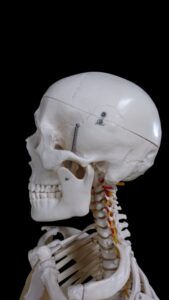
Natural facial bone structure
Your underlying bone structure affects the appearance of nasolabial folds. For example, prominent cheekbones can create changes in contour between the inner and outer cheek, producing a more noticeable shadow.
A hollow at the base of the nostril can make the upper part of the nasolabial fold appear deeper. Jaw size, tooth alignment, and other structural features around the mouth may also play a role.
Age-related remodeling of facial bones
With age, facial bones can change in shape and the support they provide. Changes in the maxilla, which supports the area beside the nose and upper nasolabial fold, may contribute to more prominent hollows in this region.
Bone structure is not the only factor. Supporting ligaments, fat, muscles, and skin also influence facial appearance, so we do not select a treatment on bone structure alone.
Cause 5Gravity and skin sagging
As the tissues supporting the cheeks become weaker, downward movement under gravity can make shadows and changes in contour more visible.

Gravity is unavoidable. As the skin loses collagen and elastin and cheek support weakens, cheek tissue may descend and overlap the outer edge of the nasolabial fold.
You may notice that your smile lines look less prominent when looking into a mirror or phone camera while lying down. This can happen because the direction of gravity changes, altering the contours and shadows created by the cheeks.
However, less visible folds when lying down do not necessarily mean sagging is the only cause. Persistent skin creases and hollows beside the nose should also be assessed.
Cause 6Rapid weight loss
When cheek fat decreases over a short period, hollows or sagging can become more noticeable depending on the person’s skin firmness and bone structure.

Rapid weight loss can make nasolabial folds more apparent. If cheek fat is lost quickly, sagging and lines may become more visible while the skin adjusts to the change.
This may be especially noticeable in people who already have reduced skin firmness. On the other hand, in someone with fuller cheeks, fat loss can sometimes reduce the shadows. The effect varies from person to person.
Cause 7Changes in the cheeks after fat-dissolving injections or liposuction
After reducing cheek fat, wrinkles or sagging may become more noticeable if the amount removed is not well matched to the skin’s remaining firmness.
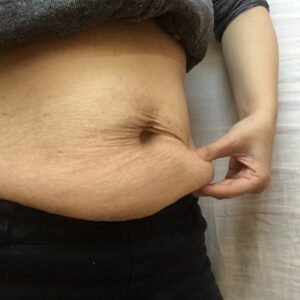
Some patients tell us that smile lines or wrinkles became more visible after fat-dissolving injections or liposuction. Reducing the fat may reveal preexisting loss of skin firmness or sagging. Particular caution may be appropriate from the 40s onward, when sagging becomes more common.
The result depends not only on age, but also on where and how much fat was removed, the original fat volume, skin condition, and bone structure. Anyone considering cheek fat reduction should discuss the possibility of future hollows or sagging, not only the immediate slimming effect.
Cause 8Changes around the mouth after dental or oral surgery
If smile lines look different after orthodontics, tooth extraction, or jaw surgery, it is important to consider facial shape, weight, facial movement, and aging rather than assuming the dental procedure is the only cause.
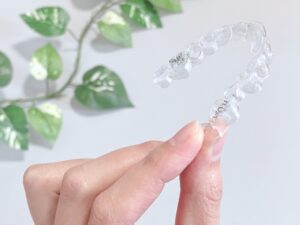
Some patients begin to notice their nasolabial folds after dental treatment, particularly orthodontics, extractions, or jaw surgery.
Jaw surgery, which changes the skeletal structure itself, can noticeably alter the shape of the mouth area. By contrast, orthodontic treatment or extractions alone do not necessarily cause dramatic changes in facial bone structure. Weight changes during treatment, how the mouth is used, chewing habits, expressions, and aging can all be involved.
Lighting can also make nasolabial folds appear deeper
Have you ever caught your reflection in a train window or a dimly lit bathroom mirror and thought, “My smile lines suddenly look so much deeper”?
Even on the same face, changing the direction or intensity of light can cast shadows along the contour between the cheeks and nasolabial folds. This does not necessarily mean the wrinkles have physically deepened in a short time.
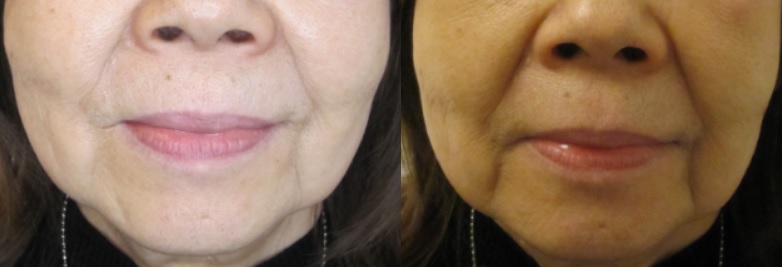
Distinguishing shadows from actual creases in the skin can help you decide what measures are most appropriate.
How contributing factors change with age
Even in your 20s and 30s, smile lines may be visible due to bone structure, habitual facial movements, or fat distribution. From the 40s onward, reduced skin firmness and sagging are more likely to play a role.
Treatment should be based on the person’s current appearance and underlying causes, not age alone.
Choose nasolabial fold treatments based on the cause and your goals
At-home beauty devices are one form of self-care, but they may produce little visible improvement when several causes contribute to the appearance of nasolabial folds.
HIFU delivers focused ultrasound energy to heat tissue and is intended to tighten areas of sagging. However, it does not directly fill wrinkles that remain at rest or hollows beside the nose. Thread lifts and surgical facelifts can lift sagging tissue, but etched skin creases or skeletal hollows may remain.
Injectable treatments may be an option for addressing wrinkles and volume loss around nasolabial folds more directly. At our clinic, we primarily consider growth factor injections and hyaluronic acid fillers, depending on the causes and the patient’s goals.
For a broader comparison of available procedures, see how to choose a treatment for nasolabial folds.
Hyaluronic Acid Fillers
Growth Factor Injections
There is no fixed order in which treatments must be performed. When skin creases and hollows coexist, treatments may be combined or carried out in stages. The order, or whether to begin with only one treatment, depends on the type of fold, desired results, timing, downtime, cost, and risks.
For more detail, see growth factors versus hyaluronic acid and comparing injectable treatments for smile lines.
For downtime information including HIFU and thread lifts, see our comparison of recovery times for nasolabial fold treatments. For an overview of self-care and medical treatment, see prevention, self-care, and treatment for nasolabial folds. For additional guidance on selecting an option, see effective approaches to nasolabial folds.
Downtime, lumps, and important risks to understand before treatment
Injectable procedures do not involve surgical incisions, but they are not risk-free. Questions about swelling, bruising, pain, and how long recovery may take should be discussed before treatment.
At our clinic, we use anesthesia for both types of injection and take steps to minimize discomfort during treatment.
Main risks of hyaluronic acid fillers
Possible side effects include swelling, bruising, pain, asymmetry, lumps, uneven contours, infection, and allergic reactions. Very rarely, vascular complications can lead to skin necrosis, visual impairment or blindness, or stroke. Our clinic reports no history of these rare severe complications.
Main risks of growth factor injections
Possible side effects include swelling, bruising, pain or discomfort, and asymmetry. Rare complications include infection, allergic reactions, uneven tissue changes, lumps, and excessive tissue growth. Our clinic reports no history of these rare complications.
Treatment costs and typical timelines at our clinic
Growth Factor Injections for Nasolabial Folds
Hyaluronic Acid Fillers for Nasolabial Folds
*Fees and treatment details may change. Before treatment, confirm eligibility, product selection, required sessions and quantities, total cost, downtime, and risks.
Summary: understand the eight possible causes of nasolabial folds

Nasolabial folds can become more noticeable through a combination of factors including skin changes, facial muscle activity, muscle and fat volume, bone structure, gravity, dieting, fat-reduction procedures, and changes after dental or oral surgery.
Daily measures include moisturizing, sun protection, and reviewing drastic weight loss or self-directed facial exercises. However, hollows related to bone structure, cheek fat volume, or established skin creases may not improve sufficiently with self-care alone.
At our clinic, we mainly consider treatments such as growth factor injections and hyaluronic acid fillers according to the causes and the patient’s desired results. You can learn more about fillers in our comprehensive guide to hyaluronic acid for nasolabial folds.
Find out what is causing your smile lines before deciding on treatment
You are welcome to book a consultation even if you do not yet know which treatment is right for you.
We explain not only which treatments may be appropriate, but also their expected benefits, limitations, downtime, risks, and costs. You can consider the options at home after your consultation. We will not pressure you into unnecessary procedures.
Online consultations are free. The initial in-person consultation fee is ¥0.
Frequently Asked Questions (FAQ)
Can I treat my nasolabial folds with self-care alone?
Moisturizing, UV protection, and healthy lifestyle habits can help prevent worsening caused by dryness and sun exposure. However, skin creases visible at rest, hollows beside the nose, and contours created by cheek tissue may not improve sufficiently with self-care alone.
Which is better for me: hyaluronic acid or growth factor injections?
Hyaluronic acid may be appropriate for people who want a faster change in hollows or contour differences beside the nose or around the folds. Growth factor injections may be considered for established skin creases or reduced firmness when a gradual improvement is preferred. If several causes coexist, we assess whether to begin with one treatment or combine them.
Can injections help smile lines that only appear when I smile?
Botox may be considered when lines are mainly emphasized by facial muscle movements during smiling or talking. It is generally not effective for folds that remain prominent at rest, and it may interfere with smiling or make mouth movements look unnatural. We therefore assess candidacy and injection technique carefully for each patient.
Can I book a consultation before deciding on treatment?
Yes. You do not need to select a procedure before making an appointment. We discuss your concerns and goals, explain potential causes and suitable treatment options, and review benefits, precautions, and costs. You may choose not to undergo treatment on the day and consider the recommendations at home.






 03-6434-7678
 オンライン相談
 来院予約